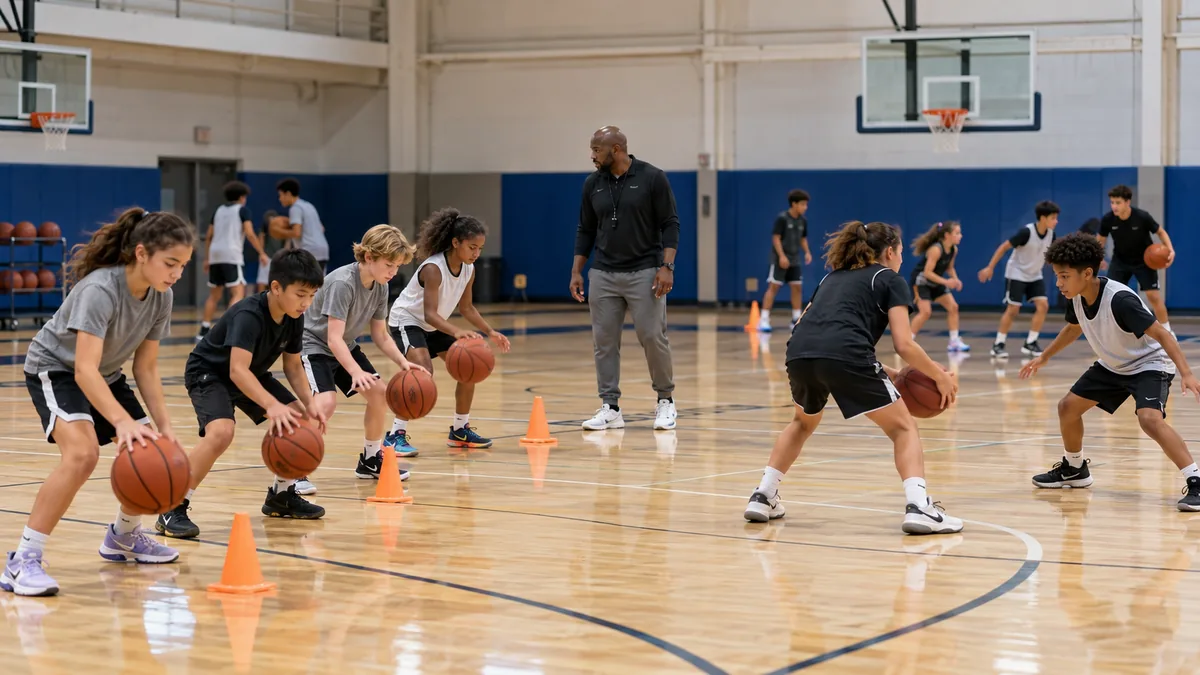
Coaching mixed skill levels in youth basketball is one of the most common challenges a youth coach can face.
One player may still look at the basketball every time they dribble.
Another may already be comfortable changing direction against pressure.
One player is learning how to make a chest pass.
Another is ready to read help defense.
If every player receives exactly the same drill, at exactly the same difficulty, someone will usually be in the wrong learning environment.
The beginner becomes overwhelmed.
The advanced player becomes bored.
The coach becomes frustrated trying to solve both problems at once.
The answer is not to run two completely separate practices.
A better approach is to keep the team working on the same basketball concept while adjusting the challenge for different players.
That allows everyone to practice together without pretending everyone is at the same stage.
Different Ability Levels Are Normal
Youth teams are rarely perfectly balanced.
Players may have different amounts of previous experience, different coordination levels, different confidence, and different physical development.
Two children of the same age can require very different challenges.
Jr. NBA’s development pathway reflects this idea. Its progression uses Rookie, Starter, All-Star, and MVP levels, and the pathway is based on skill proficiency rather than simply a player’s age. NBA.com: Jr. NBA
That is useful for coaches.
Instead of asking:
“What should every ten-year-old be able to do?”
Ask:
“What does this player understand now, and what is the next useful challenge?”
That question makes coaching much easier.
Keep the Concept the Same, Change the Difficulty
A team does not need three completely different practice plans.
Suppose today’s focus is passing.
A beginner can practice making an accurate pass while balanced.
A developing player can pass while moving.
A more advanced player can make the same type of pass against defensive pressure.
Everyone is still working on passing.
Only the challenge changes.
The same approach works with dribbling, shooting, defense, finishing, and decision-making.
Jr. NBA’s current curriculum specifically includes modifications that increase or decrease difficulty within activities, which is exactly the type of approach coaches can use with mixed groups. NBA.com: Jr. NBA
Use a Three-Level Coaching System
A simple system is to prepare three versions of the same activity.
Call them:
Foundation → Challenge → Game
At the Foundation level, players learn the basic movement or skill.
At the Challenge level, they add speed, movement, a weaker hand, or another decision.
At the Game level, they use the skill against a defender or under realistic pressure.
Imagine a ball-handling activity.
Foundation players dribble under control with one hand while maintaining balance.
Challenge players change direction while moving.
Game-level players attack a live defender in a small space.
Nobody needs to be told:
“You are the bad group.”
They are simply working at the version that currently helps them improve.
Do Not Label Players as Beginners and Advanced Players
This distinction is important.
Coaches may need to recognize different ability levels internally, but children should not feel permanently ranked.
Avoid saying:
“All the good players go here.”
Or:
“Beginners stay on this basket.”
Instead, describe the task.
You might say:
“This group is working on control first.”
And:
“This group is adding defensive pressure.”
Players can move between versions as they improve.
The practice structure should communicate:
Your current challenge can change.
That helps protect confidence while maintaining useful difficulty.
Start With a Team Activity Everyone Can Do
When coaching mixed skill levels in youth basketball, it helps to begin practice with something the whole team can participate in successfully.
Warm-up activities are ideal.
Use movement, simple dribbling, footwork, partner passing, or low-pressure finishing.
The objective is not to immediately expose who is strongest.
The objective is to get everyone active.
Your existing article on basketball warm-up drills for kids already provides a useful foundation for this kind of opening because it emphasizes movement and basketball involvement rather than long lines. How to Coach Youth Basketball
After the team is moving, difficulty can gradually separate.
Give Beginners More Space
Space changes difficulty dramatically.
A beginner trying to dribble through a defender in a tiny area may experience constant failure.
Give that player more room.
As control improves, reduce the space.
The same principle works with passing.
A beginner can have a larger passing window.
An advanced player can make decisions in tighter space against active defenders.
The basketball skill has not changed.
The environment has.
This is one of the easiest ways to scale practice without creating entirely different drills.
Adjust Time Pressure
Time is another useful coaching tool.
A beginner may receive the ball and have several seconds to find the next option.
An advanced player may need to make the same decision immediately.
For example, during a passing activity:
A Foundation player catches, gets balanced, looks, and passes.
A Challenge player receives while moving.
A Game-level player has one second to make a decision against pressure.
The coach can adjust difficulty simply by changing how quickly the player must process the situation.
Adjust Defensive Pressure
Defense does not need to be either completely absent or fully competitive.
There are several useful stages.
A player can begin without defense.
Then add a passive defender.
Next, allow the defender to challenge passing lanes without stealing.
Finally, play live.
This progression is especially useful when teaching finishing, passing, and ball handling.
If a player cannot perform a skill without pressure, adding aggressive defense usually does not improve learning.
Build control first.
Then gradually make the environment more realistic.
Use Small-Sided Games
Small-sided games are one of the best tools for coaching different ability levels.
One-on-one, two-on-two, and three-on-three create more involvement than traditional five-on-five.
Players receive more touches.
They make more decisions.
Coaches can also balance teams more easily.
Jr. NBA has expanded its use of 1-on-1, 2-on-2, 3-on-3, and advantage situations specifically to help players learn through play and improve decision-making. NBA.com: Jr. NBA
Your existing 3-on-3 basketball drills for youth teams article is therefore a natural internal link here.
Do Not Always Put Strong Players Together
There are moments when ability groups are useful.
But they should not become permanent.
Sometimes mix players.
A developing player may learn from being alongside someone who sees the floor well.
An experienced player can learn communication and leadership by helping the group function.
However, do not make advanced players responsible for teaching the entire practice.
They are there to develop too.
The coach still needs to challenge them.
Do Not Always Put Strong Players Against Beginners
This sounds obvious, but it happens frequently during live drills.
If a confident ball handler repeatedly attacks a brand-new defender, neither player receives the ideal challenge.
The offensive player may succeed without needing to make a better decision.
The beginner may experience repeated failure.
Matchups should occasionally stretch players without making the result predictable.
You want competitive difficulty.
Not helplessness.
Give Advanced Players Constraints
When a player has already mastered the basic version of a drill, do not always invent another complicated move.
Sometimes add a constraint.
For example, require the player to use the weaker hand.
Limit the number of dribbles.
Require a pass before scoring.
Make the player finish from a different angle.
Ask them to recognize a second defender.
Constraints can make a familiar activity challenging again.
They also encourage decision-making instead of simply increasing drill complexity.
Give Beginners Clear Success Targets
Beginners need to know what success looks like.
Do not tell a new player:
“Dribble better.”
Give them something achievable.
For example:
“Can you reach the cone without losing control?”
Then:
“Can you do it while looking up twice?”
Then:
“Can you use your other hand for the final five dribbles?”
Progress becomes visible.
That matters because beginners may compare themselves with teammates who have played for years.
The coach should redirect attention toward personal improvement.
Avoid Long Lines
Long lines make mixed-level practices even harder.
The beginner gets too few repetitions to improve.
The advanced player becomes bored while waiting.
Instead, divide the gym into small working areas.
If you have twelve players, several pairs or groups of three can be active simultaneously.
Your existing 60-minute youth basketball practice plan already follows the broader principle of keeping players active with clear structure and frequent repetitions. How to Coach Youth Basketball
More repetitions give every ability level more opportunities to improve.
Use Stations Without Making Them Skill Rankings
Stations work especially well with mixed groups.
Imagine four stations:
| Station | Main Focus | Easy Adjustment | Harder Adjustment |
|---|---|---|---|
| Ball Handling | Control | Larger space | Weak hand + defender |
| Passing | Accuracy | Stationary target | Moving target + pressure |
| Finishing | Footwork | No defender | Live defender |
| Defense | Positioning | Guided movement | Live 1-on-1 |
Players rotate through all stations.
The coach changes difficulty inside the station.
This keeps the team together while still providing individual challenge.
Use the Same Coaching Language
Different difficulty does not require different fundamentals.
Use consistent cues throughout the team.
For dribbling:
“Control first. Eyes up.”
For passing:
“See the target. Step. Pass.”
For defense:
“Stay balanced. Protect the basket.”
For shooting:
“Balanced and controlled.”
A beginner may apply the cue in a simple drill.
An advanced player may apply the same cue during live play.
This creates a shared basketball language across the team.
Pair Players With Purpose
Partner selection can change the quality of a drill.
Sometimes match players at similar levels.
That works well when both need an equal challenge.
At other times, use mixed pairs.
For example, an experienced passer may work with a developing receiver.
But avoid creating a system where the same stronger player is always paired with the same beginner.
Rotate partners.
Everyone should experience different teammates and different challenges.
Watch for the Quiet Middle Group
Coaches often notice two groups first:
Players who struggle.
Players who dominate.
The players in the middle can become invisible.
They may perform every drill reasonably well without drawing attention.
Make sure they still receive coaching.
Ask:
What is the next challenge for this player?
Maybe they need to use the weaker hand.
Maybe they need faster decisions.
Maybe they need more confidence attacking defenders.
Every player needs a next step.
Scale Shooting by Distance
Shooting is a simple example of why identical practice can be harmful.
If everyone must shoot from the same spot, younger or less-developed players may need to throw the basketball with poor mechanics just to reach the rim.
Move them closer.
Players with stronger mechanics can shoot from farther away.
The objective is not to prove who can shoot farthest.
The objective is to develop a balanced, repeatable shot.
USA Basketball and the NBA specifically recommend developmentally appropriate equipment and court conditions because success and proper technique can be affected by physical development. USA Basketball
Your site’s shooting-form article can support this section as an internal link. How to Coach Youth Basketball
Scale Ball Handling by Decision-Making
For beginners, ball handling may mean simply controlling the basketball with either hand.
For intermediate players, add direction changes.
For advanced players, add a defender and choices.
The site’s Basketball Ball Handling Drills for Beginners is useful for the Foundation stage because it focuses on control, coordination, balance, and both hands before complicated combinations. How to Coach Youth Basketball
The final objective is not fancy dribbling.
It is useful dribbling.
Scale Passing by Pressure
Passing can follow the same progression.
First:
Accurate partner passing.
Then:
Passing while moving.
Then:
Passing against pressure.
Finally:
Passing during small-sided games.
The site’s passing guide already follows that kind of progression from basic partner work toward movement, defenders, and game-like decisions. How to Coach Youth Basketball
That makes it especially useful when your roster has several levels of passing ability.
Scale Defense by Responsibility
A new defender may focus on one thing:
Stay between the offensive player and the basket.
A developing player can add closeouts and help positioning.
An advanced player can read screens, recover, communicate, and defend multiple actions.
Everyone is learning defense.
The responsibility simply expands.
This is better than giving beginners complicated team rotations before they can maintain a balanced stance.
Your site’s defensive drills article similarly builds from stance and movement toward more complex defensive decisions. How to Coach Youth Basketball
Keep Advanced Players From Dominating Every Scrimmage
During five-on-five, one experienced player may control every possession.
The beginner stops participating.
The advanced player also stops developing because every decision becomes predictable.
Temporary rules can help.
For example, limit one player’s dribbles for several possessions.
Ask different players to initiate the offense.
Require the team to change sides of the floor before attacking.
These are teaching constraints.
They should eventually be removed.
The goal is to create participation and decisions, not strange basketball rules forever.
Do Not Make Beginners Afraid of Mistakes
Players learning new skills will lose the ball.
They will miss layups.
They will forget where to stand.
That is normal.
Correct one useful thing and let them try again.
If every mistake results in a long explanation or immediate removal from the drill, the player may begin avoiding difficult actions.
Confidence grows when challenges are achievable but not guaranteed.
Do Not Let Advanced Players Coast
The opposite problem also matters.
An experienced player may complete an easy drill successfully every time.
Success alone does not mean learning is happening.
Ask:
Does this player still need to think?
If not, increase the difficulty.
Add pressure.
Reduce space.
Require the weaker hand.
Add a second decision.
An appropriate challenge should demand attention without turning every repetition into failure.
Build Practice Around Individual Progress
When coaching mixed skill levels in youth basketball, progress should not always mean one player catching another.
The beginner might improve from five controlled left-hand dribbles to twenty.
The advanced player might improve at reading a defender after a ball screen.
Both improved.
Their goals were simply different.
This mindset helps coaches stop comparing every player using one standard.
Explain the System to Parents
Parents may notice that some players perform different versions of an activity.
Explain why.
You can say:
“Everyone is working on the same basketball concept, but I adjust the challenge so each player is practicing at an appropriate level.”
This prevents a parent from assuming the simpler variation is punishment.
It also prevents advanced variations from appearing like favoritism.
Different challenge does not mean different value.
How to Know Whether the Practice Is Balanced
Watch the players.
If beginners fail almost every repetition, the activity may be too hard.
If advanced players finish without thinking, the activity may be too easy.
A good practice has both success and difficulty.
Players should feel:
“I can do this, but I have to concentrate.”
That is often the useful middle ground.
USA Basketball’s youth guidance similarly stresses that differences in motor, cognitive, and social development should be considered when coaches establish goals and expectations. USA Basketball
A Simple 60-Minute Mixed-Level Practice
You do not need a completely new practice format.
Start with a team warm-up.
Move into one fundamental skill where everyone shares the same coaching cue.
Then divide into small stations and adjust difficulty inside each station.
After that, use small-sided games with balanced matchups.
Finish with live basketball where players try to transfer the day’s concepts.
The structure stays unified.
The challenge changes.
That is the core idea.
Common Mistakes When Coaching Different Skill Levels
The biggest mistake is running one identical difficulty level for everyone.
Another is permanently separating players into “good” and “bad” groups.
Avoid giving all your attention to beginners while advanced players wait.
Also avoid focusing only on advanced players while beginners repeatedly fail.
Do not assume age equals ability.
Do not use physical size as the only way to judge readiness.
And do not make a player’s current level feel permanent.
The objective is movement.
Every player should be working toward the next useful challenge.
Frequently Asked Questions
Should beginners and advanced players practice together?
Yes. They can work on the same basketball concepts while the coach modifies space, speed, defensive pressure, rules, and decision-making demands.
Should I divide players by skill level?
Sometimes. Temporary ability groups can make certain activities more productive, but groups should remain flexible rather than becoming permanent labels.
How do I keep advanced players from getting bored?
Add constraints, defenders, smaller spaces, faster decisions, weaker-hand requirements, or more complex reads rather than simply giving them more repetitions of an easy drill.
How do I keep beginners from becoming frustrated?
Reduce difficulty enough that success is possible. Use clear goals, more space, slower speed, fewer decisions, and gradual defensive pressure.
What if one player is far ahead of everyone else?
Continue involving the player with the team while creating additional challenges. Use constraints, stronger matchups, leadership opportunities, and higher-level decisions without allowing that player to dominate every team activity.
Should every player perform exactly the same drill?
Not necessarily. The basketball concept can remain the same while the difficulty changes according to player readiness.
Final Thoughts
Coaching mixed skill levels in youth basketball does not require running several unrelated practices at the same time.
Keep the basketball concept consistent.
Change the challenge.
Give beginners more space, time, repetition, and clear success targets.
Give advanced players pressure, constraints, decisions, and stronger competition.
Use small-sided games.
Rotate partners.
Keep groups flexible.
And avoid turning current ability into a permanent label.
A successful youth practice does not mean every player performed the exact same task.
It means every player had a meaningful opportunity to improve.
When coaches begin thinking in terms of same concept, different challenge, mixed-level teams become much easier to organize.
More importantly, beginners can develop without feeling left behind, while advanced players can continue progressing instead of waiting for everyone else to catch up.
