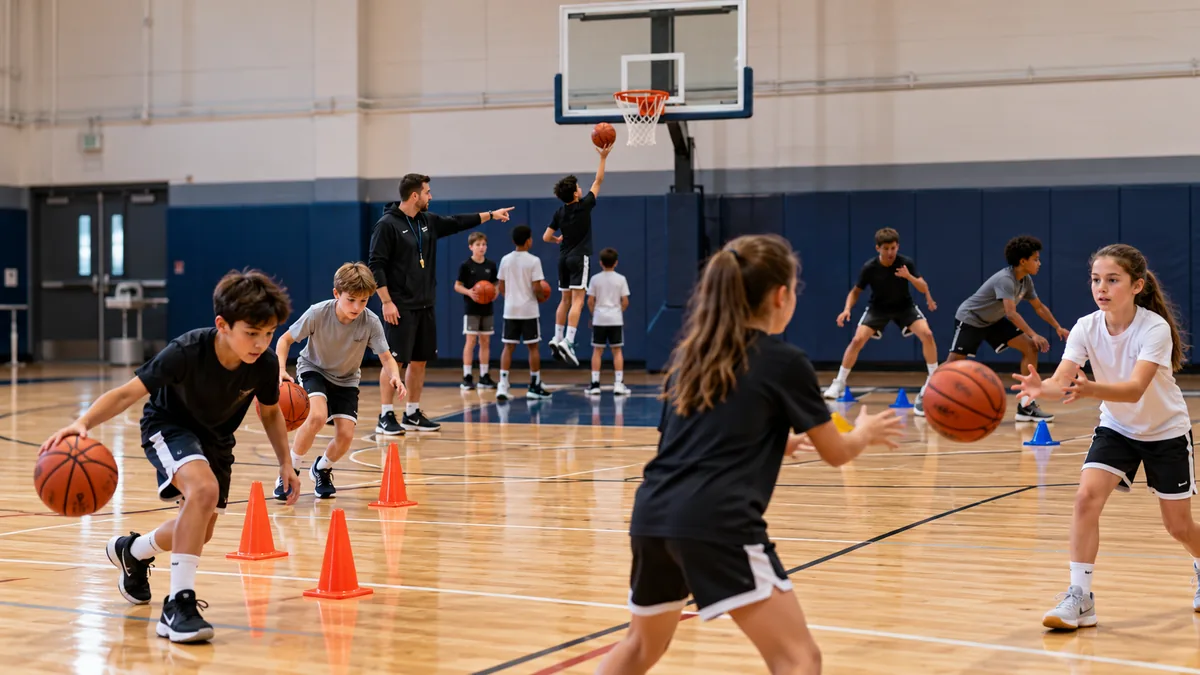
Running a youth basketball practice with one hoop can feel limiting.
You may have ten or twelve players, one basket, a small gym, and only an hour of practice time.
The obvious problem is easy to see.
If every activity requires the basket, players spend too much time standing in line.
One child shoots.
Everyone else waits.
Then the next player shoots.
A coach can lose a large part of practice simply waiting for players to take turns.
But one hoop does not have to create a bad practice.
In fact, the limitation can encourage coaches to organize sessions more efficiently.
Ball handling, passing, footwork, defense, decision-making, movement, communication, and small-sided basketball can all be trained without every player using the basket at the same time.
The key is simple:
Treat the hoop as one practice station, not the entire practice.
The Biggest Mistake: Building Every Drill Around the Basket
Many youth practices naturally move toward the hoop.
Layup lines.
Shooting drills.
Finishing.
One-on-one.
Scrimmages.
All of those activities can be useful.
The problem begins when every drill requires players to finish at the same basket.
Imagine twelve players in one layup line.
Each player may receive only a few meaningful repetitions in several minutes.
The solution is not to avoid shooting.
The solution is to separate the skills that actually require a hoop from the skills that do not.
Players can practice:
- Ball handling
- Passing
- Pivots
- Defensive movement
- Closeout footwork
- Cutting
- Screening
- Rebounding technique
- Reaction
- Spacing
- Decision-making
away from the basket.
That allows the hoop to remain active without creating one long line.
Think in Small Groups
When there is only one hoop, large-group drills become inefficient quickly.
Instead of thinking:
“I have twelve players.”
Think:
“I have four groups of three.”
Now practice becomes easier to organize.
One group can work at the basket.
One group can practice passing.
One group can work on ball handling.
One group can work on defensive movement.
After several minutes, rotate.
Every player stays active.
The coach still teaches one team, but players do not all need the same physical space at the same moment.
Use the Hoop for Skills That Actually Need It
Protect your basket time.
Do not use the hoop for something that could easily happen elsewhere.
For example, players do not need to stand under the rim while the coach explains pivoting.
Teach the pivot somewhere else.
Players do not need a basket to practice chest passes.
Move that group to a sideline.
Players do not need the rim to practice defensive slides.
Use the baseline or another section of the court.
Save the basket for:
- Layups
- Finishing
- Shooting
- Rebounding
- Live attacking situations
This makes each minute at the hoop more valuable.
A Simple Four-Station Setup
For a team of 8–12 players, a four-station system works well.
Station 1: Finishing at the Hoop
This is the only station that requires the basket.
Work on:
- Right-side layups
- Left-side layups
- Finishing from different angles
- Controlled jump stops
- Short-range shooting
Keep the group small.
Three players can receive far more repetitions than twelve players sharing the same basket.
Station 2: Ball Handling
Use a section of the court with cones.
Players can work on:
- Right-hand control
- Left-hand control
- Crossovers
- Changes of direction
- Stops
- Protecting the ball
Beginners can use more space.
More experienced players can use smaller spaces or add defensive pressure.
Station 3: Passing and Movement
Use pairs or groups of three.
Players practice:
- Chest passes
- Bounce passes
- Passing on the move
- Pass-and-cut movement
- Catching under control
- Communication
The station should involve movement rather than players standing in one place throwing fifty passes.
Station 4: Defense and Footwork
Players can practice:
- Defensive stance
- Slides
- Closeout footwork
- Drop steps
- Mirror movement
- Recovery positioning
No basket is required.
Rotate every five or six minutes.
In roughly twenty minutes, every player has worked through all four areas.
Avoid Long Shooting Lines
A single hoop makes traditional shooting lines especially inefficient.
Instead, use short rotations.
For example, three players work at the basket.
Player 1 shoots.
Player 2 rebounds.
Player 3 passes.
Then everyone rotates.
Shoot → Rebound → Pass
This creates continuous movement.
Players are also practicing more than shooting.
They learn to rebound and deliver a useful pass.
After several minutes, the group rotates to another station and a new group uses the hoop.
Use Both Sides of the Basket
One hoop still has two sides.
For layup work, you can often use the right and left side simultaneously if the activity is organized carefully.
For example:
Two players operate on the right side.
Two players operate on the left.
One side can practice simple finishes while the other works on footwork.
Be careful not to create dangerous crossing paths.
Younger players need clear starting points.
If the movement becomes crowded, return to one group at a time.
Efficiency should never come at the expense of safety.
Ball Handling Is Your Best Friend
If the hoop becomes temporarily occupied, ball handling gives every player something useful to do.
Ideally, several players have basketballs.
If you do not have enough balls, use pairs.
A simple progression could be:
Level 1: Stationary control
Level 2: Moving dribble
Level 3: Change direction
Level 4: Add a defender
Level 5: Add a decision
The activity can become more challenging without needing the basket.
This makes ball handling particularly valuable in a limited-space practice.
Passing Can Fill a Large Part of Practice
Passing also requires very little equipment.
Two players and one basketball are enough.
But do not leave players stationary for too long.
Progress from:
Stationary pass
to:
Pass and move
to:
Pass while running
to:
Pass with a defender
to:
Small-sided decision-making
This progression keeps the activity connected to actual basketball.
Your existing passing article can become a natural internal link here because it already progresses from simple technique toward movement and pressure.
Teach Footwork Away From the Hoop
Footwork is often taught near the basket because coaches associate pivots and jump stops with finishing.
That is not necessary.
Use open floor space.
Teach:
- Jump stops
- Stride stops
- Front pivots
- Reverse pivots
- Triple-threat positioning
- Change of direction
- Balance
Then later connect those movements to finishing when a group reaches the basket station.
This saves valuable hoop time.
Defensive Training Does Not Need a Basket
Defense is another ideal area for one-hoop practices.
Players can learn defensive habits anywhere on the court.
Try partner mirror drills.
One player leads.
The other stays in a balanced defensive stance and mirrors the movement.
Then progress to one-on-one without a basket.
The offensive player tries to cross a line rather than score.
Now the defender must:
- Stay balanced
- Move their feet
- Protect a direction
- React to changes of speed
This creates realistic defensive work without using the hoop at all.
Use Gates Instead of Baskets
Cones can create scoring targets.
Place two cones several feet apart.
That becomes a gate.
In one-on-one, the offensive player scores by dribbling through the gate under control.
Now players practice:
- Attacking
- Defense
- Changes of direction
- Ball protection
without a basket.
You can create several gates around the gym and run multiple one-on-one games at the same time.
This is much more active than six players waiting to attack one rim.
Make Passing Games With End Zones
You can also create basketball games without shooting.
Mark an end zone with cones.
Play two-on-two or three-on-three.
A team scores when a player catches a pass inside the end zone.
No dribbling may be allowed at first.
This teaches:
- Getting open
- Passing
- Cutting
- Spacing
- Defense
- Communication
Later, allow one or two dribbles.
The activity still feels like a game even though the basket is not being used.
Use Small-Sided Basketball
Five-on-five is often unnecessary during practice, especially with one hoop.
Two-on-two and three-on-three provide:
- More touches
- More decisions
- More space
- More involvement
- Fewer players standing
Your existing 3-on-3 content already emphasizes how fewer players can make spacing and decisions easier to recognize. howtocoachyouthbasketball.com
For one-hoop practice, this becomes even more useful.
One group can play at the basket while another group works elsewhere.
Try 2-on-2 With Quick Rotations
Place two offensive players against two defenders.
Play one possession.
When the possession ends, four new players enter.
The previous group moves to a skill station or short rest area.
Keep rotations fast.
Avoid long coaching lectures between possessions.
After several possessions, stop briefly and give one useful correction.
This keeps the hoop active while still allowing players to compete.
Use Advantage Games
Advantage situations are efficient because they usually end quickly.
Try:
- 2-on-1
- 3-on-2
- 2-on-1 from the wing
The offense must recognize the advantage and make a decision.
Then rotate.
These games teach more than finishing.
Players work on:
- Passing
- Spacing
- Defender reads
- Timing
- Decision-making
One basket is enough because possessions are short.
Do Not Let the Best Players Dominate the Hoop
When basket time is limited, coaches may accidentally give more repetitions to advanced players.
They finish quickly.
They rebound quickly.
They take more shots.
Beginners can become spectators.
Track the rotation.
Make sure every player receives meaningful basket repetitions.
The advanced player can receive additional challenge through:
- Weak-hand finishes
- Limited dribbles
- A defender
- Different angles
- Faster decisions
They do not need extra turns at the expense of teammates.
Make Every Player Rebound
When a shooting group uses the basket, nobody should stand and watch.
If one player shoots, another player should rebound.
Teach players to:
- Track the ball
- Secure it
- Chin the ball
- Find a passer
- Deliver the next repetition
Rebounding becomes part of shooting practice.
That increases the value of every station.
Use a Rebound-and-Outlet Station
A useful one-hoop activity is:
Coach shoots.
Player rebounds.
Player pivots.
Player finds an outlet.
Outlet player catches and advances the ball toward half court.
Then everyone rotates.
The drill combines:
- Rebounding
- Ball security
- Pivoting
- Passing
- Transition habits
The hoop is being used, but one shot produces several learning opportunities.
Practice Shooting Form Close to the Basket
One hoop does not mean players need to take dozens of long shots.
Close-range shooting can be efficient.
Two or three players rotate through the basket.
Focus on:
- Balance
- Control
- Comfortable range
- Follow-through
- Repeatable movement
Shorter shots also reduce long rebounds, making the station easier to organize.
For young players, quality repetitions matter more than shooting from a distance they cannot comfortably reach.
Create a “Make It, Move On” Challenge
Instead of standing in one location taking ten shots, players move after success.
For example:
Spot 1: Close right side
Spot 2: Close left side
Spot 3: Middle
Spot 4: Short bank shot
Make one controlled shot, then move.
This keeps the station active.
Avoid turning it into a high-pressure competition where beginners get stuck at one spot for several minutes.
The goal remains repetition and development.
Coach One Station More Closely
A station practice does not mean the coach must watch everything equally every second.
Choose one station as the primary teaching station.
For example, today the coach spends most attention on finishing.
The other stations use familiar activities players already understand.
At the next practice, passing may become the teaching station.
This keeps instruction manageable.
If every station contains a brand-new skill, the coach will spend the entire practice running from group to group explaining rules.
Teach Players How to Rotate
Station practice can become chaotic if transitions take too long.
Before starting, explain:
“When I whistle, leave the ball where it belongs and move clockwise to the next station.”
Practice the transition once.
It may feel unnecessary.
But saving thirty seconds on every rotation can recover several minutes of practice time.
Put Equipment Out Before Practice
With limited gym time, setup matters.
Before players arrive, prepare:
- Cones
- Basketballs
- Floor markers
- Pinnies
- Station locations
If the coach spends five minutes between activities moving cones and deciding what happens next, the one-hoop problem becomes much worse.
A simple practice plan solves that.
A Sample 60-Minute One-Hoop Practice
Here is a practical example for approximately 8–12 players.
0–8 Minutes: Active Warm-Up
Use:
- Movement
- Dribbling
- Defensive slides
- Change of direction
Keep everyone moving.
The existing warm-up article on the site already recommends avoiding long lines and specifically notes that if only one basket is available, coaches can divide players into smaller groups and use both sides efficiently. howtocoachyouthbasketball.com
8–28 Minutes: Four Stations
Five minutes per station.
Station A: Finishing at the hoop
Station B: Ball handling
Station C: Passing and movement
Station D: Defensive footwork
Rotate four times.
28–38 Minutes: Passing Game
Play 3-on-3 to an end zone.
No hoop required.
Focus on getting open and moving after the pass.
38–50 Minutes: 2-on-2 at the Basket
Quick live possessions.
Other players perform ball-handling challenges while waiting for their turn.
50–57 Minutes: Advantage Basketball
Use 2-on-1 or 3-on-2.
Fast possessions.
57–60 Minutes: Team Challenge and Review
Finish with a short shooting or finishing challenge.
Then ask:
“What was one thing we improved today?”
Practice ends with players reflecting on the session rather than simply leaving after the final shot.
What If You Have 14 or More Players?
A large roster requires even smaller groups.
You may use five stations instead of four.
For example:
- Hoop finishing
- Dribbling
- Passing
- Defense
- Footwork/reaction
Keep groups at two or three players when possible.
If you have assistant coaches, assign one person to the basket station.
If not, make the non-hoop stations activities players already know.
What If You Have Very Little Court Space?
Use shorter distances.
Players do not need the entire court to develop basketball skill.
Ball handling can happen in a small box.
Passing can happen between two floor lines.
Defense can use a narrow lane.
One-on-one can use cone gates.
Three-on-three can use only part of the half court.
The important question is:
Can players make basketball decisions safely in the available space?
If yes, practice can still be productive.
What If Players Keep Gathering Around the Hoop?
Young players naturally move toward the action.
Make station boundaries obvious.
Use cones.
Tell players:
“If you are not at the finishing station, you should not be inside this area.”
Clear physical boundaries reduce confusion.
It also prevents stray basketballs from rolling into live finishing activities.
Do Not Turn Stations Into Babysitting
Stations are not simply a way to keep children busy while one group receives real coaching.
Every station should have a basketball purpose.
Players should know:
- What they are practicing
- What success looks like
- When they rotate
For example:
At passing station:
“Your goal is ten accurate passes while both players continue moving.”
At defense:
“Stay balanced and keep your chest in front for five seconds.”
Clear targets create focus.
Keep Instructions Short
One-hoop practices often involve several moving parts.
Long explanations make organization harder.
Use short cues.
For ball handling:
“Control first. Eyes up.”
For passing:
“Step, pass, move.”
For defense:
“Stay balanced.”
For finishing:
“Under control.”
If players understand the cue, the coach can move between stations quickly.
Reuse Familiar Stations
Do not invent four completely new stations every practice.
Consistency saves teaching time.
Keep two or three familiar activities.
Change one station to match the week’s focus.
For example:
Monday:
Finishing focus.
Wednesday:
Passing focus.
Friday:
Defense focus.
The structure remains familiar.
The learning objective changes.
One Hoop Can Actually Improve Practice Design
Having multiple baskets is useful.
But limited equipment can force coaches to think more carefully.
Players cannot spend the whole practice shooting.
They have to work on the rest of basketball.
That can create more time for:
- Passing
- Ball handling
- Defense
- Movement
- Communication
- Decisions
A hoop is important.
But basketball development is much bigger than the hoop.
Common One-Hoop Practice Mistakes
One Giant Layup Line
Too much waiting.
Use small groups.
Every Drill Ends With a Shot
Not every basketball skill needs a finish.
Players Waiting Without a Task
Give waiting players an active skill assignment.
Too Many New Stations
Players spend more time learning rules than basketball.
Ignoring Non-Shooting Skills
Passing, defense, movement, and ball handling deserve significant practice time.
Allowing Stations to Become Crowded
Use clear boundaries and small groups.
Coaching Only the Basket Station
Check the other groups and provide simple feedback.
Frequently Asked Questions
Can you run a good youth basketball practice with only one hoop?
Yes. Use small groups, stations, non-shooting games, and small-sided basketball so the hoop becomes one part of practice rather than the center of every activity.
How many players should be at the basket station?
Usually two to four players works well. Smaller groups create more repetitions and less waiting.
What drills can kids do without a hoop?
Ball handling, passing, pivots, defensive footwork, reaction games, cutting, spacing, cone-gate one-on-one, and end-zone passing games can all be done without a basket.
Should every practice include shooting?
Shooting is important, but it does not need to dominate the entire session. With one hoop, rotate players through short shooting or finishing stations while others train different skills.
Are stations good for young basketball players?
Yes, especially when stations are simple, active, and clearly organized. Avoid introducing too many unfamiliar activities at once.
How do you keep kids active while waiting for the hoop?
Give them ball-handling, passing, footwork, defensive, or reaction activities instead of having them stand in line.
Final Thoughts
A youth basketball practice with one hoop can still be fast, productive, and enjoyable.
Do not organize the entire session around the basket.
Use small groups.
Create stations.
Save hoop time for the skills that actually require it.
Teach ball handling, passing, footwork, and defense in other areas of the gym.
Use small-sided games.
Use cone gates and end zones.
Keep rotations short.
And make sure players are doing basketball much more often than they are waiting for basketball.
The quality of a youth practice is not determined by how many baskets are available.
It is determined by how well the coach uses the players, space, equipment, and time that are available.
One hoop is a limitation.
It does not have to become an excuse for standing in line.
