A good youth basketball practice does not need dozens of drills or a complicated playbook.

Young players benefit most from a session with clear structure, frequent repetitions, simple coaching cues, and opportunities to make decisions in realistic basketball situations.

This 60-minute practice plan gives volunteer and developing coaches a practical framework that can be adjusted for different ages, roster sizes, gym space, and experience levels.

What Should a Youth Basketball Practice Accomplish?

Every session should have a clear purpose.

Instead of trying to teach everything in one hour, choose a small number of priorities and build the practice around them.

A productive session usually combines:

individual skill development
movement without the ball
decision-making
basic team concepts
competitive play

Beginners may need more time learning how to stop, pivot, pass, dribble, and finish near the basket. More experienced players can spend additional time on spacing, defensive positioning, reads, and game situations.

For more guidance on teaching habits and communication, visit Coaching Fundamentals:

https://howtocoachyouthbasketball.com/category/coaching-fundamentals/

Simple 60-Minute Practice Structure

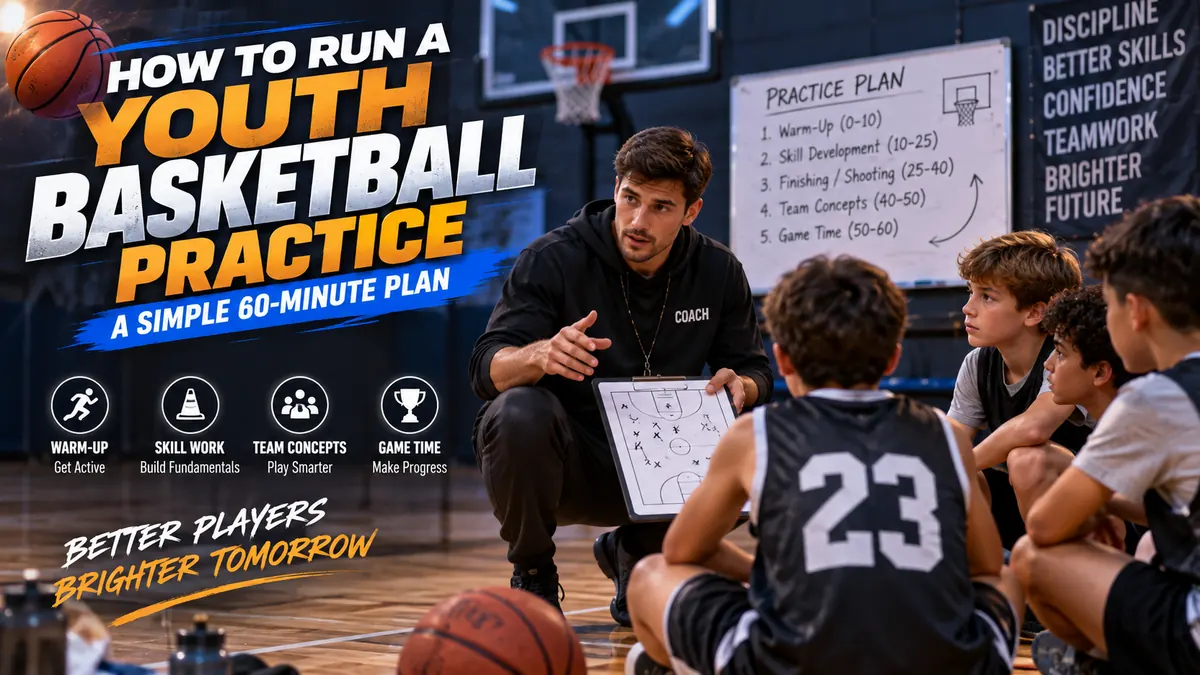
A useful one-hour structure looks like this:

0–10 minutes: Dynamic warm-up and ball handling
10–25 minutes: Fundamental skill development
25–40 minutes: Finishing, passing, or shooting
40–50 minutes: One team concept
50–60 minutes: Small-sided competition

The exact drills can change from session to session. The important part is maintaining a balance between technical work, decision-making, and actual play.

0–10 Minutes: Dynamic Warm-Up and Ball Handling

The opening portion should prepare players physically while immediately connecting them to basketball.

Long-distance running is rarely necessary when movement activities can warm players up more efficiently.

Start with two or three minutes of:

light jogging
defensive slides
high knees
skipping
backpedaling
short controlled accelerations

Then introduce basketballs.

Whenever possible, give every player a ball so nobody has to stand and wait.

Ball-Handling Activities

Useful activities include:

right-hand control dribbles
left-hand control dribbles
low crossovers
change-of-speed dribbling
walking while keeping the eyes forward
controlled retreat dribbles

The goal is control before speed.

Encourage players to bend their knees, use their fingertips, protect the ball with their body, and gradually become more comfortable looking away from the basketball.

10–25 Minutes: Focus on One Fundamental Skill

One of the easiest ways to make practice confusing is to introduce too many concepts at once.

Choose one main skill for this part of the session and build a short progression around it.

Possible themes include:

passing
dribbling under pressure
pivoting
defensive footwork
finishing
rebounding
shooting fundamentals

A useful progression moves from simple execution toward a more realistic situation.

For example, a passing session can begin with partner passing, continue with movement, and finish with light defensive pressure.

More drill ideas can be found in Basketball Drills:

https://howtocoachyouthbasketball.com/category/basketball-drills/

Example Passing Progression

Start players in pairs at a comfortable distance.

Focus on accuracy, balance, stepping toward the target, and giving the receiver a clear passing window.

Next, introduce movement.

After making a pass, the player should relocate instead of standing in the same spot. This introduces an important game habit: players should remain active after releasing the ball.

Finally, add light defensive pressure.

The defender does not need to force immediate turnovers. The goal is simply to make the passer recognize space and choose a better option.

25–40 Minutes: Finishing and Shooting Development

Shooting is usually one of the most enjoyable parts of practice, but it still needs to be organized so players receive frequent repetitions.

Avoid one long line whenever possible.

Use both sides of the basket, multiple baskets, partner shooting, or small stations.

Start Near the Basket

Young players often develop poor mechanics when they repeatedly attempt shots from distances that require too much strength.

Begin close to the rim.

Useful activities include:

close-range form shooting
right-handed layups
left-handed layups
short bank shots
one-step finishes
finishes after a controlled dribble
Teach Layup Footwork Slowly

For a traditional right-handed layup, the player normally jumps from the left foot and finishes with the right hand.

On the opposite side, the player jumps from the right foot and finishes with the left hand.

Beginners often mix up the steps.

Do not immediately demand game speed. Let players rehearse the movement slowly until the rhythm becomes natural.

40–50 Minutes: Introduce One Team Concept

Young teams usually benefit more from understanding basic basketball principles than memorizing a large collection of set plays.

Good concepts for this segment include:

offensive spacing
moving after a pass
help-side defense
transition defense
give-and-go action
inbound positioning
defensive communication
Example: Teaching Offensive Spacing

Place several players close together and ask them what happens to the available space.

Then spread those same players across the half court.

Explain how better spacing can create:

driving lanes
clearer passing angles
more difficult decisions for defenders

After the demonstration, play three-on-three and encourage players to recognize when they are standing too close to a teammate.

More team concepts are available in Game Strategy:

https://howtocoachyouthbasketball.com/category/game-strategy/

50–60 Minutes: Finish With Small-Sided Competition

The final part of practice should allow players to make decisions without the coach controlling every movement.

Small-sided games are especially valuable because fewer players mean more touches, more defensive actions, and more opportunities to solve basketball problems.

Useful formats include:

one-on-one
two-on-two
three-on-three
three-on-two advantage games
short controlled scrimmages

Three-on-three is particularly effective for youth development because players have enough space to dribble, pass, cut, defend, and make decisions.

Connect the Game to the Practice Theme

Add one simple rule that reinforces the lesson.

If practice focused on passing, require several passes before a shot.

If spacing was the main concept, reward possessions where players maintain useful distance.

If defense was the focus, award an extra point for a stop or turnover.

The rule should reinforce learning without making the game unnecessarily complicated.

How to Reduce Standing and Waiting

Long lines are one of the most common problems in youth practices.

Every minute spent waiting is a minute without a repetition, decision, or meaningful movement.

Instead of one group of twelve players, consider creating three groups of four.

If multiple baskets are available, use them.

If gym space is limited, create stations that develop different skills in smaller areas.

A useful question for coaches is:

Can more players be active during this activity?

Small changes in organization can significantly increase the amount of learning that happens during one hour.

How Much Should a Youth Coach Talk?

Clear instruction matters, but young players generally learn more by performing a skill than by listening to a long explanation.

A practical teaching sequence is:

Explain one idea.
Demonstrate the movement.
Let players attempt it.
Give one or two corrections.
Let them try again.

Avoid correcting every detail at the same time.

If a player is learning defensive positioning, first make sure the player understands how to stay between the offensive player and the basket.

Additional details can come later.

Adjust the Practice to the Age of the Players
Younger Beginners

Younger players usually need shorter activities and more frequent changes of pace.

Emphasize:

basic movement
ball control
passing
balance
finishing
simple competitions
Developing Players

Players with more experience can begin combining skills with decisions.

Add:

defensive pressure
weak-hand development
spacing concepts
rebounding responsibilities
structured small-sided games
More Experienced Youth Teams

Older or more advanced groups can work at a faster pace and include more complex reads, transition situations, defensive rotations, and tactical decisions.

The overall structure does not need to change dramatically.

The difficulty simply increases.

Common Youth Basketball Practice Mistakes
Trying to Teach Too Much

Players usually learn more when a coach develops a few ideas thoroughly rather than introducing a completely different concept every few minutes.

Using Long Lines

Reduce waiting by creating smaller groups, adding stations, or using activities where several players work simultaneously.

Spending Too Much Time on Plays

A complicated offense cannot compensate for weak passing, poor spacing, limited ball control, or poor defensive understanding.

Stopping Practice Constantly

Coaches should correct important mistakes, but repeated interruptions can destroy the rhythm of a session.

Sometimes quick feedback while players continue moving is more effective.

Ignoring Decision-Making

Drills teach technique, but players also need opportunities to decide when to pass, dribble, shoot, cut, or defend.

Small-sided games connect technical skills to actual basketball situations.

Pre-Practice Checklist for Coaches

Before players arrive, prepare:

basketballs
cones
pinnies or reversible jerseys if needed
a water-break plan
one primary teaching objective
two or three supporting activities
one competitive game to finish

Planning ahead reduces downtime and allows the coach to spend more attention on the players instead of deciding what to do next.

Example Practice at a Glance

Here is one possible schedule for a beginner team:

0–5 minutes: Dynamic movement
5–10 minutes: Ball-handling warm-up
10–20 minutes: Passing fundamentals
20–25 minutes: Passing while moving
25–35 minutes: Layup development
35–40 minutes: Short-range shooting
40–50 minutes: Offensive spacing
50–60 minutes: Three-on-three competition

This is only a framework.

Coaches can replace individual drills while preserving the balance between skill development, team understanding, and game-like play.

Frequently Asked Questions
How long should youth basketball practice last?

Sixty minutes is enough for many beginner and recreational teams when the session is well organized.

Older or more competitive groups may practice longer, but additional time is only useful when players remain engaged and productive.

How many drills should a coach use?

There is no required number.

A small collection of well-designed activities is often more effective than constantly introducing new ones.

Players need enough repetitions to actually learn.

Should every practice include a scrimmage?

Some form of game-like play is usually valuable.

It does not need to be full five-on-five.

Two-on-two and three-on-three can provide even more useful touches and decisions for developing players.

Should young players practice plays or fundamentals?

Fundamentals should receive significant attention.

Simple team concepts can be introduced, but players still need strong passing, dribbling, finishing, movement, and defensive habits before they can execute more complicated systems effectively.

Final Thoughts

The best youth basketball practices are not necessarily the most complicated.

They are organized around clear goals and give players repeated opportunities to move, think, communicate, and improve.

A simple one-hour session can combine a dynamic warm-up, focused skill work, finishing or shooting, one team concept, and competitive play.

Coaches should adjust the difficulty to the players in front of them instead of forcing every team through the same activities.

Over time, consistent fundamentals and meaningful repetitions create a stronger foundation than constantly changing drills.

For additional structured sessions, visit Youth Basketball Practice Plans:

https://howtocoachyouthbasketball.com/category/practice-plans/

External reference: NYALATOTOHow to Run a Youth Basketball Practice: A Simple 60-Minute Plan
Learn how to run a youth basketball practice with a simple 60-minute plan covering warm-ups, ball handling, passing, shooting, defense, and team play.

Written by qrlon_a696ae4bcb25
Youth basketball enthusiast focused on practical coaching tips, player development, teamwork, fundamentals, and creating a positive learning environment for young athletes.