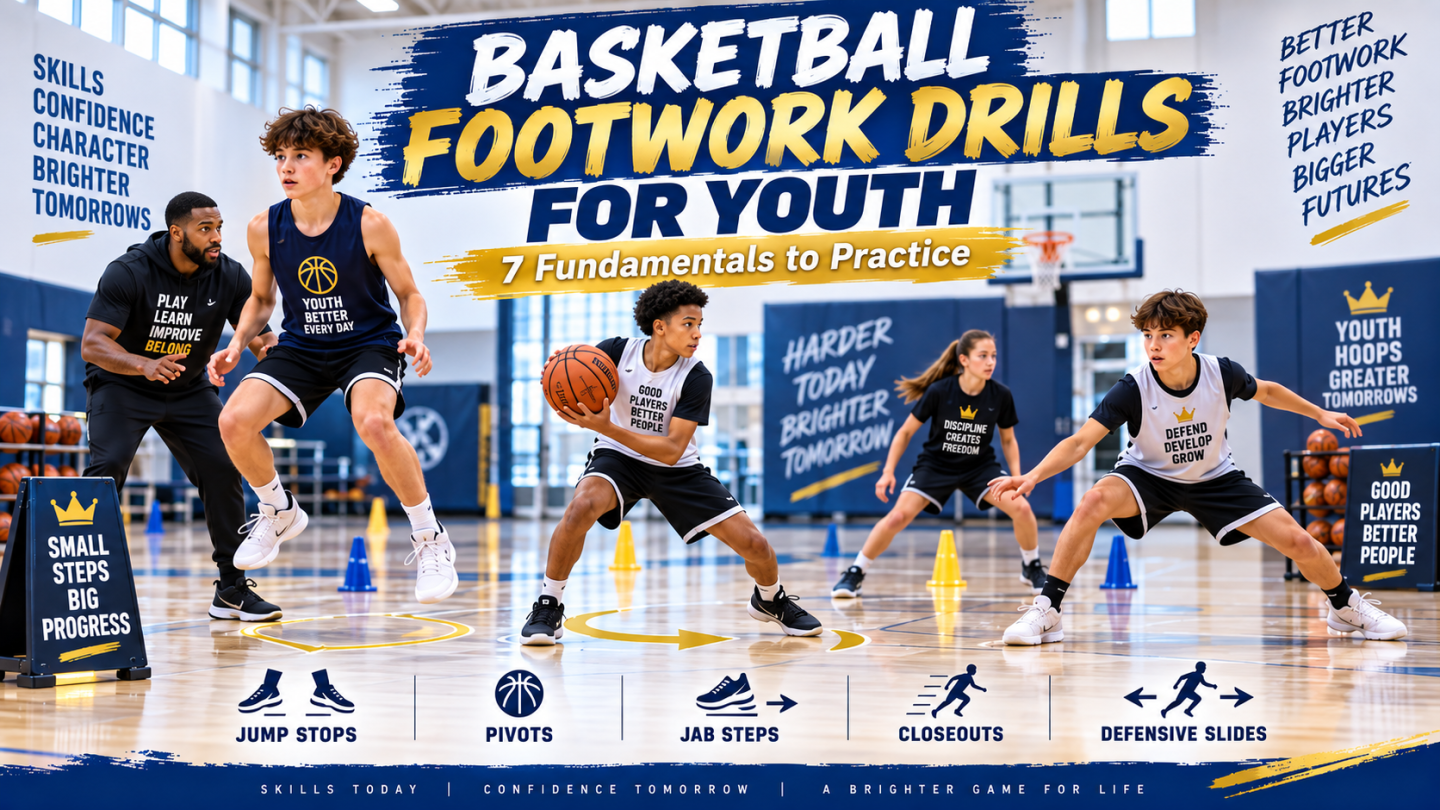
Good basketball starts with good footwork.
Young players often spend most of their attention on dribbling, shooting, and passing. However, nearly every basketball skill becomes easier when a player can stop, pivot, change direction, stay balanced, and move efficiently.
That is why basketball footwork drills for youth players should be part of regular practice.
Footwork does not need to be complicated. Coaches can teach a small number of movements repeatedly until they become natural. Once those fundamentals improve, players usually become more confident with the ball, more controlled on defense, and better prepared to make decisions during games.
This guide covers seven practical footwork drills that youth coaches can introduce progressively.
Why Footwork Matters in Youth Basketball
Footwork connects almost every basketball skill.
A player uses the feet when receiving a pass, attacking the basket, shooting, defending, rebounding, and changing direction.
Poor footwork often creates problems that appear to be caused by something else.
For example, a player may miss a shot because the feet were not balanced before the release. Another player may lose the ball while driving because the body was moving faster than the feet could control.
Good footwork can help young players improve balance, coordination, body control, change of direction, defensive movement, and overall confidence.
The goal is not to make young athletes memorize complicated patterns.
Instead, coaches should build a few reliable movement habits.
Start With Balance and Athletic Position
Before teaching advanced movement, players should learn what a balanced basketball position feels like.
The feet should generally be around shoulder-width apart.
The knees remain slightly bent.
The player’s chest stays upright rather than leaning dramatically forward.
Weight should be balanced so the player can move in any direction.
A useful coaching cue is:
“Stay ready to move.”
If a player becomes too upright, movement becomes slower.
If the stance becomes too low or tense, the player may struggle to react naturally.
The goal is a comfortable position that allows quick movement.
Drill 1: Jump Stop and Hold
The jump stop is one of the most useful footwork skills for beginners.
It helps players stop under control after dribbling, catching, or moving toward the basket.
How to Set It Up
Players begin several steps away from a marked line or cone.
They move forward at a controlled speed.
At the marker, they land on both feet at approximately the same time.
After landing, they hold the position for two seconds.
What Coaches Should Watch
Look for balanced landings.
Players should avoid falling forward or allowing the feet to become extremely narrow.
A good cue is:
“Land balanced and stay strong.”
Once players can perform the stop comfortably, add a basketball.
Have them dribble toward the marker, pick up the ball, and execute the same jump stop.
This creates a direct connection between footwork and ball control.
Drill 2: Front Pivot and Reverse Pivot
Pivoting allows a player to protect the basketball and change direction without traveling.
Young players should become comfortable pivoting in both directions.
Begin without a defender.
The player starts in a balanced position with one foot designated as the pivot foot.
The other foot moves around the body.
For a front pivot, the player turns toward the direction of movement.
For a reverse pivot, the player turns away.
Keep the first repetitions slow.
The most important rule is that the pivot foot remains connected to the floor until the movement is complete.
A useful cue is:
“Keep one foot home.”
Once the player understands the movement, add a basketball.
Later, coaches can add a passive defender to give the pivot a purpose.
Drill 3: Catch, Jump Stop, Pivot
This drill connects passing with footwork.
Pair players together.
One player passes while the other receives the ball.
The receiver catches the basketball, performs a controlled jump stop, and then executes either a front pivot or reverse pivot.
After the pivot, the player passes the ball back.
This sequence can be repeated from both sides.
The drill works particularly well after players have practiced basketball passing drills for kids, because it teaches them what to do immediately after receiving a pass.
Instead of catching the basketball and standing upright, players learn to become balanced and ready.
As players improve, allow the coach to call out:
“Front!”
or:
“Reverse!”
The receiver must react quickly.
Drill 4: Jab Step and Go
A jab step is a simple offensive movement that can help create space from a defender.
Players begin in triple-threat position with the basketball.
One foot remains planted while the other makes a short, quick step toward one side.
The player then returns to the balanced starting position.
At first, practice the movement without driving.
Focus on body control.
The jab should look threatening without becoming so large that the player loses balance.
After several repetitions, allow the player to jab and then attack in the opposite direction.
For example:
Jab right.
Then drive left.
This introduces the idea that footwork can influence the defender before the dribble even begins.
Avoid teaching exaggerated movements.
A small, controlled jab is usually more useful than a dramatic step that leaves the player off balance.
Drill 5: Closeout Footwork
Footwork is just as important on defense.
A closeout occurs when a defender moves toward an offensive player who has received the ball.
Begin with the defender several steps away from a cone or offensive player.
The defender runs quickly for the first part of the distance.
As the defender approaches, the steps become shorter and more controlled.
The player finishes in a balanced defensive stance.
A useful cue is:
“Sprint, then shorten.”
Young defenders often make one of two mistakes.
Some approach too slowly and give the offensive player an open shot.
Others sprint the entire way and lose control, allowing the offense to drive past.
The closeout drill teaches players how to combine speed with balance.
Once they understand the movement, connect it to 3-on-3 basketball drills for youth teams so they can practice closeouts in realistic situations.
Drill 6: Defensive Slide and Change Direction
Defensive movement requires players to stay balanced while moving laterally.
Place two cones approximately eight to twelve feet apart.
The player begins in a defensive stance.
They slide toward the first cone, change direction, and slide back.
The feet should not cross.
The player should push from the outside foot rather than jumping from side to side.
A useful cue is:
“Push the floor away.”
Keep the distance short.
Defensive slides become less effective when players become tired and begin standing upright.
Quality matters more than completing a long distance.
Later, coaches can point left or right randomly so the player must react instead of following a predictable pattern.
This improves both footwork and decision-making.
Drill 7: Footwork to Finish
The final drill connects movement directly to scoring.
Start players on the wing or near the lane.
The player receives a pass, establishes balance, and attacks the basket.
Depending on the progression, require one of several finishes:
- Jump stop
- One-two stop
- Pivot
- Layup
- Shot fake and step-through
The coach can call the required movement before the repetition begins.
For example:
“Jump stop, pivot, finish.”
The player must perform the sequence under control.
This drill helps athletes understand that footwork is not something practiced only with cones.
It is part of real offensive basketball.
You can also combine this activity with the principles from how to teach basketball shooting form so players learn to establish their feet before finishing or shooting.
Teach the One-Two Stop
The jump stop is not the only useful way to stop.
Players should also learn a one-two stop.
In this movement, one foot contacts the floor first, followed by the second foot.
The technique is commonly used when catching and preparing to shoot.
Start slowly.
Players walk toward a marker and practice placing one foot down followed by the other.
Then increase the speed.
When a basketball is added, the player catches the pass while completing the one-two rhythm.
This can make catch-and-shoot situations feel more natural.
Do not force every player into exactly the same foot sequence.
Right-left or left-right may depend on the direction of movement and the player’s situation.
Connect Footwork With Shooting
Many shooting problems begin with the feet.
If the player catches the ball while leaning sideways or moving too quickly, the upper-body technique may become inconsistent.
Before a shot, encourage players to establish balance.
A simple sequence is:
Feet ready — catch — rise — finish.
Players who already understand shooting mechanics can use footwork drills to make their technique more game-like.
Rather than standing still for every shot, they learn to enter the shot from movement.
Connect Footwork With Passing
Players also need footwork to create passing angles.
A pivot can help a player move the basketball away from defensive pressure.
A jump stop can prevent traveling after picking up the dribble.
A balanced stance makes it easier to deliver accurate passes.
This is why passing and footwork should not always be treated as separate skills.
During partner passing drills, ask receivers to jump stop or pivot before returning the pass.
One small addition can turn a basic passing drill into a more complete basketball activity.
Use Footwork During Small-Sided Games
Isolated drills are useful for learning movement patterns.
However, players eventually need to apply those skills against defenders.
Two-on-two and three-on-three games are excellent for this.
Watch whether players use the footwork naturally.
Do they jump stop when pressure arrives?
Can they pivot away from a defender?
Do they stay balanced when closing out?
Can they change direction without crossing their feet?
The goal is for the movement to appear automatically during live play.
If players only perform proper footwork during cone drills, the skill has not fully transferred yet.
Common Youth Basketball Footwork Mistakes
One common mistake is teaching movements too quickly.
Players may imitate the speed without understanding the balance or body position.
Slow repetitions usually help in the beginning.
Another mistake is using complicated ladder patterns that look impressive but have little connection to basketball.
Agility ladders can be useful for coordination, but youth coaches should still prioritize movements players actually use during games.
Players also commonly stand too upright.
Remind them that basketball is easier when the body is ready to move.
Finally, avoid treating every imperfect movement as a major error.
Young athletes need time to coordinate their feet.
Correct the most important issue first and allow repetition to do the rest.
How Long Should Footwork Drills Last?
Footwork activities do not need to take over the entire practice.
For many youth teams, five to ten minutes of focused footwork can be enough.
The drills can also be integrated into other parts of practice.
For example, a passing drill can include jump stops.
A shooting drill can begin with one-two footwork.
A defensive drill can include closeouts and slides.
This approach saves practice time while helping players understand that footwork supports every basketball skill.
Adjusting Footwork Drills by Age
For younger players, keep movements simple.
Focus on balance, jump stops, pivots, and basic defensive slides.
As players become more experienced, add jab steps, closeouts, directional changes, and footwork after receiving passes.
Older youth players can begin combining multiple movements.
For example:
Catch.
Shot fake.
Pivot.
Attack.
Jump stop.
Finish.
The progression should follow the player’s ability.
Complexity should never replace control.
How Coaches Can Measure Improvement
Do not evaluate footwork only by how quickly players complete a drill.
Speed without control is not the goal.
Instead, watch for better balance, fewer traveling violations, stronger defensive positioning, more controlled changes of direction, better shooting preparation, and smoother movement after catches.
Game situations provide the best evidence.
If players begin using these movements naturally during scrimmages, the training is transferring.
Frequently Asked Questions
What are the best basketball footwork drills for youth players?
Jump stops, pivots, jab steps, defensive slides, closeouts, one-two stops, and finishing footwork are excellent fundamentals because they appear frequently during games.
At what age should basketball players learn footwork?
Basic footwork can be introduced as soon as players begin organized basketball. The drills should simply match their age and coordination level.
How often should youth teams practice footwork?
Footwork can be included in almost every practice. Short, consistent sessions are usually more useful than occasional long workouts.
Should beginners use agility ladders?
Agility ladders can help coordination, but they should not replace basketball-specific movements such as pivots, stops, slides, and closeouts.
How can players stop traveling?
Teach controlled jump stops, one-two stops, and pivoting. Players should learn which foot is established before beginning the next movement.
Is footwork important for shooting?
Yes. Balanced feet provide a stronger foundation for a repeatable shooting motion.
Final Thoughts
Strong basketball footwork drills for youth players do not need complicated equipment or advanced patterns.
The most useful movements are often the simplest.
Teach players how to stop.
Teach them how to pivot.
Help them change direction without losing balance.
Show them how to close out, slide defensively, and prepare their feet before catching or shooting.
Then place those movements into real basketball situations.
When good footwork becomes automatic, young players can move with greater confidence and control. That foundation makes passing, shooting, defense, rebounding, and decision-making easier to develop.
