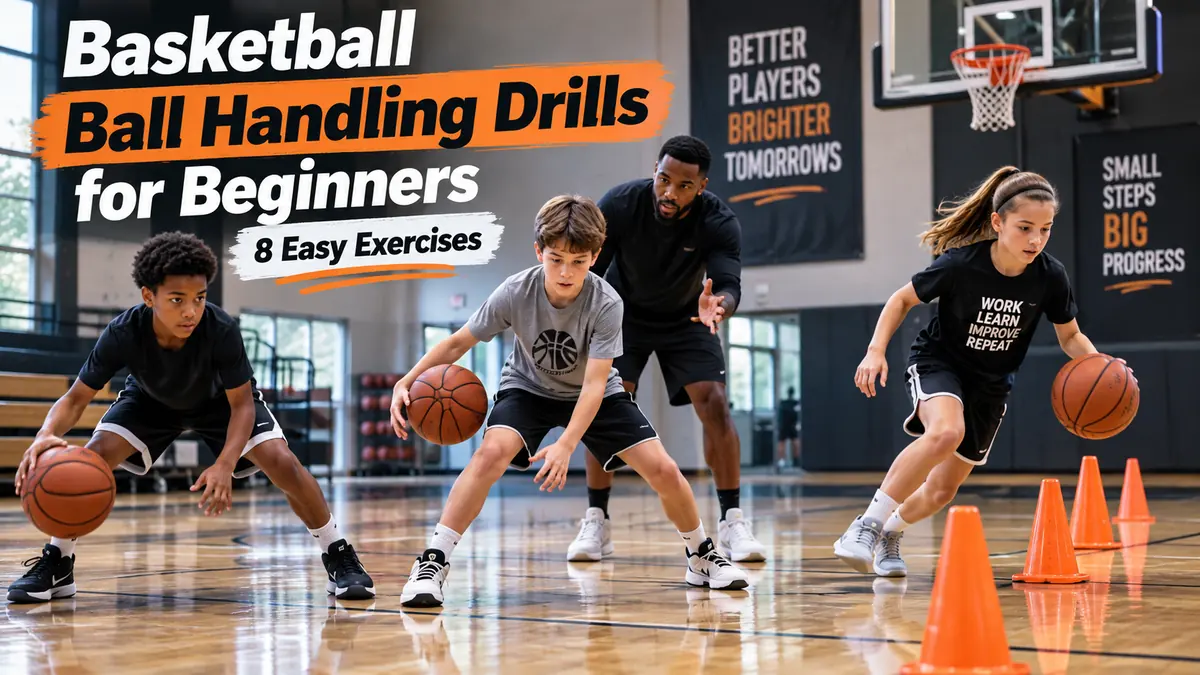
Ball handling is one of the most important skills for young basketball players. A player who feels comfortable controlling the basketball can move with more confidence, protect the ball from defenders, and make better decisions during games.
For beginners, however, ball handling should not start with complicated dribble combinations. Young players first need to develop control, coordination, balance, and the ability to use both hands.
The best basketball ball handling drills for beginners are simple enough to learn quickly but challenging enough to improve coordination over time.
Below are eight easy exercises youth basketball coaches can use during practice.
Why Ball Handling Is Important for Beginners
Young players often focus on how fast they can dribble. Speed is useful later, but beginners first need to learn how to control the basketball.
Good ball handling helps players:
- Keep possession under defensive pressure
- Move confidently around the court
- Change direction without losing the ball
- Use both hands
- Keep their eyes away from the basketball
- Create better passing and driving opportunities
- Develop overall basketball coordination
A beginner who learns strong fundamentals early will have an easier time adding advanced dribble moves later.
Coaches should emphasize control before speed.
Basic Ball Handling Technique
Before starting the drills, teach players a few simple fundamentals.
Use the Fingertips
Players should control the basketball mainly with their fingertips rather than slapping it with the palm.
The hand should remain relaxed while controlling the direction and height of the dribble.
Keep the Knees Bent
A lower athletic stance makes it easier to control the basketball and change direction.
Players should avoid standing completely upright while dribbling.
Keep the Ball Near the Body
Beginners sometimes push the basketball too far away from themselves.
A controlled dribble should stay close enough that the player can quickly recover it.
Practice With Both Hands
Young players naturally prefer their dominant hand.
Coaches should deliberately provide repetitions with the weaker hand so players become comfortable attacking in either direction.
Look Up
Beginners will initially watch the ball.
As their control improves, encourage them to gradually raise their eyes and observe the court.
Drill 1: Stationary Right-Hand Dribble
Start with the simplest possible exercise.
Each player has a basketball and stands in an athletic position.
Players dribble repeatedly with the right hand for approximately 20–30 seconds.
Coaching cues:
- Bend the knees
- Keep the chest up
- Use the fingertips
- Keep the basketball near the hip
- Avoid slapping the basketball
- Gradually look forward instead of downward
Beginners should first use a comfortable dribble height.
Once they gain confidence, ask them to lower the dribble slightly.
The objective is consistent control rather than maximum speed.
Drill 2: Stationary Left-Hand Dribble
Repeat the same exercise with the left hand.
For many players, this side will feel significantly more difficult.
That is normal.
Encourage players to remain patient and avoid immediately switching back to their dominant hand when they make a mistake.
Coaches can alternate between:
20 seconds right hand → 20 seconds left hand → rest → repeat.
Over time, increasing weaker-hand repetitions can help reduce the difference between the two sides.
Drill 3: Low Dribble Challenge
The low dribble teaches players to control the basketball closer to the floor.
Players begin in a low athletic stance and dribble below knee height.
Start with the right hand and then switch to the left.
Challenge players to complete as many controlled dribbles as possible without losing the basketball.
A lower dribble can be useful when protecting the ball from defensive pressure.
However, players should not bend completely at the waist.
Encourage them to keep their head and chest reasonably upright while bending through the knees.
Drill 4: High-to-Low Dribble
This exercise teaches players that dribble height can change depending on the situation.
Players begin with a slightly higher controlled dribble around waist height.
On the coach’s signal, they immediately lower the basketball below the knee.
On the next signal, they return to the higher dribble.
Example:
High → High → Low → Low → High
This helps beginners develop better touch and control because they must change the amount of force used on the basketball.
Perform the drill with both hands.
Drill 5: Stationary Crossover
Once players can control the basketball with either hand, introduce a basic crossover.
Players stand with their feet slightly wider than shoulder width.
They dribble the ball from the right hand across the body into the left hand and then back again.
Start slowly.
The basketball should travel below the knees rather than bouncing high in front of the body.
Coaching cues:
- Stay low
- Push the basketball sideways
- Keep the crossover below the knees
- Shift the body slightly with the ball
- Maintain balance
Beginners do not need an explosive crossover immediately.
The first objective is simply learning to transfer control smoothly between hands.
Drill 6: Walking Dribble
Stationary drills improve control, but players eventually need to move while dribbling.
Set up a straight line across the court.
Players walk forward while dribbling with their right hand.
At the opposite end, they return using the left hand.
Encourage players to:
- Keep the basketball beside the body
- Take natural steps
- Maintain balance
- Look forward whenever possible
- Avoid pushing the basketball too far ahead
Once walking becomes easy, increase the pace to a light jog.
Do not immediately ask beginners to sprint.
Control should remain the priority.
Drill 7: Cone Slalom Dribble
Place several cones in a straight line approximately three to five feet apart.
Players dribble around each cone while moving toward the opposite end.
Beginners can start by using whichever hand feels comfortable.
After several repetitions, require them to switch hands when changing direction.
For example:
Approach the cone with the right hand → crossover → continue with the left hand.
The drill teaches players to combine:
- Ball control
- Direction changes
- Footwork
- Body positioning
- Awareness
Keep the cones relatively far apart initially.
As players improve, move them slightly closer together.
Drill 8: Dribble and React
The final drill adds decision-making.
Every player has a basketball and dribbles inside a designated area.
The coach gives simple commands such as:
Right hand
Left hand
Low dribble
Crossover
Stop
Go
Change direction
Players must listen, react, and maintain control of the basketball.
This makes basic ball handling more game-like because players cannot focus entirely on their dribble.
As the group improves, the coach can use visual signals instead of verbal commands.
For example, point left or right and require players to react without looking at the basketball.
Simple 10-Minute Ball Handling Routine
Coaches do not need an entire practice dedicated to dribbling.
A short routine can provide consistent repetitions.
Try this:
Minute 1: Right-hand stationary dribble
Minute 2: Left-hand stationary dribble
Minute 3: Low right-hand dribble
Minute 4: Low left-hand dribble
Minutes 5–6: Stationary crossovers
Minutes 7–8: Walking dribble with both hands
Minutes 9–10: Cone slalom or reaction dribbling
This routine can be used near the beginning of practice after players warm up.
Consistent short sessions can gradually improve control without taking too much time away from passing, shooting, defense, and team concepts.
Common Ball Handling Mistakes
Beginners will naturally make mistakes while learning.
The coach’s job is to identify the most important problems without overwhelming the player with too many corrections at once.
Dribbling With the Palm
Players sometimes slap the basketball instead of controlling it.
Encourage a relaxed hand and fingertip control.
Watching the Ball Constantly
Looking down is common for beginners.
Do not demand perfect vision immediately.
Instead, gradually challenge players to look forward for longer periods while continuing to dribble.
Standing Too Upright
An upright stance makes direction changes more difficult.
Remind players to bend their knees and stay balanced.
Using Only the Dominant Hand
A player who practices only one hand may become easy to defend.
Include weaker-hand work during every ball-handling session.
Dribbling Too High
A high dribble is easier for defenders to attack.
As players become more comfortable, encourage them to keep the basketball lower when changing direction or protecting it.
Moving Too Fast Too Soon
Beginners often want to perform drills at full speed before they can control the movement.
Slow the drill down whenever technique begins to break down.
How Coaches Can Make Ball Handling More Fun
Repetition is important, but young athletes can lose focus if every activity feels identical.
Coaches can keep drills engaging by adding small challenges.
Examples include:
- Count consecutive controlled dribbles
- See how long players can use their weak hand
- Dribble while responding to coach signals
- Add cone courses
- Use short relay races
- Play controlled dribbling games
- Ask players to perform moves without looking down
Competition can be useful, but avoid rewarding speed at the expense of technique.
A player who moves slowly while maintaining good control may be developing better habits than a player who races through the drill while repeatedly losing the basketball.
When Should Beginners Learn Advanced Moves?
Moves such as between-the-legs dribbles, behind-the-back dribbles, hesitation moves, and combination crossovers can eventually be useful.
However, beginners do not need to rush into them.
Players should first demonstrate reasonable control with:
- Right-hand dribbling
- Left-hand dribbling
- Low dribbling
- Moving forward with the ball
- Basic crossovers
- Changes of direction
Once these fundamentals become comfortable, more advanced moves can be introduced gradually.
The goal is not to collect as many dribble moves as possible.
The goal is to help players control the basketball well enough to solve problems during a game.
From Drills to Game Situations
Ball handling drills are valuable, but players eventually need defensive pressure.
Once beginners demonstrate basic control, introduce simple one-on-one activities.
For example, create a narrow lane using cones.
The offensive player must dribble from one end to the other while a defender applies controlled pressure.
This encourages the ball handler to:
- Protect the basketball
- Change direction
- Keep the dribble alive
- Use either hand
- Recognize defensive positioning
Begin with light defensive pressure.
As players improve, gradually allow the defender to become more aggressive.
Final Thoughts
The best basketball ball handling drills for beginners focus on control, coordination, both-hand development, and confidence before introducing complicated moves.
Start with stationary dribbling, gradually add movement, introduce simple changes of direction, and eventually include decision-making and defensive pressure.
Eight useful exercises are:
- Stationary right-hand dribble
- Stationary left-hand dribble
- Low dribble challenge
- High-to-low dribble
- Stationary crossover
- Walking dribble
- Cone slalom dribble
- Dribble and react
Young players do not need perfect handles immediately.
Consistent practice with simple drills can gradually help them become more comfortable with the basketball and more confident during games.
