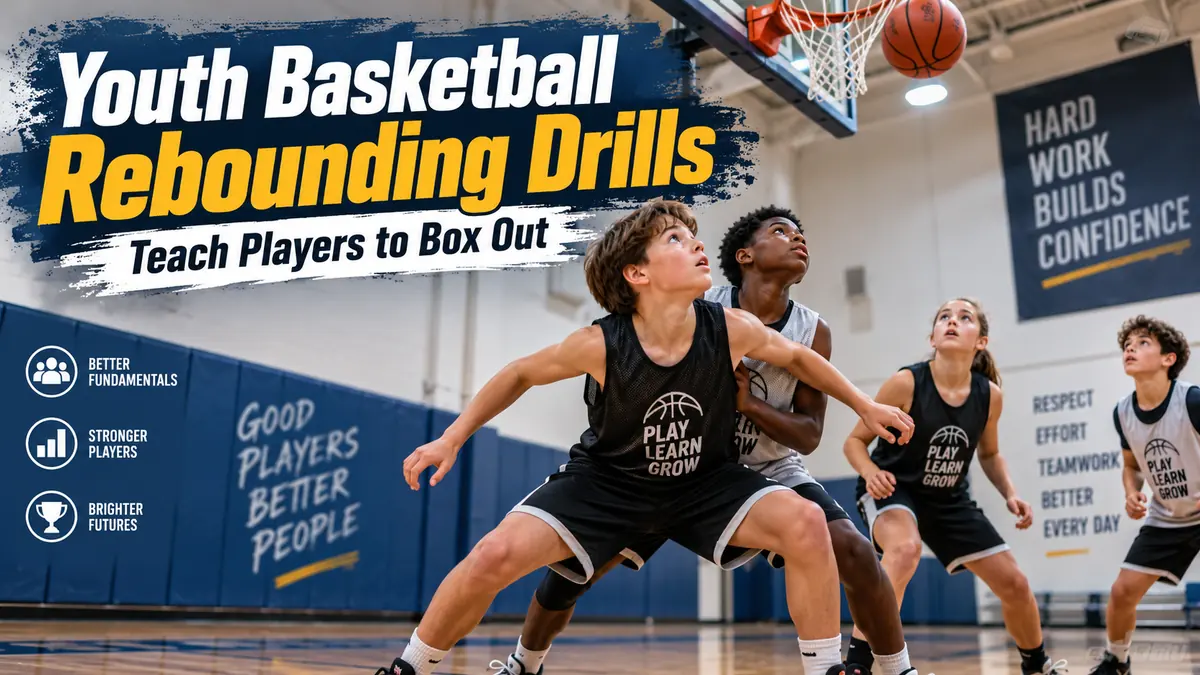
Rebounding is an essential basketball skill that helps teams gain possession, limit second-chance points, and create new scoring opportunities. For young players, learning how to box out is just as important as jumping for the basketball.
The best youth basketball rebounding drills teach players to find their opponent, establish good positioning, and secure the ball with both hands.
Here are five simple drills coaches can use to develop better rebounding habits.
Why Boxing Out Matters in Youth Basketball
Young players often watch the basketball after a shot and forget about the opponent standing beside them.
Boxing out helps players establish position between their opponent and the basket before pursuing the rebound.
Teach players this simple sequence:
Find your opponent → Make legal contact → Establish position → Go get the ball.
Players should keep their knees bent, maintain balance, and use their body position rather than pushing or holding opponents.
Drill 1: Partner Box-Out Drill
This beginner drill teaches players the basic movement without requiring a shot.
How to run it:
- Divide players into pairs.
- Position one player on offense and one on defense.
- The coach calls out, “Shot!”
- The defender finds their opponent and establishes a legal box-out position.
- The offensive player attempts to move toward the basket without excessive contact.
- Hold the position briefly, then switch roles.
Focus on balance, positioning, and keeping the opponent away from the rebounding area.
Drill 2: One-on-One Rebounding
Once players understand the basic box-out movement, introduce a real rebound.
Position two players near the basket. One plays offense while the other plays defense.
The coach shoots the basketball, and both players compete for the rebound.
The defender should first locate the offensive player, establish position, and then pursue the ball.
After securing the rebound, the player should land in a balanced stance and protect the basketball.
Rotate players after each repetition.
Drill 3: Three-on-Three Box-Out
This drill develops rebounding awareness in a small-group situation.
Place three offensive and three defensive players around the key.
The coach takes a shot from outside the lane.
Each defender must identify an offensive opponent, establish a legal box-out position, and pursue the rebound.
After securing the ball, the defensive team makes an outlet pass to the coach.
This drill teaches players that rebounding is a team responsibility, not simply the job of the tallest player.
Drill 4: Rebound and Outlet Pass
Securing a defensive rebound is only the beginning of the next possession.
In this drill, players practice collecting the basketball and making a controlled outlet pass.
How to run it:
- The coach shoots from near the free-throw line.
- A player boxes out an opponent and pursues the rebound.
- After securing the ball, the rebounder lands with good balance.
- The player pivots away from defensive pressure.
- The rebounder passes to a teammate positioned near the sideline.
Encourage players to keep the basketball protected and look for a clear passing option.
Drill 5: Rebounding Competition
This drill brings energy to the end of practice.
Divide players into two small teams.
The coach shoots, and both teams compete for the rebound.
Award one point for securing a defensive rebound and completing an outlet pass. Award one point for an offensive rebound followed by a controlled putback.
Play several short rounds, rotating players so everyone gets multiple opportunities.
Emphasize proper positioning and safe, legal contact rather than simply rewarding the strongest jumper.
Common Rebounding Mistakes
Young players often make a few predictable mistakes when learning to rebound.
Watching the ball: Players should locate their opponent when a shot goes up before pursuing the rebound.
Standing upright: Encourage a balanced athletic stance with bent knees.
Pushing opponents: Teach players to establish legal position without extending their arms to shove or hold.
Waiting for the ball: Players should actively pursue the rebound after boxing out.
Bringing the ball down: After securing a rebound, players should protect the basketball from nearby defenders.
A Simple 10-Minute Rebounding Routine
Coaches can incorporate rebounding practice into a regular training session.
| Time | Activity |
|---|---|
| 0–2 minutes | Partner box-out drill |
| 2–4 minutes | One-on-one rebounding |
| 4–6 minutes | Three-on-three box-out |
| 6–8 minutes | Rebound and outlet pass |
| 8–10 minutes | Rebounding competition |
Adjust the difficulty according to the players’ age, confidence, and experience.
Final Thoughts
Good rebounding begins with positioning, awareness, and effort.
These five youth basketball rebounding drills help beginners understand how to box out, secure possession, and transition from defense to offense.
With consistent practice, young players can develop better rebounding habits and become more confident competing for the basketball during games.
