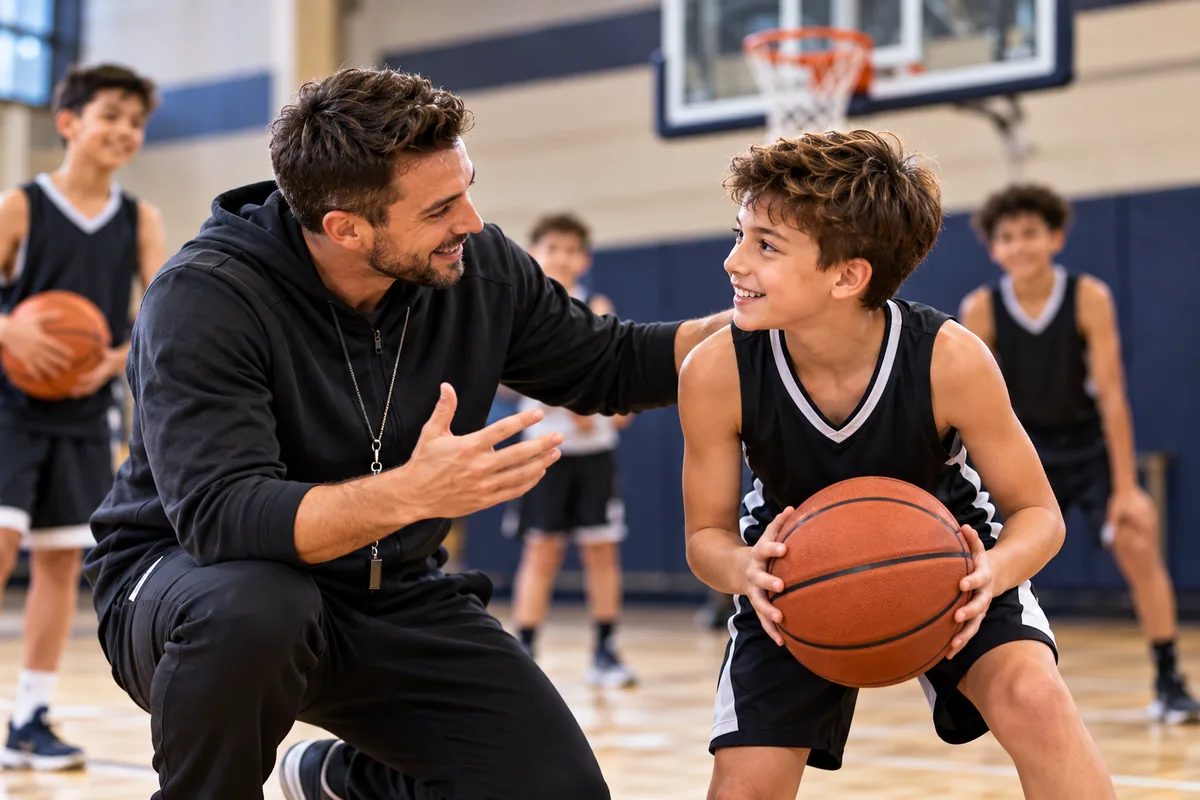
Confidence can change the way a young basketball player approaches the game.
A confident player is more willing to dribble against pressure, attempt a shot, make a pass, defend aggressively, and recover after making a mistake.
A player who lacks confidence may hesitate even when they already have the physical skill to make the correct play.
For youth coaches, this creates an important responsibility.
Developing players is not only about improving shooting, passing, dribbling, and defense. Coaches also need to create an environment where athletes feel comfortable learning, making decisions, and trying again after something goes wrong.
The good news is that confidence does not require motivational speeches before every practice.
It is usually built through small successes, clear expectations, useful feedback, and repeated opportunities to make decisions.
Here are ten practical ways coaches can help build confidence in young basketball players.
Why Confidence Matters in Youth Basketball
One of the most effective ways to build confidence in young basketball players is to give them repeated opportunities to make decisions and learn from the results.
Basketball requires constant decisions.
A player may have only a second to decide whether to:
- Shoot
- Pass
- Dribble
- Cut
- Help defensively
- Attack the basket
- Rebound
- Move into open space
Players who constantly worry about making mistakes can become hesitant.
Instead of reacting naturally, they begin looking toward the coach after every possession.
The goal should not be to create players who believe they will never fail.
Young players need to understand something more useful:
Mistakes are part of learning, and the next possession is another opportunity to improve.
Confidence grows when players begin trusting the skills and decisions they have practiced.
1. Give Players Achievable Challenges
Progressive challenges help build confidence in young basketball players because they can see clear evidence of their own improvement.
Confidence usually develops through successful experiences.
That does not mean every drill should be easy.
Instead, the challenge should be appropriate for the player’s current ability.
For example, a beginner who struggles to shoot from close range does not need to spend practice attempting three-pointers.
Start closer to the basket.
Let the player develop balance, control, and a repeatable motion.
Once those skills improve, gradually increase the challenge.
The same principle applies to dribbling, passing, defense, and decision-making.
A useful progression is:
Learn it → Repeat it → Add pressure → Use it in a game
Players build confidence when they can recognize their own improvement.
2. Praise Specific Actions Instead of Giving General Praise
Telling a player “good job” can be encouraging, but specific feedback is usually more useful.
Instead of saying:
“Great job.”
Try:
“Great job keeping your head up while dribbling.”
Or:
“Good decision. You saw the help defender and made the pass.”
Specific feedback tells players exactly what they did well.
That makes the positive action easier to repeat.
It also shifts attention away from whether the possession ended with a basket.
A player can make an excellent decision and still miss the shot.
Coaches should recognize both the decision and the result separately.
3. Avoid Correcting Everything at Once
Young players make many mistakes during practice.
Their footwork may be wrong.
Their hands may be in the wrong position.
Their spacing may be poor.
They may forget to communicate.
Trying to correct every mistake immediately can overwhelm the player.
Choose the most important correction.
Give one clear instruction.
Then let the athlete try again.
For example, when teaching shooting, you might focus first on balance rather than simultaneously discussing the feet, elbow, guide hand, release, arc, and follow-through.
Players can work on those details gradually.
For a more detailed progression, coaches can use the site’s guide on <a href=”/how-to-teach-shooting-form-to-young-basketball-players/”>teaching shooting form to young basketball players</a>.
Simple instruction creates a better learning environment than constant correction.
4. Reward Good Decisions, Not Only Made Baskets
Young players often judge themselves almost entirely by whether they score.
Coaches can change that.
During practice, recognize actions such as:
- Making the extra pass
- Cutting into open space
- Taking a good shot
- Helping a teammate defensively
- Boxing out
- Communicating
- Using the weaker hand
- Making the correct read
- Sprinting back on defense
A player who attacks the basket correctly but misses the layup may still have made a good basketball decision.
If coaches only praise successful shots, players may become afraid to attempt difficult but appropriate actions.
Confidence improves when athletes understand that basketball includes many ways to contribute.
5. Let Players Make Decisions
Giving athletes responsibility during small-sided games is another practical way to build confidence in young basketball players.
Confidence cannot develop if players are constantly waiting for instructions.
Youth coaches sometimes control every possession from the sideline.
They tell players:
“Pass!”
“Drive!”
“Shoot!”
“Go left!”
“Move there!”
The player may complete the action, but they did not necessarily make the decision.
Instead, give young athletes opportunities to solve basketball problems themselves.
Small-sided games are especially useful.
Playing 2-on-2 or 3-on-3 gives each athlete more touches and more decisions than many traditional five-on-five situations.
The site’s guide to <a href=”/how-to-use-3on3-drills-to-boost-spacing-for-youth-teams/”>3-on-3 basketball drills for youth teams</a> can help coaches create those situations during practice.
Coaches can still provide feedback between possessions.
But during live play, allow players to see, think, and react.
Every independent decision helps develop basketball confidence.
6. Make Mistakes Safe During Practice
Players need to understand that practice is where learning happens.
If every turnover leads to frustration from the coach, players may begin choosing the safest possible option.
A player might stop attempting a weak-hand dribble.
Another may refuse to make a difficult pass.
Someone else may stop shooting completely.
This reduces development.
Coaches should separate careless effort from productive mistakes.
A player who ignores instructions repeatedly may need correction.
But a player who tries a newly learned move and loses the basketball has experienced part of the learning process.
A useful response is:
“Good idea. Try it again, but keep the ball closer to your body.”
That message corrects the skill without discouraging the attempt.
7. Give Every Player a Meaningful Role
Confidence grows when players believe they can help the team.
Not every young athlete will be the leading scorer.
That should not mean the remaining players feel unimportant.
Help players understand different ways they can contribute.
One player may become a strong rebounder.
Another may defend well.
Another may communicate consistently.
Someone else may be an excellent passer.
As players develop, their roles can change.
The objective is not to permanently label children as “the defender” or “the rebounder.”
Instead, show them that basketball success includes more than scoring.
When players understand how they can contribute today, they often become more willing to develop additional skills tomorrow.
8. Use Progressions Instead of Throwing Players Into Difficult Situations
A player who has just learned a new skill may not be ready to perform it immediately against full defensive pressure.
Build confidence through progressive difficulty.
For example, a passing progression might look like:
- Partner passing without defense
- Passing while moving
- Passing against a passive defender
- Passing in a 2-on-1 situation
- Passing during 3-on-3
- Using the skill during normal play
The same structure can be used for many basketball skills.
Each stage increases the difficulty while keeping the skill recognizable.
Players experience improvement rather than feeling as though every new skill immediately becomes a test.
9. Keep Players Active During Practice
It is difficult to improve confidence without enough repetitions.
Long lines reduce opportunities to learn.
If twelve players stand in one line and only one player performs the drill, most of the team spends practice watching instead of developing.
Whenever possible:
- Create smaller groups
- Use multiple baskets
- Use partner activities
- Build stations
- Give more players basketballs
- Use 2-on-2 and 3-on-3 games
- Keep instructions short
A structured session also helps coaches balance repetition with live basketball.
The <a href=”/how-to-run-youth-basketball-practice/”>60-minute youth basketball practice plan</a> provides a useful framework for organizing skill work, team concepts, and competition.
More meaningful repetitions give players more chances to succeed.
Those successes gradually build confidence.
10. Help Players Respond to Mistakes
Mistakes are unavoidable.
Players will miss shots.
They will turn the ball over.
They will get beaten defensively.
They will forget an assignment.
Confidence is not the absence of mistakes.
It is the ability to continue playing after them.
Teach players a simple reset routine.
For example:
Recognize it. Learn from it. Get ready for the next play.
During a game, the reset may need to happen in two seconds.
A player who turns the ball over cannot spend the next possession thinking about the turnover.
They need to transition back on defense.
Coaches can reinforce this habit by avoiding long emotional reactions from the sideline.
Correct what needs to be corrected, then help the player move forward.
Use Practice Language That Builds Independence
The words coaches use can affect how players approach challenges.
Instead of constantly giving answers, ask questions.
For example:
“What did you see?”
“Where was the open space?”
“What could you try next time?”
“What happened when the defender helped?”
“Which teammate became open?”
These questions encourage players to think about basketball rather than simply waiting for instructions.
Over time, young athletes begin solving more problems independently.
That is an important form of confidence.
Avoid Comparing Players
Young athletes develop at different speeds.
One player may improve quickly because they have played for several years.
Another may be touching a basketball for the first time.
Comparing them directly can create unnecessary pressure.
Instead, encourage players to measure progress against their previous ability.
Can they dribble better than last month?
Can they use both hands?
Are they making quicker decisions?
Are they communicating more?
Can they maintain better spacing?
Are they more comfortable defending?
Personal progress gives players something they can control.
Confidence Does Not Mean Removing Competition
Youth basketball should still include competition.
Players can compete in shooting games, defensive challenges, small-sided games, and scrimmages.
The important part is how competition is used.
Competition should encourage effort and decision-making rather than create fear of failure.
Avoid activities where one early mistake leaves a child standing on the sideline for several minutes.
Instead, design competitions where players quickly return to the action.
Short rounds work well.
Players compete, receive feedback, and get another opportunity.
Adjust Confidence Building by Age
Coaches who want to build confidence in young basketball players should also adjust their teaching style to the age and experience level of the team.
Ages 6–8
Keep coaching extremely simple.
Focus on:
- Participation
- Basic movement
- Ball control
- Fun
- Effort
- Trying new skills
Praise courage and participation.
Young players should leave practice excited to return.
Ages 9–11
Players can begin handling more specific feedback.
Encourage:
- Better decisions
- Using both hands
- Passing and moving
- Defensive effort
- Communication
- Small-sided competition
Give players opportunities to recognize their own improvement.
Ages 12–14
Older youth players can begin taking greater responsibility for their development.
Coaches can discuss:
- Decision-making
- Shot selection
- Practice habits
- Leadership
- Communication
- Individual strengths
- Areas for improvement
Feedback can become more detailed, but it should remain focused on actions the player can control.
Common Coaching Mistakes That Can Reduce Confidence
Only Talking to Players After Mistakes
If a player hears the coach only when something goes wrong, they may begin associating coaching with failure.
Recognize good habits as well.
Removing Players Immediately After an Error
Sometimes substitutions are necessary.
However, consistently removing a young player immediately after every mistake can make them afraid to take risks.
Giving Too Many Instructions
More information is not always better.
One clear coaching cue is often enough.
Measuring Everyone by Scoring
Basketball includes passing, defense, rebounding, spacing, communication, screening, cutting, and decision-making.
Recognize the complete game.
Expecting Immediate Improvement
Development is rarely perfectly linear.
A player may understand something during one practice and struggle with it again several days later.
Continue teaching.
Frequently Asked Questions
How do you help a child who is afraid to shoot?
Start by giving the player comfortable shooting opportunities close to the basket. Focus on balance and technique rather than makes and misses. Gradually introduce more game-like situations as confidence improves.
Should coaches praise players after every play?
No. Feedback should remain meaningful. Specific praise for effort, good decisions, improved technique, communication, or teamwork is usually more useful than automatic praise after every action.
How do you help a player recover after a bad game?
Focus on a few specific learning points rather than reviewing every mistake. Identify what the player did well, choose one or two areas to improve, and return attention to the next practice.
Can competition improve confidence?
Yes, when the challenge is appropriate and players receive repeated opportunities. Short competitions can help athletes become comfortable performing skills under pressure.
What if a player is more confident in practice than in games?
Gradually make practice more game-like. Add defenders, time limits, scoring, small-sided games, and decision-making so the player becomes familiar with performing under pressure.
Final Thoughts
Learning how to build confidence in young basketball players takes time, consistency, and patience.
Building confidence in young basketball players takes time.
There is no single drill or motivational phrase that creates confidence immediately.
Coaches can help by creating an environment where players receive appropriate challenges, useful feedback, plenty of repetitions, and opportunities to make decisions.
Teach skills progressively.
Recognize good decisions.
Allow productive mistakes.
Give every player a meaningful way to contribute.
And help athletes focus on improvement rather than perfection.
When young players become comfortable trying, learning, adjusting, and trying again, their basketball skills can develop with greater freedom.
That is the type of confidence youth coaches should work to build.
