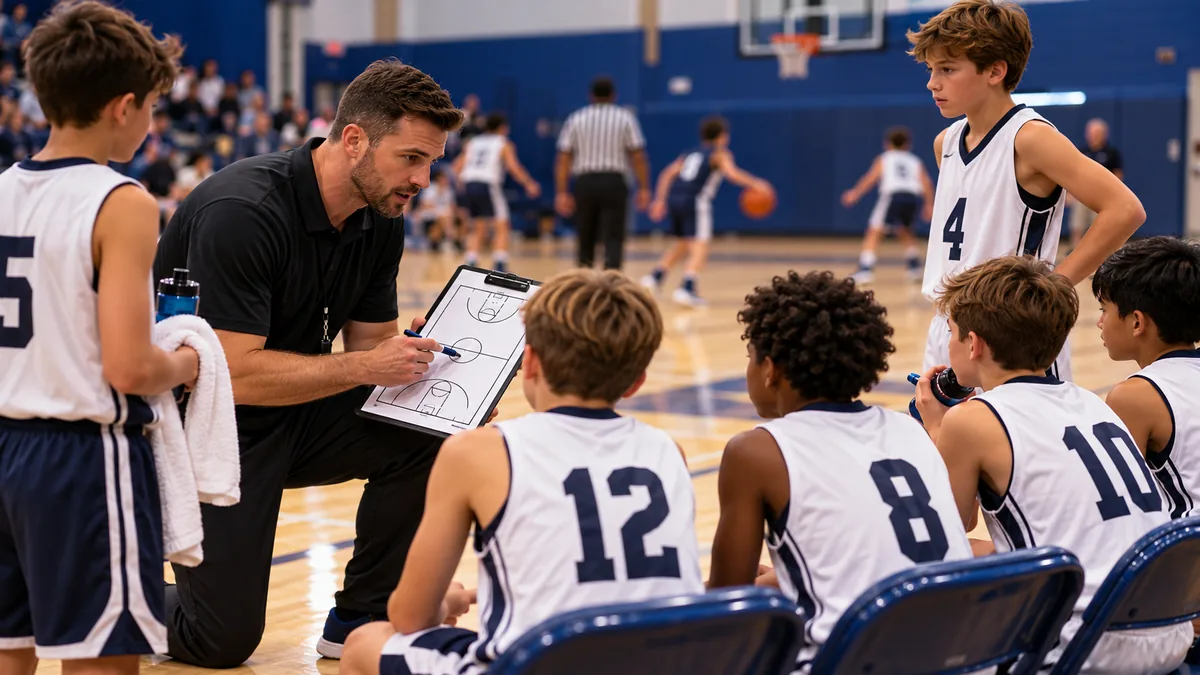
Managing a youth basketball rotation can be more difficult than drawing up a play.
A coach may have eight, nine, ten, or twelve players available. Some are experienced. Others are still learning basic positioning. One player may be in foul trouble. Another may arrive late. A game may be close, while the next one may be decided early.
At the same time, youth basketball should give players meaningful opportunities to participate, learn, and contribute.
That is why a good rotation should not be improvised possession by possession.
The best approach is to create a simple structure before the game, understand the rules of your league, and leave enough flexibility to respond when the game changes.
This guide explains how youth coaches can organize playing time without turning every substitution into a stressful decision.
Start With Your League Rules
Before creating any rotation, check the competition rules.
Some youth leagues require equal playing time.
Others use minimum participation rules.
Some give coaches more freedom as players get older.
USA Basketball’s youth guidelines recommend equal playing time for ages 7–8. For ages 9–11, the guidelines recommend equal playing time during periods one through three, with coach discretion in the fourth period and overtime. USA Basketball also encourages equal and fair playing time throughout youth competition. USA Basketball
That does not mean every league uses exactly the same system.
Your first question should always be:
What does this league require?
A rotation plan should satisfy those rules before considering strategy.
What Does a Good Youth Basketball Rotation Accomplish?
A useful rotation does more than divide minutes.
It should help the team:
- Keep players involved
- Avoid leaving one child on the bench for a long stretch
- Maintain reasonable lineup balance
- Give developing players meaningful game experience
- Manage fatigue
- Handle foul trouble
- Keep substitutions organized
- Reduce unnecessary sideline confusion
The rotation should also make coaching easier.
If you already know approximately when players will enter and leave, you can spend more time watching the game instead of constantly calculating minutes.
Decide Your Playing-Time Philosophy Before Game Day
Do not wait until the opening tip to decide how playing time will work.
Before the season or competition begins, determine what type of team you are coaching.
Recreational and Beginner Teams
For younger or recreational teams, development and participation usually deserve strong emphasis.
Players need game experience to learn.
A child cannot improve decision-making, defense, spacing, passing, and confidence while sitting for most of the game.
A relatively balanced rotation also helps coaches evaluate players more accurately.
Practice tells you a lot.
Games reveal different things.
Competitive Youth Teams
More competitive teams may allow greater variation in playing time.
Even then, coaches should have a clear philosophy.
Players and families should not have to guess whether attendance, effort, skill development, team role, game situation, or another factor affects minutes.
Clarity prevents many problems later.
Build the Rotation Before the Game
Do not create your entire youth basketball rotation from memory while the game is happening.
Use a simple chart.
Write down:
- Player names
- Available periods or shifts
- Starting lineup
- Planned substitutions
- Any participation requirements
For younger teams, planning by period can be easier than tracking exact minutes.
For example, if the game has four quarters, decide which players are expected to participate in each quarter before the game begins.
You can still make adjustments.
The chart simply gives you a starting structure.
Rotation Example for an 8-Player Team
With eight players, substitutions are fairly simple because only three players are on the bench at one time.
One possible approach is to use short groups rather than replacing one player every minute.
For example:
Opening group: Players A, B, C, D, E
After several minutes:
Second group: Players A, B, F, G, H
Later:
Third group: Players C, D, E, F, G
This is only an example.
The important principle is that players should not repeatedly sit for extremely long stretches while others remain on the court almost the entire game.
A coach can rotate combinations while keeping one or two experienced players on the floor to provide structure.
Rotation Example for a 10-Player Team
Ten players create an easy option: two groups of five.
That can be useful for very young or recreational teams.
Group 1 plays one segment.
Group 2 plays the next.
Then the coach can mix the groups later.
However, completely separate five-player units are not always ideal.
One group may be much stronger than the other.
A better long-term approach may be to mix players so each lineup contains:
- A confident ball handler
- At least one capable passer
- Players willing to defend
- Reasonable size or rebounding
- Players at different development levels
The goal is not to build one “good group” and one “weak group.”
Try to create lineups where everyone has a chance to function.
Rotation Example for a 12-Player Team
Twelve players require more planning.
If substitutions are random, some players can easily disappear from the game for long periods.
Use a written chart.
One useful method is to divide the roster into three groups of four.
Then combine two groups at different points rather than thinking about twelve individuals separately.
For example:
Group A: Players 1–4
Group B: Players 5–8
Group C: Players 9–12
The coach can rotate combinations while tracking who has already played.
This reduces mental workload during the game.
For a larger roster, an assistant coach can also track participation while the head coach watches the game.
Avoid Substituting Too Frequently
Constant substitutions can destroy rhythm.
A player enters.
Thirty seconds later, another player replaces them.
Then two more players enter.
Soon nobody knows who is guarding whom.
Instead, allow players enough time to actually experience the game.
Young athletes need several possessions to settle in.
Short but meaningful stretches are often more useful than repeated one-minute appearances.
When possible, substitute in small groups during natural stoppages.
Do Not Leave Developing Players With No Support
One common rotation mistake is putting several inexperienced players on the floor together simply because they all need minutes.
The result can become chaotic.
Instead, spread experience across lineups.
A developing player often learns more when playing beside teammates who understand spacing, defensive positioning, and passing.
This makes the game more manageable.
The same idea applies during practice. A structured session should combine skill development with realistic decision-making instead of separating everything into isolated drills. Our 60-minute youth basketball practice plan follows the same principle. How to Coach Youth Basketball
Keep At Least One Ball Handler on the Floor
Youth lineups can fall apart quickly when nobody is comfortable bringing the ball up the court.
Before the game, identify several players who can handle basic pressure.
You do not need one permanent point guard.
In fact, young players often benefit from learning multiple positions.
But each lineup should ideally include someone who can:
- Receive an inbound pass
- Dribble with control
- Look up
- Make a simple pass
- Help organize teammates
This prevents the rotation itself from creating unnecessary turnovers.
Think About Lineup Balance, Not Just Minutes
Fair playing time does not require identical lineups.
You still need to consider how the five players fit together.
Ask:
Does this group have someone who can handle the ball?
Can this group rebound?
Are there enough players willing to defend?
Can they create reasonable offensive spacing?
Do several players occupy the same role?
The goal is to give players opportunities in an environment where they can actually succeed.
If spacing is a recurring problem, review how to teach spacing in youth basketball during practice rather than trying to solve everything with substitutions during games. How to Coach Youth Basketball
Use Game Segments Instead of Constant Minute Counting
Some coaches become distracted trying to track every second.
A simpler system is to divide the game into segments.
For example:
Segment 1: Start of first quarter
Segment 2: Middle of first quarter
Segment 3: Start of second quarter
Segment 4: Middle of second quarter
Continue the pattern after halftime.
Before the game, assign players to segments.
This gives you structure without forcing you to stare at the clock every possession.
What If a Player Gets Into Foul Trouble?
A rotation plan should be flexible.
If a player picks up several early fouls, you may need to change the schedule.
Do not panic.
Move another player into the planned segment and note the change.
Later, look for an opportunity to restore some of the missed playing time if appropriate.
The rotation is a guide.
It is not a rule that prevents common-sense adjustments.
What If a Player Arrives Late?
Decide your policy before the season.
Do not invent a punishment in the middle of the game.
For younger recreational teams, you may simply place the player into the next reasonable rotation.
For competitive teams, attendance and punctuality may affect roles depending on team expectations.
Whatever your policy is, apply it consistently.
What If a Player Is Having a Bad Game?
Young players will make mistakes.
A turnover should not automatically trigger a substitution.
Neither should a missed shot.
If players believe every mistake sends them to the bench, they may become afraid to make decisions.
Substitute when it makes sense for the rotation, fatigue, safety, team structure, or a specific teaching reason.
Do not use the bench as an immediate response to every error.
Games are part of development.
Players need opportunities to recover from mistakes while still playing.
Do Not Coach Playing Time Only by Scoring
Scoring is easy to notice.
Other contributions are just as important.
A player may:
- Box out consistently
- Defend the best opposing player
- Make good passes
- Communicate
- Set up teammates
- Protect the ball
- Create spacing
- Sprint back on defense
If playing time becomes entirely connected to points scored, young players may begin forcing shots.
Evaluate the whole game.
Use Small-Sided Games to Prepare Players for Bigger Roles
Sometimes a coach hesitates to give a player more game time because the athlete struggles to make decisions in five-on-five situations.
Practice can help.
Three-on-three creates more touches and fewer players to process at once.
It allows young athletes to work on spacing, passing, cutting, defending, and decision-making in a simpler environment. Our guide to 3-on-3 basketball drills for youth teams explains how to structure these situations. How to Coach Youth Basketball
Improved practice decisions often make game rotations easier because more players become capable of filling different roles.
What Should Happen in a Close Game?
This depends heavily on:
- Player age
- League rules
- Team level
- Your stated playing-time philosophy
For very young teams, development and participation should remain central.
USA Basketball’s guidelines specifically recommend equal playing time for ages 7–8 and equal playing time through the first three periods for ages 9–11 before allowing more discretion later. USA Basketball
For older competitive teams, coaches may have more flexibility.
The important point is consistency.
Do not tell families that everyone will receive the same opportunity and then completely abandon that philosophy whenever the score is close.
Set expectations before competition begins.
Avoid the “Best Five Play Everything” Trap
Winning can become emotionally important for coaches.
But playing the same five players for nearly the entire game creates several problems.
The bench receives little development.
Starters become fatigued.
Less experienced players become even less prepared for future games.
The team also becomes overly dependent on a few athletes.
Youth development works better when more players gradually become capable of contributing.
That does not mean every player must always have exactly the same role.
It means coaches should think beyond one game.
Communicate Roles Without Labeling Children
Avoid permanent labels such as:
“You are only a defender.”
“You are our bench player.”
“You are not a scorer.”
Young athletes change quickly.
A player who struggles today may develop significantly over several months.
Instead, describe current responsibilities.
For example:
“Today I want you to focus on defense and rebounding.”
That provides direction without defining the player’s future.
Keep a Simple Playing-Time Record
After the game, make a quick note.
You do not need advanced software.
Record:
- Who started
- Approximate playing segments
- Unusual substitutions
- Injuries or foul trouble
- Players who received less time than planned
This is especially useful with larger rosters.
Without a record, coaches can unintentionally give the same players fewer opportunities every week.
A basic written log helps you recognize patterns.
Do Not Promise Exact Minutes You Cannot Guarantee
There is a difference between having a playing-time philosophy and promising an exact number.
Basketball games are unpredictable.
Players may get injured.
Someone may foul out.
A player may arrive late.
League rules may create unusual situations.
Instead of promising:
“Everyone will play exactly 16 minutes.”
It is often better to explain the principle:
“We plan for balanced participation, subject to league rules and normal game situations.”
That leaves enough flexibility to coach responsibly.
A Simple Pre-Game Rotation Checklist
Before warm-ups finish, confirm:
- How many players are available?
- Does anyone have an injury limitation?
- Are there league participation requirements?
- Who is starting?
- Which players can handle the ball?
- Are the planned lineups balanced?
- Is anyone scheduled to sit too long?
- Who will track substitutions?
- Are there players who need a specific developmental opportunity?
This takes only a few minutes once the system becomes familiar.
A Simple In-Game Substitution Checklist
Before sending players to the scorer’s table, ask:
Who has already been sitting?
Does the new lineup have a ball handler?
Is the lineup reasonably balanced?
Is someone exhausted?
Is someone in foul trouble?
Am I changing the plan for a good reason?
These questions prevent many random substitutions.
Common Youth Basketball Rotation Mistakes
Making the Plan During the Game
The coach becomes distracted and playing time becomes uneven.
Prepare beforehand.
Substituting After Every Mistake
Players become nervous and stop taking reasonable risks.
Forgetting Players on the Bench
This happens more often than coaches expect, especially with larger rosters.
Use a chart.
Playing One Group for Too Long
Fatigue increases and other players lose opportunities.
Creating Extremely Unbalanced Lineups
Try to distribute experience and ball handling across groups.
Ignoring League Rules
Playing-time regulations vary.
Know them before tipoff.
Treating Every Game Like a Championship
Youth development occurs over a season, not one final score.
Frequently Asked Questions
Should youth basketball players receive equal playing time?
It depends on age, league rules, and team level. USA Basketball recommends equal playing time for ages 7–8 and equal time through periods one to three for ages 9–11, with greater coach discretion later. USA Basketball
How often should coaches substitute?
There is no single correct interval. Players should receive meaningful stretches rather than entering and leaving constantly. Period-based or segment-based rotations can make substitutions easier to organize.
Should the best players always finish a close game?
That depends on the age group, league rules, and the playing-time expectations established for the team. Coaches should make those expectations clear before the season rather than changing philosophy unexpectedly during close games.
How do you manage playing time with 12 players?
Plan the rotation before the game, track segments, and consider grouping the roster into smaller units. An assistant coach can help record substitutions.
Should a player be benched immediately after making a mistake?
Usually not simply because of one mistake. Youth games are learning environments. Players need opportunities to recover and make the next decision.
Can playing time be used to teach responsibility?
Team expectations such as attendance and effort can be part of a coaching philosophy, especially with older players, but expectations should be explained clearly and applied consistently.
Final Thoughts
A good youth basketball rotation should create structure without becoming rigid.
Plan before the game.
Know your league rules.
Track participation.
Balance lineups.
Avoid punishing every mistake with an immediate substitution.
Give players meaningful stretches on the court.
And remember that game experience is part of player development.
The goal is not simply to distribute minutes.
The goal is to create a game environment where young athletes can participate, learn, contribute, and gradually become more capable basketball players.
When the rotation is organized before tipoff, coaches can spend less time worrying about the bench and more time actually coaching the game.
