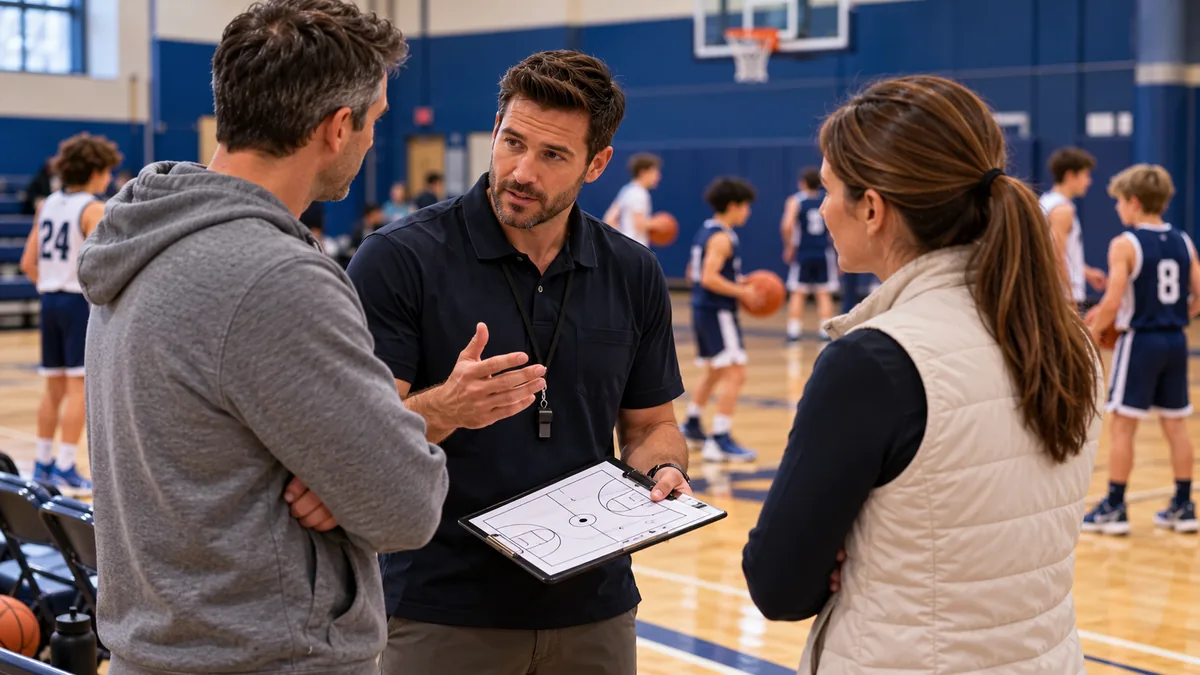
Good parent communication in youth basketball can make an entire season easier.
Poor communication can do the opposite.
A coach may have an organized practice plan, understand basketball fundamentals, and care deeply about player development, but misunderstandings with parents can still create unnecessary tension around playing time, positions, mistakes, tournament schedules, and game-day decisions.
Most problems do not begin because coaches or parents want a bad experience for the player.
They often begin because expectations were never clearly discussed.
For youth coaches, communication with families is therefore part of coaching.
You do not need to become everyone’s best friend.
You do need a simple system for explaining expectations, sharing important information, listening to concerns, and keeping conversations focused on the development of the player.
This guide provides a practical framework coaches can use throughout the season.
Why Parent Communication Matters
Parents see the game from a different perspective than coaches.
A coach may be thinking about:
- Team balance
- Player development
- Defensive assignments
- Practice attendance
- Playing-time requirements
- Fatigue
- Matchups
- Long-term improvement
A parent may naturally be focused primarily on their own child.
Neither perspective is automatically wrong.
The problem appears when both sides assume the other person understands what they are thinking.
Clear communication reduces those assumptions.
Positive Coaching Alliance recommends that coaches establish expectations early, explain policies such as playing time and communication, and build relationships before problems develop. Positive Coaching Alliance
That is a useful starting principle:
Communicate before there is a problem, not only after one appears.
Start the Season With a Parent Meeting
One of the easiest ways to prevent confusion is to hold a short parent meeting before the season begins.
It does not need to last an hour.
Fifteen or twenty focused minutes can cover most important topics.
Explain:
- Your coaching philosophy
- The team’s developmental goals
- Practice attendance expectations
- Game-day arrival times
- Playing-time philosophy
- How positions will be handled
- How parents should contact you
- When basketball concerns should be discussed
- Appropriate sideline behavior
- What you expect from players
Jr. NBA also provides beginning-of-season parent resources specifically designed to reduce future misunderstandings between coaches and families. NBA.com: Jr. NBA
The purpose of the meeting is not to create a long list of rules.
It is to make expectations visible.
Explain What Success Means
Parents often judge a season partly by wins and losses.
Coaches should give them a broader picture.
For a developing youth team, success might include players becoming better at:
- Passing
- Ball handling
- Shooting technique
- Defensive positioning
- Spacing
- Communication
- Decision-making
- Confidence
- Teamwork
Explain this early.
If families understand that development is one of the main objectives, they are less likely to judge every game only by the scoreboard.
This aligns with the overall philosophy behind building confidence in young basketball players: progress often comes from repeated learning opportunities rather than perfect results.
Be Clear About Playing Time
Playing time is one of the most common sources of tension in youth sports.
Do not leave your philosophy unclear.
Tell families whether your team uses:
- Equal playing time
- Minimum participation
- Rotation-based playing time
- Coach discretion
- Different rules for recreational and competitive games
Also explain what factors may affect minutes.
Depending on the team, those might include:
- League rules
- Attendance
- Injury
- Fatigue
- Foul trouble
- Player safety
- Game format
Do not invent your playing-time philosophy halfway through the season.
If families know the structure in advance, game-day decisions are easier to understand.
For coaches who need a system, the site’s youth basketball rotation guide provides a practical way to organize substitutions without improvising every decision.
Do Not Promise What You Cannot Guarantee
Avoid promises such as:
“Your child will always play point guard.”
Or:
“Everyone will play exactly the same number of minutes every game.”
Basketball is unpredictable.
A player may be injured.
Someone may miss practice.
League rules may change between competitions.
A player may need experience at several positions.
Instead, explain principles.
For example:
“We will work to give every player meaningful opportunities while following our league rules and team expectations.”
That is clearer and more realistic.
Establish One Communication Channel
Information becomes difficult to manage when one parent sends texts, another uses email, someone else contacts an assistant coach, and another waits until warm-ups.
Choose one primary communication method.
It might be:
- Team messaging app
- Group message
- League platform
Use it for normal team information such as:
- Practice schedules
- Game times
- Venue changes
- Uniform information
- Cancellations
- Tournament details
Positive Coaching Alliance specifically recommends agreeing on an appropriate communication method early in the season. Positive Coaching Alliance
This reduces the chance that important information gets lost.
Separate Logistics From Basketball Concerns
Not every message requires the same kind of conversation.
A question such as:
“What time is Saturday’s game?”
can be answered immediately.
A concern such as:
“Why did my child play less in the fourth quarter?”
deserves a different setting.
Do not try to solve emotional basketball issues through rushed sideline conversations.
Create a simple rule.
For example:
Schedule and logistics questions can be handled normally. Basketball concerns should be discussed privately at an appropriate time.
That boundary helps both sides.
Avoid Difficult Conversations Immediately After Games
Right after a game is often the worst time to discuss playing time or coaching decisions.
Players are emotional.
Parents may be emotional.
Coaches are reviewing the game mentally.
Everyone may remember events differently.
Positive Coaching Alliance suggests coaches establish communication guidelines and even gives the example of waiting before discussing competition-related concerns. Positive Coaching Alliance
A simple policy could be:
“I am happy to discuss basketball concerns, but let’s schedule that conversation rather than doing it immediately after the game.”
This is not avoiding the parent.
It is creating a better environment for the conversation.
Listen Before Explaining
When a parent raises a concern, coaches often begin preparing a defense before the person has finished speaking.
Instead, listen.
You may discover that the actual concern is different from what you expected.
A parent might begin by mentioning playing time but really be worried that their child has lost confidence.
Another may believe their child does not understand their role.
Start with:
“Tell me what you’re seeing.”
Then listen.
Once you understand the concern, respond to the actual issue.
Keep the Player at the Center of the Conversation
A useful question during difficult conversations is:
What will help this player develop?
That keeps the discussion productive.
For example, if a parent asks:
“Why isn’t my child starting?”
Avoid turning the conversation into a ranking of players.
Instead, explain what the athlete is currently working on.
You might say:
“Right now we’re helping them improve ball security and defensive positioning. Those are two areas that can help them earn more responsibility.”
That gives the family something constructive.
Talk About Actions, Not Labels
Avoid describing young players with permanent labels.
Do not say:
“He’s not a point guard.”
Try:
“Right now he’s still developing the ball handling and decision-making needed to handle pressure consistently.”
Do not say:
“She’s a weak defender.”
Try:
“We’re working on staying balanced and recognizing help position earlier.”
Young players change quickly.
Language should leave room for development.
Do Not Compare Children
A parent may ask:
“Why does another player get more minutes than my child?”
Avoid criticizing or evaluating the other child.
Keep the discussion focused on the player’s own development.
You can say:
“I can’t discuss another player’s situation, but I can explain what we’re working on with your child.”
This protects player privacy and keeps the conversation productive.
Give Parents Specific Ways to Help
Parents often want to support development but may not know what is useful.
Give simple suggestions.
Instead of:
“They need to practice more.”
Try:
“Ten minutes of controlled weak-hand dribbling a few times this week would help.”
Or:
“They can practice finishing close to the basket rather than taking long shots.”
Small, specific tasks are easier to follow.
However, avoid making families feel that every free hour needs to become basketball training.
Young players need recovery and time away from organized basketball too. USA Basketball’s youth guidelines emphasize appropriate rest and avoiding excessive scheduling. USA Basketball
Encourage Parents to Support Without Coaching From the Stands
A player may hear:
Coach:
“Move the ball.”
Parent:
“Shoot!”
Assistant coach:
“Drive!”
Now the child has three instructions in one second.
That is difficult for young players.
Explain to families that encouragement from the stands is valuable, but tactical coaching should come from the team staff.
Useful parent encouragement includes:
- Great effort
- Keep going
- Nice pass
- Good defense
- Great teamwork
The goal is not silent parents.
The goal is players who can hear one clear basketball voice.
Address Sideline Behavior Early
Do not wait until someone is arguing with an official.
Before the season, explain expectations around:
- Officials
- Opposing players
- Opposing coaches
- Teammates
- Your own players
Jr. NBA’s Coach’s Code of Conduct emphasizes respect for players, parents, and officials and recommends that coaches model appropriate behavior themselves. NBA.com: Jr. NBA
If adults behave calmly, players receive a consistent message about sportsmanship.
What If a Parent Disagrees With Your Coaching?
Disagreement does not automatically mean conflict.
A parent may see something differently.
Listen.
Explain your reasoning.
If the parent makes a useful point, acknowledge it.
Coaches do not need to pretend they never make mistakes.
You can say:
“That’s fair. I’ll pay attention to that at the next practice.”
Being willing to consider feedback does not remove your authority.
It can strengthen trust.
What If the Parent Is Angry?
Keep your own communication controlled.
Do not match the parent’s volume or frustration.
Try to identify the actual concern.
A useful sequence is:
Listen → Clarify → Explain → Agree on the next step
For example:
“I understand that you’re concerned about playing time. Let me explain how the rotation worked today, then we can talk about what your child can focus on this week.”
If the conversation becomes disrespectful, you can end it.
You are allowed to set boundaries.
Say:
“I’m happy to continue this conversation when we can discuss it calmly.”
Keep Assistants on the Same Page
Parent communication becomes confusing when the head coach says one thing and the assistant says another.
Before the season, agree on:
- Playing-time philosophy
- Team rules
- Communication process
- Who handles parent concerns
- Game-day responsibilities
Assistant coaches should not privately promise a player something the head coach has not agreed to.
A consistent staff produces clearer expectations.
Communicate Changes Quickly
Sometimes plans change.
Practice is cancelled.
A gym changes.
A player role changes.
The tournament schedule moves.
Tell families as soon as reasonably possible.
Small communication failures can create larger frustration because they make families feel unprepared.
Even a short message helps:
“Tomorrow’s practice is moving from 6:00 to 6:30 because the previous gym session is running longer.”
Clear and simple.
Explain Changes in Player Roles
A child who usually starts may come off the bench.
A ball handler may spend time playing off the ball.
A taller player may practice perimeter skills.
Parents may interpret these changes as punishment if nobody explains them.
When appropriate, explain the developmental reason.
For example:
“We’re giving Jordan more opportunities away from the ball so he can improve cutting and spacing instead of depending on the dribble every possession.”
That turns confusion into development.
Protect Player Confidence
Do not have conversations about a player’s weaknesses while that child is standing beside you unless the discussion is constructive and appropriate.
Young athletes listen carefully to how adults describe them.
If a parent raises a serious concern immediately after practice, it may be better to schedule a separate conversation.
This protects the player’s confidence and gives the adults time to communicate clearly.
When Should the Player Speak for Themselves?
As players get older, they should gradually learn to communicate directly with coaches.
If a 13-year-old does not understand their role, encourage them to ask.
They might say:
“Coach, what should I work on to help the team more?”
This develops responsibility.
Parents can still support the player, but not every basketball question needs to be handled entirely by adults.
That transition should happen gradually and should fit the player’s age and maturity.
Use Timeouts and Games Consistently With What You Tell Parents
Parents notice whether your actions match your stated philosophy.
If you tell families that mistakes are part of development but immediately remove every player after a turnover, the message becomes inconsistent.
Your game-day behavior matters.
The site’s guide to youth basketball timeout communication emphasizes correcting one useful problem rather than overwhelming players after mistakes.
That same principle helps build parent trust.
Send a Short Midseason Update
Do not communicate only at the beginning and end of the season.
A short midseason message can help.
Mention:
- What the team has improved
- What the next developmental priorities are
- Upcoming schedule information
- Any reminders about team expectations
For example:
“The team has made strong progress with spacing and defensive communication. Over the next few weeks we’ll focus more on transition decisions and rebounding.”
This shows parents that there is a plan behind practices.
What Not to Discuss With Parents
Some information should remain private.
Do not discuss:
- Another player’s playing time
- Another player’s behavior
- Private family information
- Another child’s skill evaluation
- Private disciplinary conversations
Keep discussions focused on the parent’s own child.
This prevents unnecessary comparison and protects trust within the team.
A Simple Coach-Parent Communication Framework
When a concern appears, use this four-step framework:
1. Listen
Understand the question before answering.
2. Clarify
Make sure you and the parent are discussing the same issue.
3. Explain
Share your coaching reasoning clearly and specifically.
4. Next Step
Finish with something actionable.
For example:
“We’ll work on ball security during practice this week, and I’ll give Sam more chances to handle pressure in our small-sided games.”
The conversation now ends with a plan rather than an argument.
Sample Playing-Time Conversation
Parent:
“Why didn’t my child play more today?”
Coach:
“I understand why you’re asking. We were following the rotation we planned before the game, and foul trouble forced us to change two segments. I also want to help your child become more comfortable defending away from the ball. We’ll work on that this week, and I’ll keep tracking their opportunities.”
Notice what the response does not include.
It does not criticize another player.
It does not become defensive.
It explains the decision and identifies a development goal.
Sample Position Conversation
Parent:
“Why isn’t my child playing point guard?”
Coach:
“We’re developing several players as ball handlers rather than assigning one permanent point guard. Your child is improving, and the next step is making quicker decisions against pressure. We’ll continue giving them opportunities in practice.”
Again, the answer focuses on development rather than status.
Sample Concern After a Loss
Parent:
“I don’t understand why we didn’t change the defense.”
Coach:
“I understand the question. We considered changing it, but our priority at this age is helping the players recognize and correct our basic defensive principles rather than switching systems every time we struggle. I’ll review the film and practice plan before our next session.”
You do not need the parent to agree with every decision.
You need to explain it professionally.
Common Parent Communication Mistakes
Only Contacting Parents When Something Is Wrong
Build relationships before difficult conversations.
Being Vague About Playing Time
Explain the philosophy early.
Discussing Other Players
Keep each conversation focused on the parent’s own child.
Arguing Immediately After Games
Choose a better time.
Sending Emotional Messages
If you are frustrated, wait before replying.
Making Promises
Explain principles instead of guaranteeing roles or minutes you cannot control.
Ignoring Concerns Completely
You do not need to agree, but you should listen.
Frequently Asked Questions
Should youth basketball coaches have a parent meeting?
Yes. A short preseason meeting can clarify coaching philosophy, schedules, playing time, communication rules, and team expectations before misunderstandings develop.
Should coaches discuss playing time with parents?
Yes, when appropriate. Explain the team’s philosophy and the player’s development without comparing them to other children.
Should parents talk to coaches immediately after games?
For simple logistics, that may be fine. More emotional basketball concerns are usually better discussed later when everyone can communicate calmly.
What should a coach do if a parent becomes angry?
Remain calm, listen to the concern, clarify the issue, and keep the conversation focused on the player. If communication becomes disrespectful, end the discussion and reschedule it.
Should parents coach from the stands?
Support and encouragement are helpful, but tactical instructions from several adults can confuse young players. Teams benefit when basketball instructions come primarily from the coaching staff.
How often should coaches communicate with families?
There is no fixed schedule, but families should receive important logistical information promptly and occasional updates about team goals and development throughout the season.
Final Thoughts
Effective parent communication in youth basketball is not about avoiding every disagreement.
That is unrealistic.
It is about creating enough clarity and trust that disagreements can be handled productively.
Set expectations early.
Explain your coaching philosophy.
Be clear about playing time.
Listen before responding.
Keep discussions centered on the player’s development.
Do not compare children.
Choose appropriate times for difficult conversations.
And make sure your actions during practices and games match the values you communicate to families.
Coaches, players, and parents do not need to agree on every basketball decision.
They do need to understand that they are working toward the same larger goal:
Helping young athletes learn, contribute, improve, and enjoy playing basketball.
