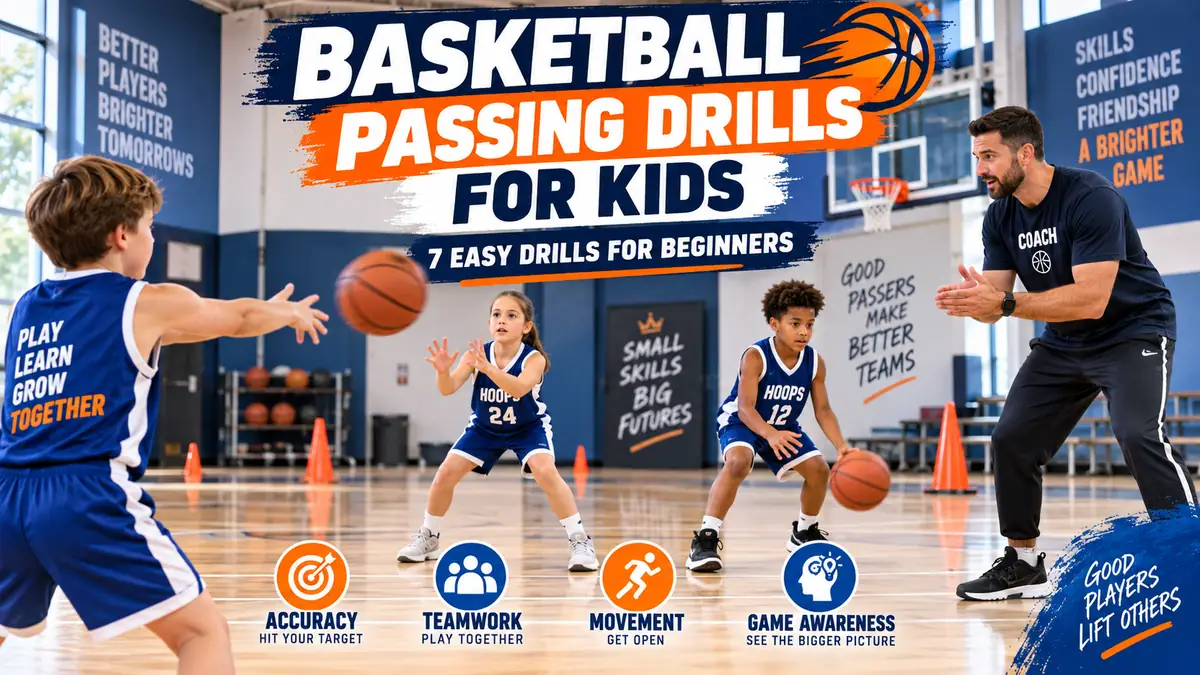
Passing is one of the first team skills young basketball players should learn. A player may be able to dribble or shoot well, but basketball becomes much easier when teammates know how to move the ball quickly and accurately.
Good passing also teaches young athletes to look away from the basketball, recognize open teammates, understand spacing, and make decisions before pressure arrives.
These basketball passing drills for kids are designed for beginners and youth teams. Each activity starts with a simple skill and gradually introduces movement, defenders, and game-like decisions.
The goal is not to create perfect passers in one practice. Coaches should focus on developing reliable habits that young players can use during real games.
Why Passing Is Important in Youth Basketball
Many beginners naturally want to dribble whenever they receive the ball. That is understandable because controlling the basketball feels safer than passing it to someone else.
However, excessive dribbling often slows the offense.
A good pass can move the ball across the court faster than a player can dribble. It can also create better shooting opportunities and make it harder for defenders to recover.
Passing practice helps young athletes learn to see teammates, anticipate movement, communicate, and understand when they should keep the ball or move it.
Those skills become especially valuable when players begin using concepts from how to teach spacing in youth basketball and other team-offense activities.
Start With Proper Passing Technique
Before introducing complicated drills, coaches should make sure players understand a few basic ideas.
For a chest pass, the basketball begins near the chest. The player steps toward the target, extends both arms, and finishes with the thumbs turning downward.
For a bounce pass, the motion is similar, but the ball is directed toward the floor so that it reaches the teammate after one controlled bounce.
Players should also learn to pass toward a teammate’s available space rather than simply throwing the basketball at the body.
A useful coaching cue is:
“See the target, step, and pass.”
Keep the language short. Young players usually respond better to one clear instruction than several technical corrections at once.
Drill 1: Partner Chest Passing
Partner passing is the simplest place to begin.
Place players in pairs approximately six to eight feet apart.
Each pair uses one basketball.
Players make controlled chest passes back and forth while focusing on balance, accuracy, and catching with two hands.
Do not immediately increase the speed.
The first goal is consistency.
Encourage the receiver to show a clear target with the hands and keep the eyes on the basketball as it approaches.
After several successful repetitions, gradually increase the distance.
If accuracy begins to decline significantly, move the players closer again.
This drill provides a strong foundation because young athletes can concentrate on the passing motion without worrying about defenders or movement.
Drill 2: Partner Bounce Passing
Once chest passes become comfortable, use the same setup for bounce passes.
Players should aim for the basketball to contact the floor before reaching their partner.
The exact bounce point can vary depending on distance, but the pass should arrive around waist level rather than forcing the receiver to reach toward the floor.
Teach players that bounce passes can be useful when a defender’s hands are high or when a direct passing lane is crowded.
This is also a good opportunity to introduce decision-making.
Ask players a simple question:
“Would a chest pass or bounce pass be easier here?”
Even without defenders, beginning to think about the purpose of each pass helps players move beyond mechanical repetition.
Drill 3: Pass and Follow
This activity adds movement.
Create two lines facing each other.
The first player passes to the player at the front of the opposite line.
Immediately after making the pass, the passer runs to the end of that opposite line.
The receiving player repeats the same action.
This creates continuous passing and movement.
The drill teaches an important youth basketball habit:
Do not stand still after passing.
Players begin learning that moving the basketball and moving themselves are connected.
Once the group understands the pattern, coaches can introduce chest passes, bounce passes, or alternating pass types.
This drill also prepares players for the movement concepts used in 3-on-3 basketball drills for youth teams, where passing and relocating become important parts of every possession.
Drill 4: Passing Through Gates
Place pairs of cones around the court to create several small gates.
Players work in pairs and move together while passing the basketball through each gate.
They cannot simply run in a straight line.
They must adjust their position, create passing angles, and communicate with their partner.
At first, remove defenders and focus on control.
The passer should avoid throwing the ball when the teammate is not ready.
The receiver should move into a position where the basketball can arrive comfortably.
This activity is useful because it introduces a key basketball concept without needing complicated terminology:
A good passer needs a good angle.
Young players begin discovering that standing behind a defender or directly beside a teammate can make passing more difficult.
Drill 5: Keep-Away Passing
Create a small playing area and use three offensive players against one defender.
The offensive players attempt to maintain possession without dribbling.
The defender tries to intercept or deflect the pass.
Because dribbling is not allowed, the offense must move, create passing angles, and make quick decisions.
Do not make the area too small for beginners.
Players need enough room to experience success.
After several passes or a turnover, rotate the defender.
This drill helps teach players to recognize pressure.
A pass that looks open while standing still may disappear quickly when a defender moves.
Encourage athletes to look before receiving the basketball so they already have an idea of where the next pass might go.
Drill 6: Pass, Cut, and Replace
This activity connects passing with offensive movement.
Use three players around the perimeter.
Player A passes to Player B.
After passing, Player A cuts toward the basket.
If the return pass is not available, Player A continues through the lane and moves toward an open perimeter position.
The third player adjusts to replace the empty space.
The ball continues moving.
At first, perform the drill without defenders.
Once players understand the movement, introduce light defensive pressure.
This activity works well because it combines several concepts young athletes need during games: passing, cutting, spacing, communication, and recognizing open areas.
If your team already understands the ideas from how to teach spacing in youth basketball, this drill is a natural next step.
Drill 7: 3-on-3 Passing Challenge
The final drill should look more like basketball.
Play normal half-court 3-on-3 with one temporary rule:
The offense must complete at least three passes before attempting a shot.
Players may cut, relocate, screen, or move into open space.
The rule prevents players from immediately dribbling into traffic and encourages them to recognize teammates.
After several rounds, remove the three-pass requirement.
Watch whether the team continues moving the ball naturally.
That final step matters.
Restrictions should teach a habit, not become a permanent part of the game.
The objective is to help players recognize when passing creates an advantage.
Teach Players to Pass Before Pressure Arrives
One of the most common mistakes in youth basketball is waiting too long to make a pass.
A player receives the ball, begins dribbling, becomes trapped, and only then looks for a teammate.
Coaches should encourage players to scan the court earlier.
A simple cue is:
“See your next option before you need it.”
Young athletes will not master this immediately, but small-sided games and passing activities give them repeated opportunities to practice.
Over time, players begin recognizing defenders, teammates, and open space before the possession becomes difficult.
Catching Is Part of Passing
A passing drill is also a catching drill.
Even an accurate pass fails if the receiver is not prepared.
Teach players to show their hands, watch the ball, and meet the pass rather than waiting passively.
When appropriate, receivers can move toward the basketball.
This reduces the chance that a defender steps into the passing lane.
Young players should also learn to secure the basketball before beginning the next action.
Rushing from the catch directly into a dribble can lead to unnecessary turnovers.
Avoid Long Passing Lines
Youth practices become less effective when players spend most of the drill waiting.
Whenever possible, divide the team into small groups.
If twelve players are available, six pairs can perform a passing activity simultaneously.
That creates far more repetitions than placing everyone in two long lines with one basketball.
The same principle applies throughout a youth basketball practice plan: more useful repetitions generally produce more learning.
Coaches should spend practice time creating activity rather than creating lines.
Common Passing Mistakes to Correct
Young players often throw passes without stepping toward the target. This can reduce both accuracy and power.
Others stare directly at the teammate they plan to pass to, making the decision easy for defenders to anticipate.
Some players also throw passes too hard at close range or too softly when the receiver is farther away.
Instead of correcting every problem simultaneously, choose one habit at a time.
For example, spend several repetitions emphasizing:
“Step toward your target.”
Once that improves, focus on another detail.
Too many instructions can make a simple skill feel complicated.
Teach Passing With Both Sides of the Body
Beginners naturally prefer their stronger side.
That is fine at first.
However, players should gradually become comfortable passing from different angles and positions.
They may need to deliver the basketball around a defender, pass while moving, or use the opposite side of the body during a game.
Coaches do not need to introduce advanced one-handed passes immediately.
Simply changing angles and movement patterns can help players become more adaptable.
How to Make Passing Drills Competitive
Competition can increase energy, but it should reward good habits.
For example, pairs can attempt to complete ten accurate passes without dropping the ball.
Teams can compete to complete a sequence while maintaining proper spacing and control.
During 3-on-3 games, coaches can award recognition for an extra pass that creates a better shot.
The important point is that players should not sacrifice technique simply to finish first.
Fast passing is useful only when it remains accurate.
Adjust Passing Drills by Age
For very young players, keep distances short and use simple chest and bounce passes.
Players around ages nine to eleven can begin adding movement, cutting, pressure, and basic decision-making.
Older youth players can work on passes after dribble penetration, skip passes, transition passing, and reads against defenders.
The skill develops gradually.
Coaches should increase complexity only when players are ready.
Connect Passing With Shooting
Passing should eventually lead to an offensive advantage.
One useful progression is to have a player pass, relocate, receive the basketball again, and take a controlled shot.
This connects passing mechanics to actual scoring opportunities.
When players are ready, combine these activities with the concepts from how to teach basketball shooting form so receivers learn to prepare their hands and feet before the ball arrives.
Good offense is rarely one isolated skill.
Passing, spacing, movement, and shooting work together.
How to Measure Passing Progress
Do not judge improvement only by how many passes are completed during a stationary drill.
Watch what happens during games.
Are players looking for teammates earlier?
Are passes reaching the receiver’s hands?
Are players moving after passing?
Are turnovers caused by poor decisions becoming less frequent?
Do teammates create better passing angles?
Those changes show that players are beginning to understand passing rather than simply performing a drill.
Frequently Asked Questions
What are the best basketball passing drills for kids?
Partner chest passing, bounce passing, pass-and-follow, keep-away games, and small-sided 3-on-3 activities are useful because they progress from basic technique to game-like decision-making.
At what age should kids learn passing?
Players can begin learning simple passing as soon as they start organized basketball. The distance, speed, and complexity should match their age and physical ability.
Should beginners learn chest passes or bounce passes first?
Both are valuable. Chest passes are often easiest to introduce first, followed shortly by bounce passes.
How long should a passing drill last?
For many youth teams, five to ten focused minutes is enough for one activity. Changing drills before players lose concentration can help maintain quality repetitions.
How can coaches reduce passing turnovers?
Teach players to look before passing, create better passing angles, avoid forcing the ball through defenders, and help receivers move toward open space.
Should players dribble during passing drills?
Some drills should eliminate dribbling temporarily because it forces players to move the ball and use teammates. Other activities should eventually allow dribbling so the skill transfers into normal basketball.
Final Thoughts
The best basketball passing drills for kids do more than teach players how to throw a basketball from one person to another.
They teach communication, movement, spacing, awareness, and decision-making.
Start with simple partner work.
Then gradually add movement, passing angles, defenders, and small-sided games.
Keep coaching instructions short and provide plenty of repetitions.
As young players become more comfortable sharing the basketball, the entire team usually becomes easier to coach. Players begin moving with a purpose, seeing teammates earlier, and understanding that the best offensive decision is not always to dribble or shoot.
Strong passing habits create stronger team basketball.
