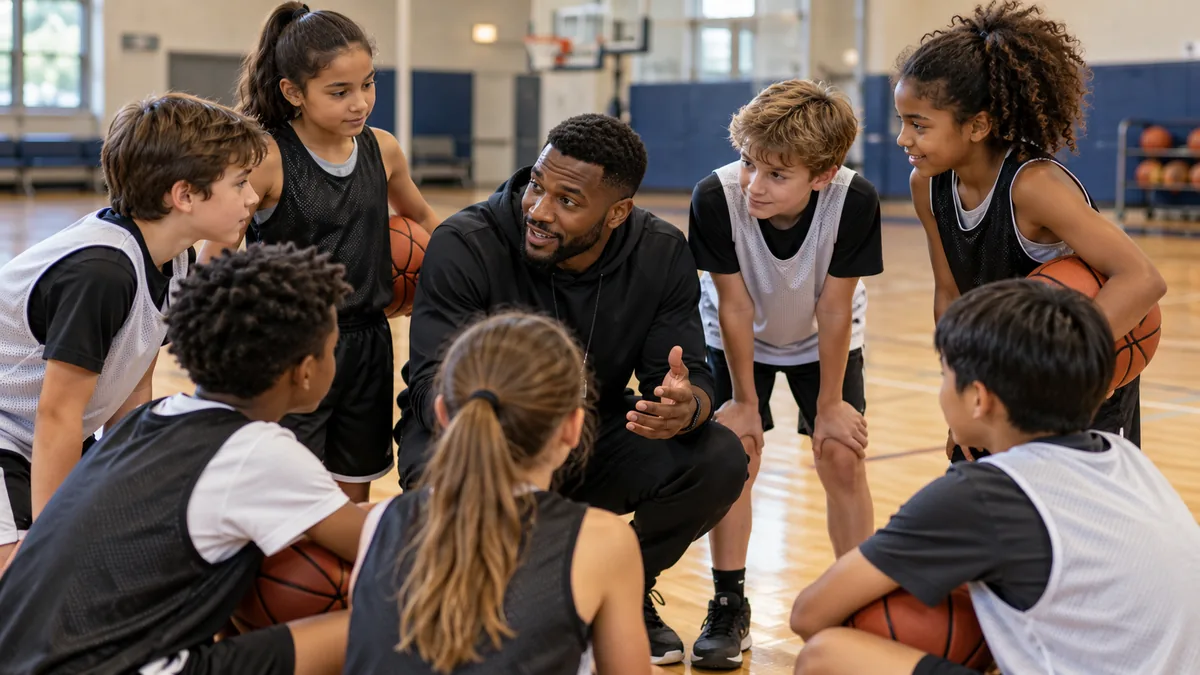
A strong youth basketball team culture is not created by one motivational speech at the beginning of the season.
It is built through repeated behavior.
How players respond after mistakes.
How teammates talk to each other.
How the team reacts when someone is substituted.
How players behave when winning.
How they behave when losing.
How the coach corrects mistakes.
And what happens when nobody is watching.
A coach can teach excellent spacing, defense, shooting, and transition offense, but the team will still struggle if players blame each other, stop communicating, complain about roles, or become afraid of making mistakes.
Culture gives basketball skills a structure.
The good news is that youth coaches do not need complicated leadership programs.
A small number of clear standards, reinforced consistently, can shape the way a team practices and competes.
What Does Team Culture Actually Mean?
Team culture is simply:
The behavior your group repeatedly accepts and reinforces.
Every team has a culture.
Even teams that never discuss it.
If players regularly arrive late and nothing happens, that becomes part of the culture.
If teammates criticize each other after turnovers, that becomes part of the culture.
If players sprint over to help a teammate off the floor, that becomes part of the culture too.
Coaches influence culture through what they:
- Teach
- Reward
- Correct
- Ignore
- Model themselves
Jr. NBA describes teamwork, respect, and sportsmanship as core values of its youth basketball philosophy and emphasizes creating a positive environment alongside basketball development. NBA.com: Jr. NBA
For coaches, that means culture should not be treated as something separate from basketball.
It should appear inside normal practices and games.
Do Not Start With Ten Team Rules
Young players do not need a handbook containing thirty expectations.
Start smaller.
Choose three or four standards that describe how you want the team to behave.
For example:
Ready
We arrive prepared and listen when instruction begins.
Talk
We communicate with teammates.
Next Play
We respond to mistakes instead of dwelling on them.
Team First
We support teammates whether we are playing or sitting.
Those four standards cover a surprising number of situations.
A player complains after a turnover?
Next Play.
Nobody communicates defensively?
Talk.
Players are joking while instructions are being given?
Ready.
Someone ignores a teammate after being substituted?
Team First.
Simple language makes standards easier to remember.
Turn Values Into Visible Behavior
Words such as:
- Respect
- Effort
- Teamwork
- Leadership
sound good.
But young players need to know what those words actually look like.
Instead of saying:
“Show better teamwork.”
Explain what teamwork means during basketball.
For example:
Teamwork means making the extra pass.
Teamwork means communicating on defense.
Teamwork means helping organize equipment.
Teamwork means encouraging a teammate after a mistake.
Teamwork means running the floor even when you may not receive the ball.
The more observable the behavior becomes, the easier it is to coach.
Standard 1: Be Ready
Being ready does not mean players must behave like professionals.
They are children.
They will joke, talk, and have fun.
But they should recognize when it is time to listen and work.
A simple readiness standard might include:
- Shoes tied
- Basketball ready
- Water bottle available
- Listening when instructions begin
- Joining activities quickly
- Moving between drills without wasting several minutes
You do not need to turn practice into military training.
The goal is to protect practice time.
Five wasted minutes in every session becomes a significant amount of lost development over a season.
Standard 2: Communicate
Young players frequently play almost silently.
They assume communication belongs to the coach.
But basketball becomes easier when players talk to each other.
Teach simple words first.
For example:
“Ball!”
“Help!”
“Screen!”
“Shot!”
“I’ve got ball!”
“One more!”
Then encourage communication outside live play too.
Players can tell teammates:
“Nice pass.”
“Good idea.”
“Next one.”
Communication creates connection.
It also gradually reduces the team’s dependence on the coach shouting instructions every possession.
Standard 3: Use a Next-Play Mentality
Mistakes are unavoidable in youth basketball.
Players will:
- Miss layups
- Turn the ball over
- Lose defensive assignments
- Commit fouls
- Make poor passes
- Forget plays
The important question is what happens next.
A player who commits a turnover and spends the next ten seconds looking at the floor creates another problem.
Teach a simple reset.
See it → Learn it → Next play.
For example:
A player throws a bad pass.
The coach might say:
“Too much traffic. Next play.”
That gives one correction and immediately redirects attention.
This connects naturally with the confidence-building approach already used elsewhere on your site.
Standard 4: Team First
“Team first” does not mean players should stop developing individual ambition.
Young athletes should want to improve.
They should want responsibility.
They may want to start.
They may want more playing time.
That is normal.
Team-first behavior means those goals do not become excuses to damage the group.
Examples include:
- Supporting teammates from the bench
- Celebrating good passes, not only baskets
- Running onto the court ready after a substitution
- Accepting temporary roles
- Sharing the basketball
- Not blaming teammates after mistakes
The bench is part of the team too.
Culture becomes visible when players are not currently playing.
The Bench Is One of the Best Culture Tests
Watch your bench during a game.
Are players paying attention?
Are they talking positively?
Do they know what is happening?
Or are they complaining, joking through instructions, and waiting only for their own substitution?
Teach bench behavior directly.
You might establish three simple expectations:
Watch.
Learn from the game.
Support.
Encourage teammates appropriately.
Be ready.
Know when you are entering and what your assignment is.
This does not require constant yelling from the bench.
It requires involvement.
Culture Starts With the Coach
Players notice more than coaches realize.
If a coach tells players to respect officials but spends the entire game arguing, the team receives two different messages.
If a coach teaches “next play” but remains angry about a turnover for five minutes, players notice.
If a coach demands punctuality but regularly arrives late, players notice.
The Jr. NBA Coach’s Code of Conduct specifically emphasizes respect, patience, sportsmanship, giving every player opportunities to contribute, and avoiding behavior that embarrasses players. NBA.com: Jr. NBA
Culture becomes believable when the coach models the same standards expected from players.
Correct Behavior Without Making Everything a Punishment
Not every culture mistake needs running.
A player complains.
The team does not need twenty suicides.
A child forgets to communicate.
That does not require punishment.
Correct the behavior itself.
For example:
“We don’t blame teammates. Tell him what you need instead.”
Or:
“Reset. What is our standard after a mistake?”
Player:
“Next play.”
Coach:
“Good. Let’s go.”
Short corrections keep attention on the behavior you actually want.
Avoid Public Embarrassment
Young players can handle correction.
They should be coached.
But there is a difference between correction and humiliation.
Instead of:
“What are you doing? Everyone knows that!”
Try:
“Freeze. Look where the help defender is. What is the better option?”
The basketball mistake still gets corrected.
The player also has an opportunity to understand it.
Jr. NBA’s coaching guidance explicitly recommends treating players respectfully rather than using yelling, sarcasm, or public embarrassment as coaching tools. NBA.com: Jr. NBA
Praise the Behavior You Want Repeated
Coaches often notice mistakes faster than positive habits.
That can accidentally teach players that only scoring receives recognition.
Highlight culture behaviors too.
For example:
“Great communication.”
“I like how you sprinted back after losing the ball.”
“Good job helping your teammate up.”
“That extra pass is exactly what we want.”
“Excellent response after the turnover.”
This helps players understand what the team’s standards look like in real basketball.
Do Not Confuse Culture With Being Nice All the Time
A positive culture can still be competitive.
Players can:
- Challenge each other
- Compete hard
- Play physical defense
- Want to win
- Hold teammates accountable
The standard is how they do it.
Competition does not require:
- Blaming
- Taunting
- Humiliating
- Complaining
- Disrespecting officials
Jr. NBA sportsmanship guidance specifically emphasizes competing while supporting teammates and treating opponents, coaches, and officials appropriately. NBA.com: Jr. NBA
You can coach intensity and respect at the same time.
Teach Players How to Win
Winning creates culture challenges too.
A team builds a large lead.
Players may begin:
- Laughing at opponents
- Trying unnecessary tricks
- Hunting individual points
- Celebrating mistakes by the other team
Talk about this before it happens.
A simple standard is:
The score changes nothing about how we treat people.
When ahead:
Keep playing correctly.
Move the basketball.
Defend.
Respect the opponent.
Do not embarrass anyone.
Winning well is a skill.
Teach Players How to Lose
Losing reveals culture quickly.
Some players become quiet.
Others blame officials.
Some criticize teammates.
Others stop competing.
Teach a post-loss routine.
For example:
- Shake hands properly.
- Thank officials when appropriate.
- Gather as a team.
- Identify one positive.
- Identify one lesson.
- Move forward.
Do not hold a twenty-minute emotional speech immediately after a difficult loss.
Players may need time to process.
A short, consistent routine is often more useful.
Give Players Ownership
Culture should not belong only to the coach.
Ask players:
“What kind of teammate helps you play better?”
Their answers may include:
- Someone who communicates
- Someone who does not blame
- Someone who shares the ball
- Someone who keeps trying
- Someone who encourages others
Now the standards become partly theirs.
Older youth players can contribute even more.
Ask them to describe what good practice behavior looks like.
Write down the best answers.
Return to them during the season.
Use Captains Carefully
Youth teams do not always need permanent captains.
One alternative is rotating leadership.
Different players can be responsible for:
- Leading the warm-up
- Starting the team huddle
- Organizing equipment
- Calling defensive communication
- Helping younger or newer teammates
- Leading a post-practice recap
This gives more players leadership experience.
It also prevents leadership from becoming a title reserved only for the team’s best scorer.
Leadership Is Behavior, Not Volume
The loudest player is not automatically the leader.
Some players lead by:
- Consistency
- Effort
- Communication
- Patience
- Helping others
- Staying composed
Teach the team that leadership can look different.
A quiet player who consistently makes good decisions and supports teammates may be developing important leadership qualities.
Create One Culture Moment in Every Practice
Culture does not require another thirty-minute lecture.
Use two minutes.
At the beginning or end of practice, choose one idea.
For example:
Today’s standard: Next Play.
Then during practice, recognize examples.
At the end ask:
“Where did we show next-play behavior today?”
Players might say:
“After we turned it over.”
“When we missed two shots.”
That takes very little time.
But repeated throughout the season, it reinforces the standard.
Build Culture Into Drills
You can attach team standards to normal basketball activities.
During passing drills:
Reward communication.
During defensive drills:
Reward players helping teammates.
During shooting:
Practice next-play response after misses.
During small-sided games:
Give a bonus point for a teammate helping create a score through an extra pass.
Basketball and culture do not have to be separate topics.
Use Small-Sided Games to Reveal Culture
Three-on-three is useful because there are fewer players to hide behind.
Players have more responsibility.
Coaches can observe:
Who communicates?
Who blames?
Who keeps playing after mistakes?
Who shares the ball?
Who helps?
Who becomes frustrated?
That makes small-sided games useful not only for skills and decisions, but also for team behavior.
Set Standards for Practice Competition
Competition can become emotional quickly.
Before starting, explain the standard.
For example:
“Compete hard. No arguing calls. No celebrating mistakes. Winner shakes hands with the other group and we reset.”
Then enforce it.
If players learn competitive behavior during practice, game situations become easier.
Keep Corrections Consistent
One of the fastest ways to weaken culture is inconsistent enforcement.
If a starter complains and nothing happens, but a bench player does the same thing and gets corrected immediately, teammates notice.
Standards should apply regardless of:
- Skill
- Playing time
- Position
- Scoring ability
- Relationship with the coach
This does not mean every situation requires identical consequences.
It means the behavioral standard remains the same.
Explain Culture to Parents
Parents should know what the team is trying to build.
At a preseason meeting, you might say:
“We coach basketball skills, but we also expect communication, respect, effort, and a next-play mentality.”
Then explain what that means.
This connects directly with the parent communication system you already have on the site.
Parents are more likely to support team standards when they understand them.
Avoid Creating a Culture of Fear
Players should respect standards.
They should not be afraid to participate.
If athletes are constantly worried that one mistake will lead to:
- Being embarrassed
- Being immediately benched
- Being yelled at
- Losing their role
they may begin choosing the safest possible option.
That can reduce development.
Accountability and psychological safety can exist together.
You can expect high standards while still allowing mistakes.
Separate Effort Problems From Skill Problems
This distinction is extremely useful.
A player misses an open layup.
That is probably a skill outcome.
Coach the technique.
A player refuses to sprint back because they are angry about missing.
That is a behavior issue.
Coach the standard.
Do not treat them the same way.
Players cannot always control whether the ball goes in.
They can control their response.
A Simple Four-Standard Team System
If you want a ready-to-use model, try:
READY
Listen quickly. Arrive prepared. Transition between activities.
TALK
Communicate with teammates during practice and games.
NEXT PLAY
Respond constructively after mistakes.
TEAM FIRST
Support teammates, share responsibility, and respect roles.
Put these four standards on your practice plan.
Mention them during the first week.
Then coach them throughout the season.
No long speech is necessary.
Age 6–8: Keep Culture Visible and Simple
At this age, use very concrete expectations.
For example:
- Listen when the whistle blows.
- Help teammates.
- Do not blame.
- Shake hands.
- Try again after mistakes.
Avoid abstract leadership lectures.
Show players the behavior.
Ages 9–11: Add Responsibility
Players can begin understanding:
- Communication
- Response to mistakes
- Bench behavior
- Team roles
- Sportsmanship
- Shared responsibility
Ask questions instead of always giving answers.
“What should our bench look like right now?”
Let them respond.
Ages 12–14: Add Player Leadership
Older youth players can take more ownership.
Let them:
- Lead warm-ups
- Participate in team standards
- Solve minor communication problems
- Mentor newer teammates
- Discuss what the team needs to improve culturally
The coach still sets boundaries.
But players should gradually become responsible for the environment they help create.
How to Know Whether Culture Is Improving
Culture is difficult to measure with one statistic.
Look for behavioral evidence.
Are players communicating more?
Do they recover faster after mistakes?
Does the bench stay engaged?
Are teammates helping each other?
Do players accept corrections without shutting down?
Is blaming decreasing?
Do players behave appropriately when winning?
Can the team handle a close loss without falling apart?
Does practice start faster?
Those are real signs of improvement.
Common Team Culture Mistakes
Creating Too Many Rules
Players forget them.
Choose a few meaningful standards.
Talking About Values but Never Coaching Them
Standards need reinforcement during actual basketball.
Only Correcting Negative Behavior
Recognize good examples too.
Applying Standards Differently to Star Players
Consistency creates trust.
Treating Every Mistake as an Effort Problem
Skill mistakes and behavior problems are different.
Expecting Captains to Fix Everything
Culture is a team responsibility.
Trying to Build Culture With Punishment Alone
Players need clear expectations and examples, not only consequences.
Frequently Asked Questions
How do you build team culture in youth basketball?
Choose a small number of clear behavioral standards, explain what they look like, model them as a coach, recognize positive examples, and correct violations consistently throughout practices and games.
How many team rules should a youth basketball team have?
There is no perfect number, but younger players usually respond better to a few memorable standards than a long list of rules.
Should youth basketball teams have captains?
They can, but permanent captains are not required. Rotating leadership responsibilities can give more players opportunities to develop leadership skills.
How should coaches handle players who blame teammates?
Correct it quickly and calmly. Redirect the player toward useful communication, such as explaining what the team needs on the next possession.
Can a team be competitive and still have a positive culture?
Yes. Competitive teams can play with intensity while maintaining respect, teamwork, sportsmanship, and emotional control.
Should parents know the team’s culture standards?
Yes. Explaining the standards early helps parents understand what the coach is reinforcing and makes it easier for adults to support consistent expectations.
Final Thoughts
A strong youth basketball team culture does not appear because the team wins.
It is built before the result.
Create a few clear standards.
Define the behavior behind those standards.
Model them yourself.
Reinforce them during practice.
Correct problems consistently.
Let players take increasing ownership.
Teach them how to compete.
Teach them how to win.
Teach them how to lose.
And show them that mistakes do not remove someone from the team—they create another opportunity to respond correctly.
A playbook can organize where players move.
Culture shapes how they behave when the play breaks down.
For youth basketball coaches, both matter.
But if players learn how to communicate, compete, support teammates, handle mistakes, and respect the game, the impact can last much longer than any offensive set.
