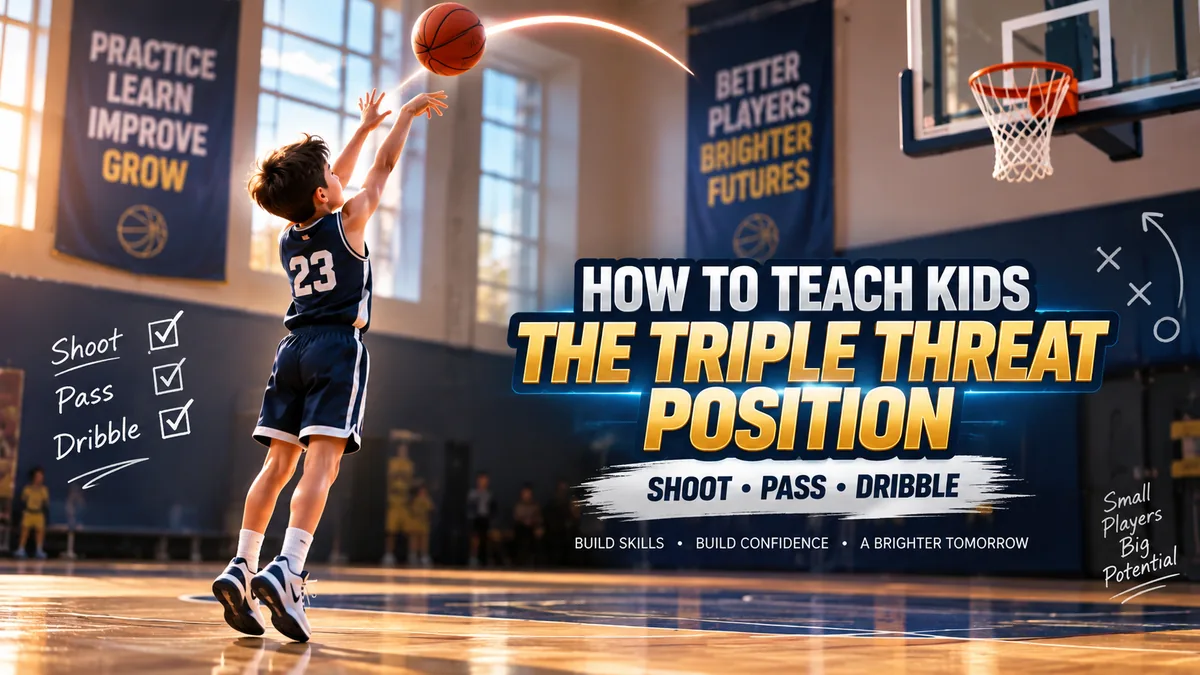
How to Teach Kids the Triple Threat Position
The triple threat position for kids is one of the most useful basketball fundamentals a young player can learn.
When a player catches the ball and enters a balanced position, they should be ready to do three things as part of the triple threat position for kids:
Shoot. Pass. Dribble.
That is why it is called “triple threat.”
However, young players often catch the basketball and immediately make one of several mistakes. They stand up straight, bring the ball too low, or dribble without looking, undermining the triple threat position for kids.
Teaching a good triple threat position helps kids become more balanced, more confident, and better decision-makers.
The key is to keep the explanation simple.
What Is the Triple Threat Position?
The triple threat position is a balanced basketball stance used after receiving the ball.
From this position, a player can:
- Shoot
- Pass
- Dribble
The player should not decide what to do before looking at the defense.
Instead, the position gives them several options.
For young players, this teaches an important basketball habit:
Catch first. Get balanced. Look at the court. Then make a decision.
Why Kids Should Learn Triple Threat Early
Many beginner players develop a habit of dribbling immediately after catching the ball.
Sometimes they do not even know where they are going.
This creates unnecessary turnovers and makes basketball more difficult.
Triple threat helps young players slow the game down.
It teaches them to:
- Stay balanced
- Protect the basketball
- See teammates
- See defenders
- Recognize open space
- Decide whether to shoot, pass, or dribble
Those habits become more important as players get older.
The Basic Triple Threat Position
A good triple threat position does not need to look complicated.
Teach kids five basic points.
1. Feet About Shoulder-Width Apart
Players need a stable base.
If the feet are too close together, it becomes harder to change direction or stay balanced.
If they are too wide, movement becomes slow.
A simple coaching cue is:
“Strong feet.”
2. Knees Bent
Players should not stand straight up.
Bent knees help them move quickly in any direction.
Ask players to imagine they are getting ready to jump.
They should feel athletic rather than stiff.
A useful cue is:
“Get low and ready.”
3. Keep the Head Up
Players need to see the court.
They should be able to identify:
- The basket
- Their defender
- Open teammates
- Open driving space
A player who only looks at the basketball cannot make good decisions.
Use the cue:
“See the floor.”
4. Protect the Basketball
The basketball should be held securely and away from the defender.
Avoid teaching kids to hold the ball directly in front of the defender where it can easily be knocked away.
The exact ball position may change depending on the situation, but the player should remain ready to pass, shoot, or begin a legal dribble.
5. Stay Ready to Move
Triple threat is not a frozen pose.
The player should be ready to move immediately.
That might mean:
- Shooting
- Passing
- Driving
- Pivoting
- Protecting the basketball
The position should create options rather than stop the offense.
A Simple Way to Explain Triple Threat to Kids
Avoid giving young players a long technical explanation.
Try this:
“When you catch the ball, get balanced and think: shoot, pass, or dribble.”
Then demonstrate it.
Show them an incorrect version first.
Stand straight up.
Look down.
Hold the basketball loosely.
Then show the correct version.
Bent knees.
Head up.
Ball protected.
Balanced feet.
Ask players which position looks more ready to play.
Visual comparisons are often easier for kids to understand than long descriptions.
Teach the Catch Before the Triple Threat
Young players cannot consistently use triple threat if they struggle to catch the basketball.
Start with simple partner passing.
Have players:
- Show their hands.
- Catch the basketball.
- Bring it under control.
- Land or settle into triple threat.
- Look up.
Do not immediately add defenders.
Let players build the movement pattern first.
A useful coaching phrase is:
“Catch. Balance. See.”
Drill 1: Catch and Freeze
This is one of the easiest ways to teach the triple threat position for kids.
Setup
Pair players with one basketball.
Players stand several feet apart.
How It Works
Player A passes to Player B.
Player B catches the basketball and immediately gets into triple threat.
Then they freeze.
The coach checks:
- Feet
- Knees
- Head
- Ball position
- Balance
After one or two seconds, Player B passes back.
Repeat.
Coaching Cue
“Catch and get ready.”
Do not spend too much time correcting every detail.
Choose one correction at a time.
Drill 2: Triple Threat Choices
This teaches the three options directly.
Setup
Each player has a basketball or works with a partner.
Players begin in triple threat.
The coach calls one command:
Shoot
Players perform a controlled shooting motion.
Pass
Players make a pass to their partner.
Dribble
Players take one or two controlled dribbles.
This helps beginners connect the position with its purpose.
Triple threat is not just a stance.
It is a starting point for basketball decisions.
Drill 3: Catch, Pivot, and Pass
Once players understand the basic stance, add pivoting.
Player A passes to Player B.
Player B catches in triple threat.
Then Player B:
- Establishes a pivot foot.
- Pivots under control.
- Finds the target.
- Makes the pass.
This teaches players that they do not always need to dribble when pressure appears.
A good pivot can create passing space while keeping possession.
Drill 4: Catch and Attack
Now connect triple threat to dribbling.
Set up a cone several feet in front of the player.
The player receives a pass, gets into triple threat, looks up, and then attacks the cone with one strong first step.
Encourage players to push the basketball forward under control rather than taking several small dribbles.
Useful cue:
“Catch. See. Go.”
As players improve, place cones on both sides so they must decide which direction to attack.
Drill 5: Defender Reads
For older or more experienced kids, add a passive defender.
The offensive player catches in triple threat.
The defender gives one simple look.
For example:
If the defender stands far away, the offensive player prepares to shoot.
If the defender gets too close, the player attacks with the dribble.
If a teammate is open, the player passes.
The goal is not to create a complicated decision-making drill.
It is to teach one idea:
The defense helps determine which option to choose.
Teach the Eyes Before the Move
One of the most important parts of triple threat is often overlooked.
The player’s eyes.
Before shooting, passing, or dribbling, encourage players to look.
Ask:
“What do you see?”
Maybe the basket is open.
Maybe a teammate is cutting.
Maybe the defender is too close.
Maybe there is open space to drive.
This begins developing basketball IQ.
Players learn that basketball is not just about performing moves.
It is about making choices.
Common Triple Threat Mistakes
Standing Too Tall
Players who stand upright are slower to move.
Remind them:
“Athletic stance.”
Looking at the Ball
The player should gradually learn to keep the head up.
Use:
“See the court.”
Dribbling Immediately
Some kids automatically start bouncing the ball after every catch.
Encourage:
“Catch first. Look first.”
Holding the Ball Where the Defender Can Reach It
Players should keep control of the basketball and protect it.
Putting the Ball on the Floor Without a Purpose
A dribble should help the player accomplish something.
Move toward the basket.
Improve a passing angle.
Escape pressure.
Create space.
Young players should gradually learn that every dribble should have a reason.
Triple Threat for Ages 6–8
Keep the lesson extremely simple.
Focus on:
- Catching
- Balance
- Bent knees
- Head up
- Shoot, pass, or dribble
Do not worry about perfect footwork immediately.
Use games and short repetitions.
A simple call-and-response works well:
Coach: “How many choices?”
Players: “Three!”
Coach: “What are they?”
Players: “Shoot, pass, dribble!”
Triple Threat for Ages 9–11
Players can begin learning more detail.
Add:
- Pivot foot awareness
- Ball protection
- Jab steps
- Reading defender distance
- Strong first dribble
Continue emphasizing decision-making.
Do not let triple threat become a pose players perform only during drills.
They should begin using it naturally during games.
Triple Threat for Ages 12–14
Older players can connect triple threat to more advanced actions.
Examples include:
- Jab-and-go
- Shot fake and drive
- Pass fake
- Rip-through moves
- Pivoting against pressure
- Attacking closeouts
But the foundation remains the same.
Balance, vision, protection, and options.
Advanced moves are much easier when the basic stance is already automatic.
How to Make Triple Threat More Game-Like
Once players understand the technique, stop practicing it only without defense.
Add simple competitive situations.
For example:
1-on-1 From a Catch
The offensive player receives a pass.
They must first establish triple threat.
Then the possession becomes live.
This forces the player to read the defender before attacking.
2-on-2 Catch and Read
Players must decide whether to drive or pass based on the defense.
This also teaches movement without the ball and spacing in youth basketball.
Three-Second Decision Game
After catching, the offensive player has three seconds to make a useful decision.
The goal is not to rush players.
It is to prevent them from holding the basketball without purpose.
Do Not Overcoach the Position
Triple threat is important, but players still need freedom to play.
Avoid stopping the entire practice every time someone’s foot is a few inches out of place.
Correct the biggest problems first.
For example:
If a player constantly looks down, work on the eyes.
If they stand upright, work on balance.
If they dribble immediately, work on decision-making.
One clear improvement is often better than five corrections at once.
Connect Triple Threat to Other Basketball Skills
The triple threat position connects naturally to many fundamentals.
After players learn triple threat, coaches can develop:
Passing
Players learn to see teammates before putting the ball on the floor.
Dribbling
Players learn to attack with purpose.
Shooting
Players learn to receive the ball balanced and ready.
Footwork
Pivoting becomes easier to understand.
Spacing
Players begin recognizing where teammates and defenders are positioned.
Decision-making
Players learn that the correct move depends on what happens during the possession.
That is why triple threat is such a useful foundation for young players.
A Simple 5-Minute Triple Threat Routine
Coaches can include this short routine during practice:
| Time | Activity |
|---|---|
| 1 minute | Triple threat stance without defense |
| 1 minute | Catch and freeze |
| 1 minute | Catch, pivot, and pass |
| 1 minute | Catch and attack |
| 1 minute | 1-on-1 defender read |
The progression moves from technique to decision-making.
It can easily be included after a basketball warm-up for kids and before more advanced team activities.
Frequently Asked Questions
What does triple threat mean in basketball?
Triple threat means a player with the basketball is in a position where they can immediately shoot, pass, or dribble.
At what age should kids learn triple threat?
Beginners can learn a simple version as soon as they begin learning organized basketball. Younger players only need the basic ideas of balance, looking up, protecting the ball, and understanding their three options.
Why do kids dribble immediately after catching the ball?
Young players often feel more comfortable bouncing the basketball than stopping to make a decision. Coaches can improve this habit by repeatedly teaching “catch, balance, see” before the player chooses an action.
Should the basketball always be held in exactly the same place?
No. Ball position can change depending on the player and situation. The important points are control, protection, balance, and readiness to perform the next action.
Is triple threat still useful for older players?
Yes. More advanced players may move through the position very quickly, but the fundamental ideas of balance, reading the defense, and keeping multiple options available remain important.
Final Thoughts
Teaching the triple threat position for kids should not become complicated.
Start with four ideas:
Catch the basketball. Get balanced. Look at the court. Make a decision.
Then teach players that they have three basic options:
Shoot. Pass. Dribble.
As players improve, add pivoting, attacking, defenders, and decision-making.
The goal is not for kids to stand perfectly in a textbook pose.
The goal is to help them become balanced, confident basketball players who see the court before they act.
