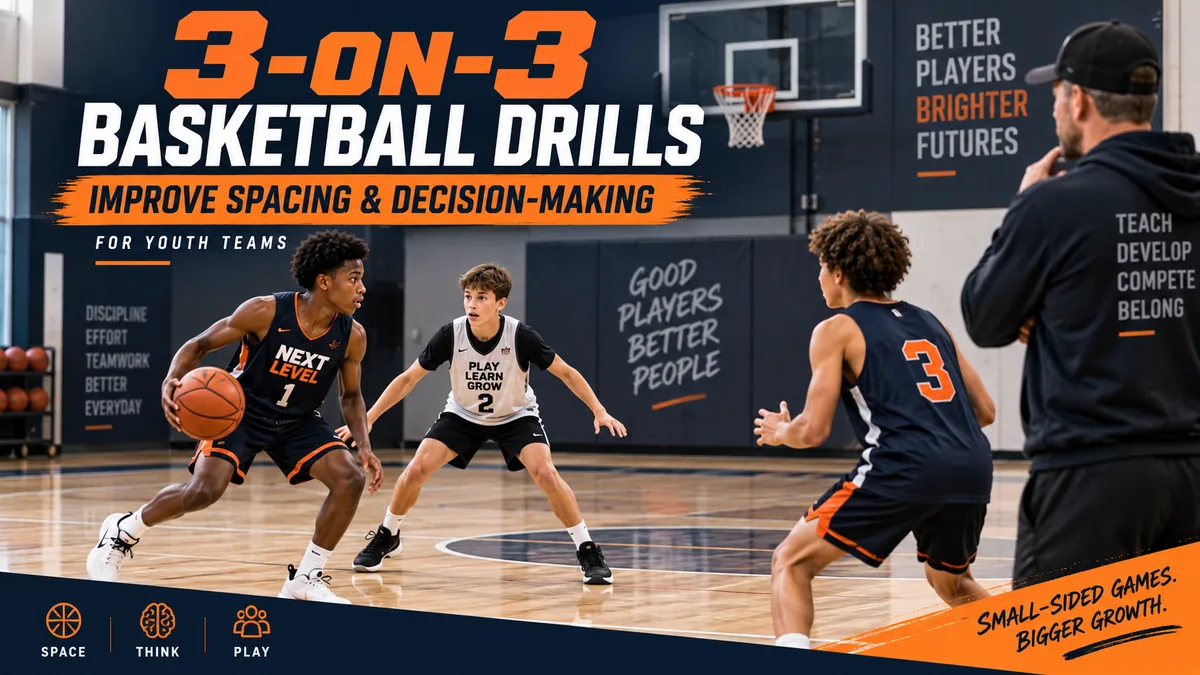
3-on-3 Basketball Drills for Youth Teams: Improve Spacing and Decision-Making
3 on 3 basketball drills for youth are among the most effective ways to help young players understand the game.
With fewer players on the court, every athlete gets more touches.
They gain more decisions and opportunities to attack, pass, cut, defend, and communicate.
3 on 3 basketball drills for youth help players who struggle with spacing.
They also address tendencies to stand and watch during five-on-five play.
Instead of teaching young athletes through long explanations, small-sided games allow them to learn through repetition and real basketball situations.
This guide covers practical 3 on 3 basketball drills for youth that coaches can use to improve spacing and movement.
It also enhances teamwork and decision-making during youth practice.
Why 3-on-3 Basketball Works So Well for Young Players
Full-court five-on-five basketball can be overwhelming for beginners.
There are ten players moving at once, several possible passing options, defensive rotations, screens, cuts, and changing areas of open space. Young athletes may understand an instruction during practice but struggle to recognize the same situation during a game.
Three-on-three simplifies the picture, yet 3 on 3 basketball drills for youth provide clearer practice options.
Each player has more room to operate and fewer teammates and defenders to track. This helps young athletes recognize what is happening before the next action develops.
Players also become more involved because there are fewer people sharing the basketball.
A typical 3-on-3 possession may require every offensive player to pass, cut, relocate, or attack. Defensively, each athlete has greater responsibility because there are fewer teammates available to cover mistakes.
That combination makes small-sided basketball valuable for both skill development and game understanding.
What Should Coaches Teach During 3-on-3?
The goal is not simply to let players scrimmage.
Coaches should use specific rules or scoring systems to emphasize one basketball concept at a time.
Important areas include spacing, cutting, passing angles, dribble penetration, communication, help defense, rebounding, and decision-making.
If your team is still learning where to stand on offense, the ideas from How to Teach Spacing in Youth Basketball: 7 Simple Drills for Better Team Offense can work especially well before introducing live 3-on-3 play.
Once players understand the basic floor positions, small-sided games give them a chance to apply those principles against defenders.

Drill 1: Pass, Cut, and Fill 3-on-3
This is one of the simplest ways to begin.
Start three offensive players around the perimeter and three defenders in normal positions.
The offense follows one rule:
After passing, the player must cut or relocate.
The passer cannot remain in the same spot.
If the basket is open, the passer can cut toward the rim. If the lane is crowded, the player should move toward an open perimeter location.
The remaining teammates must recognize the empty space and adjust.
This drill teaches several useful habits at once.
Players learn that passing the ball is not the end of the possession. They also begin to understand how one player’s movement affects the other two.
Do not stop every imperfect possession.
Let players experience the problem first.
If two teammates occupy the same area, briefly freeze the action and ask where the open space is. Once players identify it, restart immediately.
Drill 2: Three Passes Before Scoring
Young players often receive the basketball and immediately try to shoot or dribble toward the basket.
This rule forces them to see teammates first.
Play normal 3-on-3, but the offense must complete three passes before attempting a shot.
Players are still allowed to cut, screen, relocate, and change positions.
The purpose is not to create passing for the sake of passing.
It is designed to slow down the first few seconds of the possession so players begin observing defenders and teammates.
After several minutes, remove the rule.
Watch whether the team continues to move the ball before forcing difficult shots.
That transition from a restricted game to normal play is important because the ultimate goal is decision-making rather than rule-following.
Drill 3: Drive-and-Kick 3-on-3
Dribble penetration creates one of the most common decision-making situations in basketball.
When one player drives, teammates must react.
Poor youth teams often make the mistake of moving toward the driver. This crowds the lane and removes passing options.
In this drill, begin with three players spaced around the perimeter.
The ball handler attacks the basket.
The other two offensive players must maintain useful passing windows instead of following the dribbler.
The driver can finish, stop for a short shot, or pass to an open teammate.
Defenders play live.
The coach should focus on whether the off-ball players are helping the drive by creating space.
A useful coaching phrase is:
“Give the driver somewhere to pass.”
That is often easier for young players to understand than a complicated explanation about weak-side rotation.
Drill 4: No Standing 3-on-3
This game encourages constant awareness.
A player without the basketball cannot remain in exactly the same location for more than a few seconds.
Movement does not need to be dramatic.
The player may cut, exchange positions with a teammate, relocate after a drive, or move into a better passing angle.
The rule prevents young athletes from becoming spectators.
However, coaches should make an important distinction:
Movement should have a purpose.
Running randomly around the court can create as many problems as standing still.
If players become too chaotic, stop the activity and remind them that they should move because space has opened, a teammate has driven, or a passing angle needs to improve.
Drill 5: 3-on-3 With Bonus Points for Team Play
Traditional scoring rewards only made baskets.
That can encourage young players to judge every possession by who scores.
Instead, create a scoring system that also rewards good basketball decisions.
A normal basket counts as one point.
The team can earn an additional point when a possession includes a well-timed cut, a drive-and-kick pass, an extra pass to a more open teammate, or strong off-ball spacing.
The coach decides whether the bonus point is earned.
This changes what players celebrate.
A player who makes a smart pass may receive just as much recognition as the teammate who finishes the play.
Over time, this can improve teamwork and reduce the habit of forcing individual shots.
Drill 6: Advantage 3-on-2 Into 3-on-3
This activity begins with the offense having an advantage.
Three attackers play against two defenders.
The offense should move quickly and recognize which player is open.
After the first shot or defensive possession, a third defender enters and the game becomes normal 3-on-3.
This creates two different decision-making environments.
First, players learn to attack a numerical advantage.
Then they must immediately adjust when the court becomes balanced.
Encourage players to avoid unnecessary dribbling during the 3-on-2 portion.
The ball often moves faster through passing than through dribbling.
Young athletes should begin recognizing whether the best choice is to attack the rim, make one more pass, or maintain spacing.
Drill 7: Stop-and-Think 3-on-3
This is useful when players repeatedly make the same positional mistakes.
Allow the game to run normally.
When the offense becomes crowded or the defense loses proper positioning, call “freeze.”
Players must stop exactly where they are.
Instead of immediately explaining the answer, ask one short question.
For offense:
“Where is the open space?”
For defense:
“Who needs help?”
Give the players a few seconds to study the floor.
Then restart.
This approach encourages them to process the situation rather than waiting for the coach to solve every problem.
Use the freeze command sparingly.
Too many interruptions can turn a useful game into a lecture.
Drill 8: 3-on-3 Continuous Transition
Once players are comfortable in the half court, add transition.
Place three offensive players against three defenders.
After a made basket, rebound, or turnover, the team gaining possession immediately attacks the opposite basket.
The previous offense becomes the defense.
Continuous play teaches players to change roles quickly.
They must recognize whether they are attacking, protecting the basket, matching up, or finding space.
This is also an efficient way to add conditioning without spending practice time on running that does not involve basketball.
For a broader structure, this drill can fit naturally into the final section of How to Run a Youth Basketball Practice: A Simple 60-Minute Plan.
Teach Players to Read the Game, Not Memorize Movements
One of the biggest advantages of three-on-three basketball is that it creates repeated decisions.
Coaches should resist the temptation to control every possession.
If players are always told exactly where to move, they may perform well in practice but struggle when game situations change.
Instead, give them simple principles.
Create space.
Move after passing.
Do not cut into an occupied lane.
Give the driver room.
Find a passing angle.
Help a teammate defensively.
Those principles can be used in many situations.
A memorized route works only when the court looks exactly as expected.
A decision-making habit can work even when defenders or teammates move differently.
Why 3-on-3 Helps Improve Spacing
Spacing can be difficult to teach in five-on-five because the court becomes crowded quickly.
With three offensive players, the relationship between teammates is easier to see.
If two players stand close together, the problem becomes obvious.
If one player cuts, the open area left behind is easier to recognize.
If a teammate drives, the other two players can clearly see how their positions affect the available passing lanes.
Coaches should avoid teaching spacing as a fixed distance.
Instead, help players understand the purpose.
Good spacing makes it harder for one defender to guard two offensive players.
That simple idea is often enough for young athletes to begin recognizing when they are too close together.
How Long Should 3-on-3 Drills Last?
Short rounds usually work best.
Three to five minutes of intense 3-on-3 can produce many more decisions than a longer drill with players waiting in lines.
After a round, give players a short break and one coaching point.
Then restart.
For example, after the first game, emphasize spacing.
During the next round, focus on cutting.
Later, emphasize defensive communication.
Using one teaching point at a time keeps players from becoming overloaded with instructions.
Common Coaching Mistakes
One common mistake is allowing 3-on-3 to become an unstructured scrimmage every time.
Players may enjoy it, but the same habits can continue if there is no coaching purpose.
Another mistake is adding too many rules.
If players must remember six restrictions before touching the basketball, they will focus more on the rules than the game.
Choose one main constraint.
Let players learn from it.
Then remove the restriction and see whether the behavior carries into normal play.
Coaches should also avoid stopping every mistake.
Some learning needs to happen through experience.
A bad possession can be valuable if players begin recognizing for themselves why it failed.
Adjusting 3-on-3 for Different Ages
For players around ages six to eight, keep the game extremely simple.
Use a smaller playing area if necessary and focus on passing, moving, and keeping reasonable distance between teammates.
For ages nine to eleven, introduce cutting, driving, filling open positions, and simple defensive help.
Older youth players can work on more advanced decisions such as screening, backdoor cuts, drive-and-kick reads, closeouts, and defensive rotations.
The basic format remains the same.
Only the complexity changes.
How Coaches Can Measure Progress
Do not measure success only by how many baskets a team scores.
Look for better habits.
Are players moving after they pass?
Are teammates maintaining usable distance from one another?
Does the ball handler have more than one option?
Do players recognize an open lane?
Are defenders communicating earlier?
Are players making fewer rushed decisions?
Those improvements show that the drill is working even if shooting percentages have not changed yet.
Frequently Asked Questions
Is 3-on-3 better than 5-on-5 for youth practice?
Both formats are useful, but 3-on-3 usually provides more touches and decisions for each player. It can be especially effective when teaching spacing, movement, passing, and individual responsibility.
How much 3-on-3 should a youth team play?
There is no exact requirement, but including 10 to 20 minutes of small-sided basketball during many practices can provide valuable game-like repetitions.
Should coaches use rules during 3-on-3?
Yes, but keep them simple. One rule such as “pass and move” or “three passes before a shot” can emphasize a specific concept without making the activity confusing.
Can beginners play 3-on-3?
Yes. In fact, beginners often benefit because there are fewer players to track and more opportunities to touch the basketball.
What skills can 3-on-3 develop?
Small-sided basketball can improve passing, dribbling, finishing, spacing, cutting, defense, rebounding, communication, and decision-making.
Final Thoughts
3-on-3 basketball drills for youth teams are valuable because they combine skill development with real decisions.
Players are not simply repeating movements without defenders.
They must recognize space, respond to teammates, read defenders, and choose what to do next.
Start with simple rules.
Teach one idea at a time.
Then gradually remove restrictions and allow players to solve problems independently.
When coaches use three-on-three consistently, young athletes can develop a better understanding of spacing, teamwork, movement, and the decisions that make basketball easier to play.
