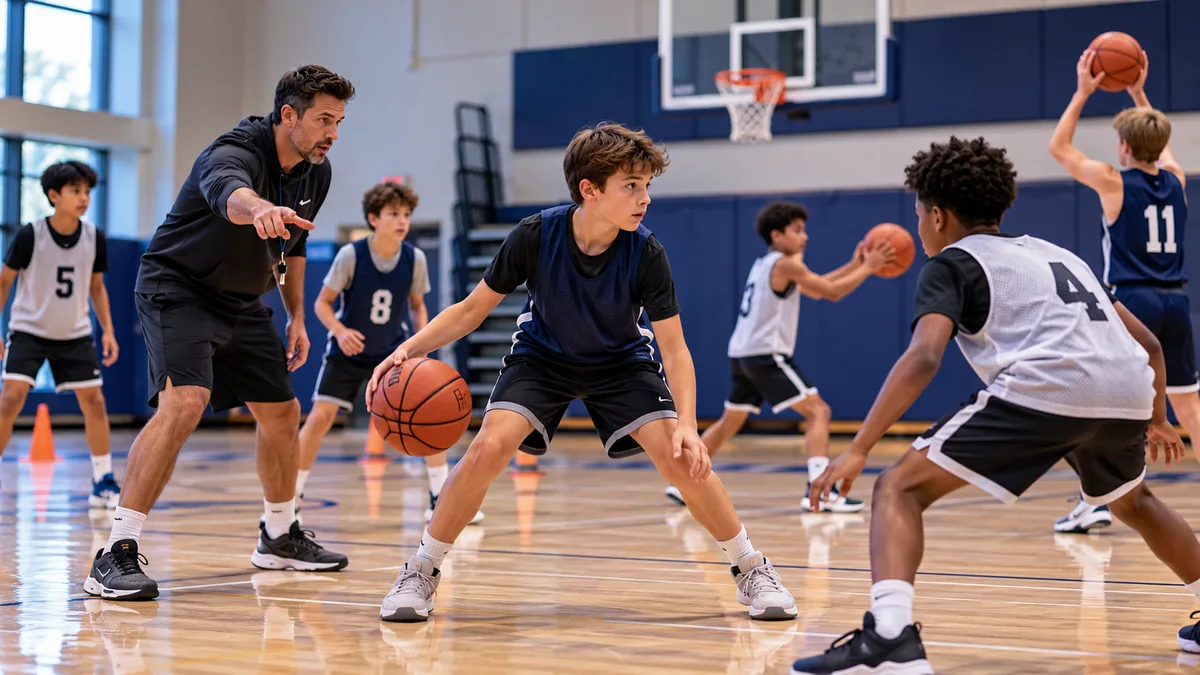
Understanding youth basketball positions can help players organize themselves on the court.
But assigning permanent positions too early can also limit development.
The tallest nine-year-old is often immediately called a center.
The smallest player becomes the point guard.
A child who makes two outside shots may suddenly become the shooting guard.
Those labels can make lineups easier for coaches, but they can also create a problem.
Young athletes are still growing.
Their bodies change.
Their coordination changes.
Their confidence changes.
And the basketball skills they develop today may completely change what they are capable of doing a year or two from now.
Youth coaches still need to teach players where to stand, what responsibilities exist, and how different roles work.
The key is to teach roles without turning them into permanent identities.
Basketball Positions Are Useful — But They Are Not Job Titles
Teaching youth basketball positions should help players understand responsibilities without limiting the skills they are allowed to develop.
Traditional basketball has five familiar positions:
- Point guard
- Shooting guard
- Small forward
- Power forward
- Center
These labels can help describe what players are doing.
The point guard may bring the ball up the floor.
A center may spend more time near the basket.
A wing may start farther from the ball.
But youth players should understand something important:
A position describes a responsibility in a moment. It does not define everything a player is allowed to do.
A center should still learn to pass.
A guard should still learn to rebound.
A taller player should still handle the basketball.
A smaller player should still learn how to defend near the basket.
Jr. NBA describes the five traditional basketball positions, but its broader youth-development philosophy emphasizes developing complete, well-rounded players. NBA.com: Jr. NBA
That distinction matters.
The Problem With Positioning Players by Height
Height is easy to see.
That is why it often becomes the first thing coaches use when assigning roles.
The tallest player stands near the basket.
The shortest player handles the ball.
It may work today.
But youth development is unpredictable.
A tall ten-year-old may stop growing earlier than teammates.
A small player may eventually become one of the tallest athletes on the team.
If the tall player spent four years only rebounding and making layups, they may reach an older age without the ball-handling and passing skills their new role requires.
The same thing can happen to smaller players.
If a guard never learns to rebound, defend larger players, or score inside, their game can become unnecessarily limited.
The better question is not:
“What position is this child?”
Ask:
“What basketball skills does this player need to develop?”
Teach Responsibilities Before Position Names
A flexible approach to youth basketball positions gives young players structure while still allowing them to experience different roles.
For younger players, responsibilities are often easier to understand than formal positions.
Instead of saying:
“You are the small forward.”
Try:
“Start wide on this side of the floor.”
Instead of:
“You are the center.”
Try:
“On this possession, I want you to rebound and protect the basket.”
Instead of:
“You are the point guard.”
Try:
“You are bringing the ball up this time. Look ahead before you dribble.”
These instructions tell players what to do without making them feel permanently assigned to one role.
Over time, athletes begin understanding the game through actions rather than labels.
Every Player Should Learn to Handle the Ball
Ball handling should not belong only to the smallest player.
Give different athletes opportunities to:
- Bring the ball up the court
- Dribble against pressure
- Change direction
- Protect the basketball
- Start transition offense
- Make decisions after the dribble
That does not mean every player needs to become an elite point guard.
It means every player should become comfortable enough with the basketball to function when circumstances change.
A rebounder may need to take two controlled dribbles after securing the ball.
A wing may receive pressure near the sideline.
A taller player may catch outside the lane.
Basketball becomes easier when players are not afraid of the ball.
If several players still lack control, your existing ball handling drills for beginners are a natural foundation before introducing more flexible roles.
Every Player Should Learn to Pass
Passing may be the most transferable basketball skill.
Every position needs it.
A player near the basket may need to pass out of pressure.
A ball handler needs to advance the ball.
A wing needs to find cutters.
A rebounder may start a fast break with an outlet pass.
Teach all players to:
- See teammates
- Pass accurately
- Pass on time
- Use appropriate angles
- Move after passing
- Avoid forcing difficult passes
When everyone can pass, the team becomes less dependent on one player controlling every possession.
Every Player Should Learn to Play Away From the Ball
Young players often believe they matter only when they have the basketball.
Role development should teach the opposite.
Players without the ball need to:
- Create spacing
- Cut
- Relocate
- Screen when appropriate
- Rebound
- Communicate
- Occupy defenders
- Prepare for the next action
This connects directly with your site’s guide to spacing in youth basketball, which teaches players to avoid crowding the ball and create useful space for teammates.
Good positioning is more valuable than memorizing a position name.
Every Player Should Learn to Rebound
Do not tell guards:
“You don’t need to rebound.”
And do not tell taller players:
“Rebounding is your only job.”
Every player should understand basic rebounding responsibilities.
Players should learn to:
- Locate the ball
- Find an opponent
- Establish position
- Pursue the rebound
- Secure possession
- Make the next decision
Sometimes the shortest player will be closest to the rebound.
Sometimes the center will be defending away from the basket.
The game does not always follow positional labels.
Your existing rebounding guide can become a strong internal link here.
Every Player Should Learn Basic Defense
Defensive skills should also remain broad.
Every player should practice:
- Defensive stance
- Sliding
- Staying between the opponent and basket
- Closing out
- Helping
- Recovering
- Communicating
- Rebounding after the shot
Avoid allowing one player to become “the defender” while everyone else thinks defense is optional.
Defensive versatility becomes increasingly useful as players get older and begin switching matchups or defending different actions.
Use Positions to Organize — Not Restrict
Coaches still need organization.
You cannot begin every possession with five players asking where they should go.
Positions can provide starting locations.
For example:
Ball handler
Starts with or receives the basketball.
Wings
Create width on both sides.
Interior player
Provides rim presence or occupies interior space.
Trailer
Follows the play and fills available space.
That gives players structure.
But during the possession, roles can change.
A wing may cut inside.
An interior player may move outside.
A rebounder may become the transition ball handler.
A guard may post up.
Players begin learning basketball rather than memorizing five fixed locations.
Rotate Roles During Practice
Rotating youth basketball positions during practice helps players understand the game from more than one perspective.
Practice is the safest place to develop versatility.
Instead of using the same point guard every possession, rotate.
During a scrimmage, tell a different player:
“You bring the ball up for the next three possessions.”
Later, another player gets the responsibility.
You can rotate:
- Inbounder
- Ball handler
- Wing
- Rebounder
- Defensive communicator
- Transition leader
The goal is not randomness.
The goal is exposure.
Players learn what different responsibilities feel like.
That improves both skill and basketball understanding.
Small-Sided Games Make Role Development Easier
Three-on-three is particularly useful because positional labels become less important.
There may not be a traditional point guard, shooting guard, power forward, and center.
There are simply three players solving basketball problems.
Everyone has to:
Pass.
Move.
Handle the ball.
Defend.
Rebound.
Make decisions.
Jr. NBA has increased the use of small-sided games in its instructional curriculum specifically to give young players more opportunities to play, read situations, and make decisions. NBA.com: Jr. NBA
Your site’s existing 3-on-3 basketball drills article is therefore an ideal internal link.
Try a “No Permanent Point Guard” Practice
One useful experiment is to run part of practice without assigning a permanent point guard.
After a defensive rebound, the nearest appropriate player can become the ball handler.
Or rotate the responsibility after each possession.
This exposes players to different situations.
A taller player may learn how difficult it is to see pressure while dribbling.
A guard may learn that teammates need clear passing targets.
Players often become more understanding of each other’s responsibilities when they experience them themselves.
Teach Players to Ask “What Does the Team Need?”
Flexible roles do not mean everyone should do whatever they want.
A team still needs balance.
Five players cannot all demand the basketball.
Five players cannot all stand outside.
Teach players to identify what the possession needs.
Ask:
Who has the ball?
Where is the open space?
Who is near the basket?
Who needs to balance the floor?
Who is protecting against transition?
Players begin learning role awareness instead of simply running to a location because a coach told them they are a certain position.
What About Competitive Games?
Practice can be highly flexible.
Games may require more structure.
A coach may have one player who is clearly the most reliable ball handler today.
It is reasonable for that player to handle the ball more often during competition.
The mistake is assuming:
“Because this player handles the ball today, nobody else needs to develop that skill.”
Game roles and development roles do not have to be identical.
During games, use players where they currently help the team.
During practice, continue expanding their abilities.
That balance allows coaches to compete without sacrificing long-term growth.
Do Not Confuse Role Clarity With Specialization
Players should know what they are responsible for during a possession.
That is role clarity.
For example:
“You are starting in the corner.”
“You are guarding the ball.”
“You are taking the inbound.”
“You are protecting the basket.”
That is useful.
Specialization becomes limiting when the message changes to:
“You are a center, so you never dribble.”
“You are a guard, so you never post up.”
“You are small, so you don’t rebound.”
Those rules prevent development.
USA Basketball’s youth guidelines broadly encourage delayed specialization and age-appropriate development, emphasizing that young athletes benefit from broad experiences rather than narrowing too early. USA Basketball
How to Introduce Positions by Age
Ages 6–8
The way coaches introduce youth basketball positions should change as players become older and more experienced. Keep positions very simple.
You may not need traditional names at all.
Use concepts such as:
- Ball
- Wings
- Basket
- Open space
Teach everyone to dribble, pass, shoot, defend, and rebound.
The main goal is understanding the game.
Ages 9–11
Begin introducing position names.
Explain:
- Point guard
- Wing
- Post
- Ball handler
- Rebounder
But continue rotating players through different roles.
Make sure taller players still spend time with the ball.
Make sure smaller players still learn interior skills.
Ages 12–14
Roles can become more defined.
Players may begin showing real strengths.
One may be an excellent passer.
Another may rebound particularly well.
Another may become an effective perimeter scorer.
Use those strengths.
But continue developing weaknesses.
A player who is primarily a post player can still practice handling.
A guard can still learn to score inside.
This creates more complete players.
What Should Coaches Tell Parents?
Parents may also become attached to positions.
You may hear:
“My child is a point guard.”
Or:
“Why is my son playing inside? He is a shooting guard.”
Explain your development philosophy early.
You might say:
“We give players different responsibilities so they develop a broader skill set. Their current role is not a permanent position.”
That message helps families understand why a taller player may occasionally handle the ball or a guard may practice near the basket.
It also connects naturally with the parent communication article we worked on previously.
Avoid Building the Offense Around One Child
A common youth basketball pattern looks like this:
One player dribbles.
Four players watch.
The same player starts every possession.
The same player makes every important decision.
This may produce short-term results.
But it slows everyone else’s development.
Look for ways to distribute responsibility.
Let another player initiate an action.
Allow different players to make inbound passes.
Use small-sided games.
Rotate who handles transition possessions.
The team becomes less predictable, and more players learn how to play.
Let Players Experience Mistakes in New Roles
If a center tries handling the ball and commits a turnover, do not immediately say:
“That’s why you shouldn’t dribble.”
The player is learning.
Correct the decision.
Maybe they dribbled into pressure.
Maybe they did not look up.
Maybe they needed to pass earlier.
Teach the basketball problem rather than using the mistake to justify a permanent label.
The same applies to guards learning to rebound or finish inside.
New responsibilities will initially produce mistakes.
Development requires those repetitions.
Positionless Does Not Mean Structureless
The phrase “positionless basketball” can be misunderstood.
It does not mean five players running wherever they want.
Teams still need:
- Spacing
- Ball security
- Rebounding
- Defensive assignments
- Transition balance
- Communication
The difference is that those responsibilities can be shared.
Players understand several jobs instead of knowing only one.
That makes the team more adaptable.
A Simple Practice Challenge
Try this during your next practice.
During a short three-on-three or four-on-four game:
Rule 1: A different player must bring the ball up after each defensive rebound.
Rule 2: Everyone must touch the ball before the same player can score twice.
Rule 3: After each possession, players rotate starting locations.
Do not keep the rules forever.
Use them temporarily to expose players to new situations.
Then return to normal basketball and see whether the behavior carries over.
Signs Your Players Are Becoming More Versatile
Look for progress such as:
- More players comfortably handling the ball
- Taller players making good passes
- Guards helping rebound
- Players understanding several defensive assignments
- Better spacing without constant coaching
- Different players initiating offense
- Players changing roles naturally during transition
- Fewer athletes standing still when they do not have the ball
Those changes show basketball understanding.
They matter more than whether every child can correctly name all five traditional positions.
Common Coaching Mistakes
Assigning Positions Entirely by Height
Today’s height is not a long-term development plan.
Letting Only One Player Handle the Ball
Other players need repetitions too.
Preventing Big Players From Practicing Perimeter Skills
They may need those skills later.
Telling Guards They Do Not Need to Rebound
Everyone has rebounding responsibilities.
Treating Position as Identity
Say what the player is doing, not what the child permanently is.
Changing Roles Without Explanation
Flexibility still requires clear communication.
Removing Players From New Roles After One Mistake
Learning includes mistakes.
Frequently Asked Questions
What are the five basketball positions?
The traditional positions are point guard, shooting guard, small forward, power forward, and center.
At what age should players have fixed basketball positions?
There is no single age at which every player needs a permanent position. Younger players generally benefit from experiencing multiple responsibilities before roles become more specialized.
Should tall kids play center?
They may spend some time near the basket, especially if that helps the team, but they should still develop passing, dribbling, shooting, footwork, and perimeter awareness.
Should every player learn to dribble?
Yes. The expected level may differ, but every youth player benefits from enough ball control to protect possession and make basic decisions.
Is positionless basketball good for beginners?
A simplified form can be very useful. Beginners still need spacing and responsibilities, but coaches can avoid rigid positional labels while teaching broad fundamental skills.
When should coaches specialize players?
Roles can become more specific as athletes mature and their skills become clearer, but skill development should remain broad. Players benefit from continuing to improve abilities outside their primary role.
Final Thoughts
Teaching youth basketball positions should help players understand the game.
It should not put limits around what they are allowed to learn.
Use positions to organize the floor.
Use roles to give players clear responsibilities.
But keep development broad.
Let guards rebound.
Let taller players handle the ball.
Let different players initiate offense.
Teach everyone to pass, defend, move, communicate, and make decisions.
As athletes get older, their strengths will naturally begin shaping their roles.
When that happens, coaches will have more versatile players because they developed basketball skills first and position labels second.
A young player’s current position should describe where they are helping the team today.
The best way to teach youth basketball positions is to use them as a guide for organization, not as permanent labels for young athletes.
It should not decide everything they are capable of becoming tomorrow.
