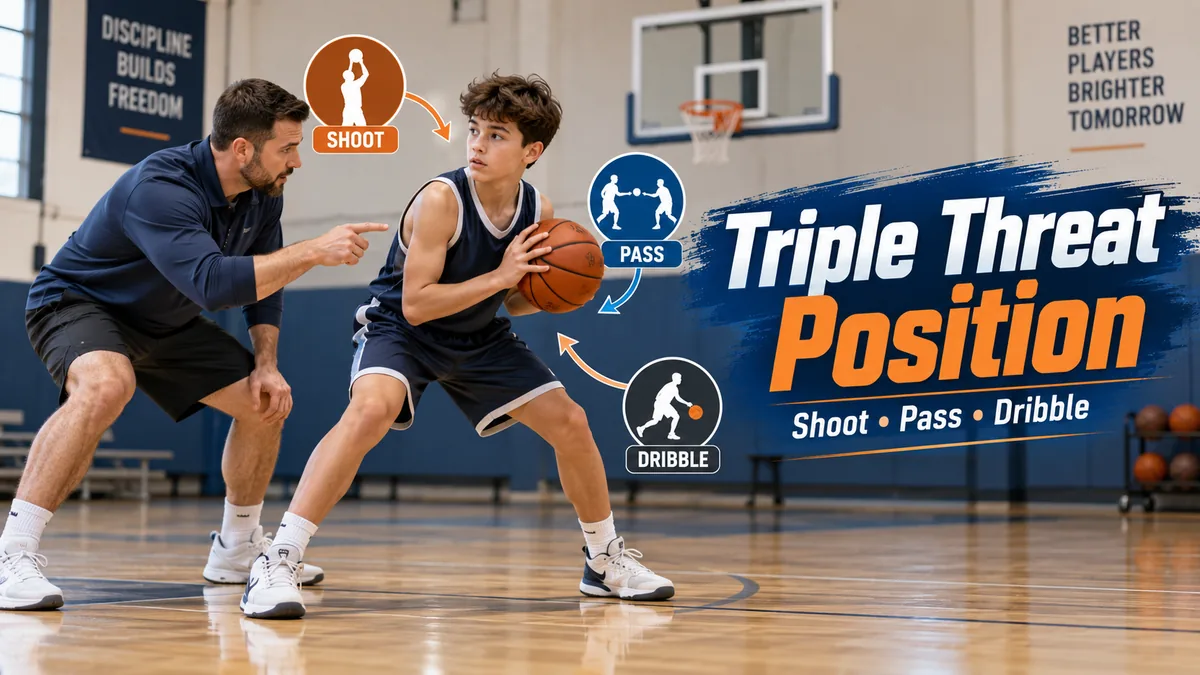
What Is the Triple Threat Position in Basketball?
The triple threat position is one of the most important fundamentals a young basketball player can learn. It gives a player three immediate options after receiving the ball: shoot, pass, or dribble.
For youth coaches, teaching triple threat is not just about showing players where to hold the ball. The goal is to help them develop balance, awareness, footwork, and the habit of making a decision before the defense takes control.
A player who catches the ball while standing upright, looking down, or holding the ball carelessly is easier to defend. A player who catches in a balanced triple threat position is ready to attack.
That difference becomes increasingly important as players progress.
Why the Triple Threat Position Matters
Young players often want to dribble immediately after catching the ball. This can create unnecessary turnovers and prevent them from seeing teammates who are open.
Triple threat teaches players to slow down for a moment and read the court.
From a strong position, the player can recognize whether the defender is giving space for a shot, pressuring too closely, or leaving a passing lane open.
The stance also creates better balance. This helps players protect the basketball and move efficiently without wasting unnecessary steps.
For coaches, triple threat is therefore connected to much more than individual skill. It supports better decision-making, spacing, passing, shooting, and team offense.
How to Get Into a Proper Triple Threat Position
A good triple threat stance should feel athletic rather than uncomfortable.
The player’s feet should generally be around shoulder-width apart. The knees should be slightly bent, with the body balanced and ready to move.
The player’s head should remain up.
This is especially important for beginners. Looking down at the basketball makes it difficult to see defenders and teammates.
The ball should be held securely with both hands in a position where the player can quickly transition into a pass, shot, or dribble.
Coaches should avoid teaching one rigid ball position for every situation. The exact position can change depending on defensive pressure, the player’s location on the court, and what the player intends to do next.
The key principle is that the basketball must remain protected and usable.
The Three Threats
The name “triple threat” comes from the three actions available to the offensive player.
Shoot: If the defender gives enough space and the player is within a comfortable shooting range, the player can move directly into the shooting motion.
Pass: If a teammate becomes open, the player can quickly deliver the ball without first taking an unnecessary dribble.
Dribble: If the defender closes out aggressively or a driving lane becomes available, the player can put the ball on the floor and attack.
Young players do not need to use every option on every catch.
Instead, they should understand that having all three options available makes them harder to defend.
Teach Players to Catch Ready
One of the easiest coaching improvements is teaching players to prepare before the ball arrives.
A player should not wait until after the catch to decide how to position the body.
Encourage players to watch the ball, prepare their feet, catch securely, and immediately establish balance.
You can use the phrase:
“Catch ready.”
It is simple enough for young players to remember during games.
Repeated consistently during practice, this cue can gradually become a habit.
Understanding the Pivot Foot
The pivot foot is an important part of triple threat.
After establishing possession, players need to understand which foot can remain planted while the other foot moves.
Teaching pivoting helps players protect the ball, create passing angles, and move away from defensive pressure without traveling.
For beginners, do not introduce too many complicated pivot combinations at once.
Start with balance and control.
Teach players to establish the pivot foot, move the free foot while staying under control, and return to an athletic position.
Once that becomes comfortable, introduce forward pivots, reverse pivots, and moves that lead into passing or driving.
A Simple Triple Threat Teaching Progression
A useful progression for beginners is:
- Start without a defender. Have players catch the ball and freeze in triple threat while the coach checks feet, knees, head position, and ball control.
- Add a pivot. Players catch, establish balance, pivot, and return to triple threat.
- Add a decision. Call out “shoot,” “pass,” or “drive” after the catch and have the player react.
- Introduce a passive defender. The defender provides light pressure while the offensive player practices protecting the ball.
- Progress to live play. Allow the offensive player to read the defender and choose the best option.
The purpose is not speed at first.
Correct technique and decision-making should come before performing the movement quickly.
Simple Triple Threat Drill for Youth Players
One effective drill requires only two players and one basketball.
Player A begins with the ball while Player B gets into a receiving position.
Player A passes to Player B.
Player B catches the basketball and immediately establishes triple threat.
The coach then calls one of three commands:
Shot, Pass, or Drive.
If the coach calls “shot,” the player moves into a controlled shooting motion.
For “pass,” the player makes a strong pass back to the partner.
For “drive,” the player takes an explosive first step and dribbles past an imaginary defender.
After several repetitions, stop giving commands.
Instead, use a defender and allow the offensive player to make the decision.
This changes the drill from simply practicing movement into practicing basketball awareness.
Common Triple Threat Mistakes
One common mistake is standing too upright.
Players who lock their knees are slower when trying to shoot or drive. Remind them to stay balanced and athletic.
Another mistake is looking at the basketball.
Players should gradually become comfortable enough with the ball to keep their eyes on the court.
Young players may also expose the basketball directly in front of the defender. Teach them to use their body and positioning to protect possession.
Another common habit is automatically dribbling after every catch.
This is one of the main behaviors triple threat training can improve.
A player who has not started dribbling still has more options than a player who has already used the dribble.
Teaching the First Step
A strong first step makes triple threat much more effective.
When a defender closes out too aggressively, the offensive player should be able to attack the available space immediately.
Young players sometimes take a small unnecessary step before beginning the drive.
Encourage them to make the first movement purposeful.
The first dribble should help the player gain an advantage rather than simply putting the basketball on the floor.
This can be practiced slowly before increasing speed.
Protecting the Basketball
Triple threat should also teach ball security.
When defensive pressure increases, players should understand how to keep the ball away from reaching hands.
The basketball should be controlled firmly without becoming tense.
Players can use their body position to create space between the defender and the ball.
However, coaches should emphasize legal basketball movement rather than pushing, swinging elbows, or making dangerous contact.
Good ball protection comes primarily from balance, awareness, positioning, and strong fundamentals.
How Often Should Coaches Practice Triple Threat?
Triple threat does not need to become a long isolated drill at every practice.
Short, frequent repetitions are usually more useful.
Coaches can include triple threat principles in passing drills, shooting drills, one-on-one activities, and offensive team drills.
For example, require every player to catch in triple threat during a passing exercise.
During a shooting drill, ask players to establish the stance before beginning the shot.
During one-on-one play, encourage offensive players to read the defender before dribbling.
This integrates the skill into real basketball situations.
Triple Threat for Younger Players
For very young beginners, keep instruction simple.
Instead of explaining every technical detail, focus on three ideas:
Stay balanced. Keep your eyes up. Be ready to shoot, pass, or dribble.
Once players consistently demonstrate those habits, coaches can add pivoting, jab steps, ball protection, and more advanced reads.
Trying to teach every detail at once can make the position feel more complicated than it actually is.
Progress gradually.
Triple Threat Is a Decision-Making Skill
The physical stance is only the beginning.
The real value of triple threat is that it encourages players to recognize what is happening around them.
Is the defender standing several feet away?
Is a teammate cutting toward the basket?
Is there an open driving lane?
Is another defender preparing to help?
Players who learn to observe these situations become more effective even without advanced moves.
This is why triple threat should be taught as both a basketball position and a decision-making habit.
Final Coaching Tips
Youth coaches should avoid expecting perfect technique immediately.
Players develop at different speeds, and young athletes need repetition before movements become automatic.
Use simple coaching cues and correct one issue at a time.
Praise players when they make good decisions, not only when they score.
A player who catches in triple threat, sees an open teammate, and makes the correct pass has successfully used the skill—even if that play never appears on the scoreboard.
Over time, consistent practice helps players become more balanced, confident, and aware with the basketball.
The triple threat position may look simple, but it creates the foundation for many offensive skills that players will use throughout their development.
