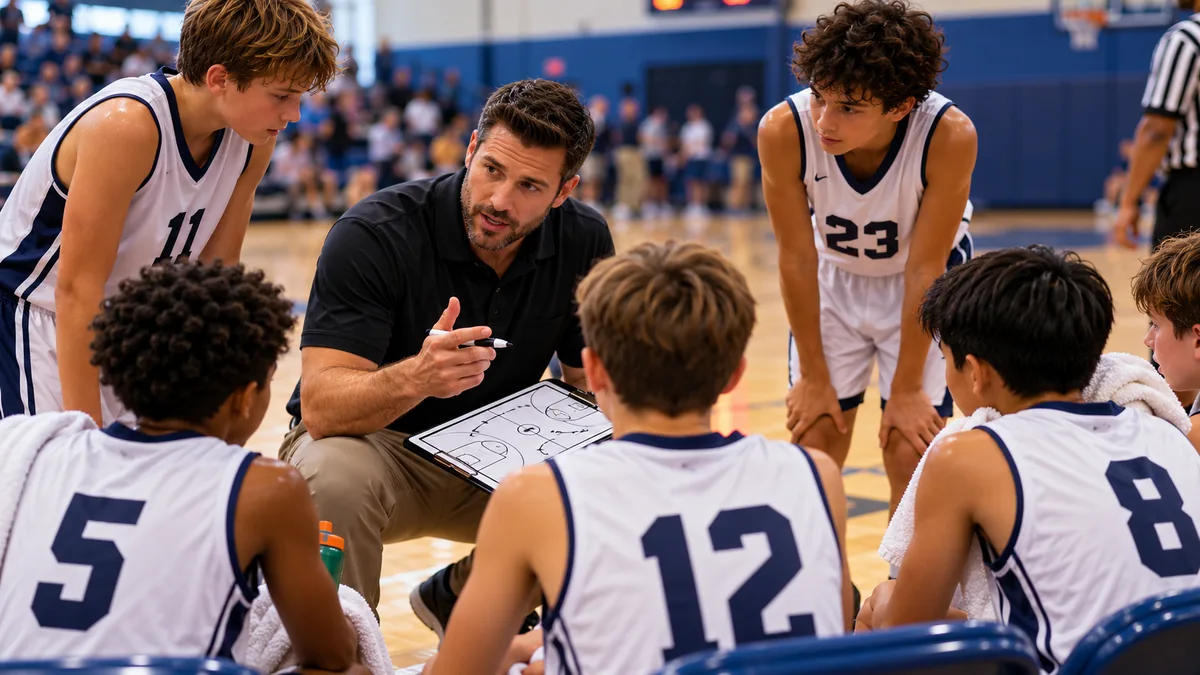
A youth basketball timeout can either help players regain clarity or leave them even more confused.
The difference is usually not how much the coach knows.
It is how clearly the coach communicates.
Young players rarely need a long tactical speech during a timeout. They need a short reset, one clear problem to understand, one or two actions they can remember, and confidence about what happens next.
When coaches try to correct five mistakes at once, players often return to the court remembering none of them.
A better approach is to keep every timeout simple and repeatable.
This guide introduces a practical framework coaches can use during games so that timeouts become teaching moments instead of rushed lectures.
What Is a Timeout Actually For?
A timeout is not automatically a strategy meeting.
Sometimes the team needs tactical information.
Sometimes players simply need to slow down emotionally.
Sometimes the coach needs to change a defensive matchup.
Sometimes everyone needs to recognize the same problem.
The first job of the coach is therefore to identify why the timeout was called.
If the team has committed three turnovers because players are rushing, drawing a complicated inbound play may not solve the real problem.
If an opponent keeps scoring because one defender is out of position, giving the entire team six different defensive instructions is unnecessary.
Good timeout coaching begins with diagnosis.
Ask yourself one question before the players reach the bench:
What is the most important thing they need to understand right now?
Build the timeout around that answer.
The RESET Framework for Youth Basketball Timeouts
A simple way to organize a youth basketball timeout is the RESET framework.
RESET stands for:
Reset → Explain → Set → Empower → Transition
The coach follows the same basic sequence each time.
This makes communication predictable for players and helps the coach avoid talking too much.
R — Reset the Players First
The first few seconds should reduce chaos.
Players may arrive at the bench frustrated, excited, tired, or talking over one another.
Do not immediately begin shouting instructions.
Get their attention.
Use a calm sentence such as:
“Eyes here. We’re okay. Let’s fix one thing.”
That does not mean ignoring poor play.
It means creating enough attention for the next instruction to actually be heard.
Players cannot process tactical information effectively when everyone is talking at the same time.
A calm opening is especially useful after turnovers, an opponent’s scoring run, or a mistake late in the game.
Confidence matters here too. Young players should understand that a bad two-minute stretch does not mean the game is over. Your existing article on building player confidence can support this idea as an internal link.
E — Explain the Main Problem
Now identify the problem in one clear sentence.
Avoid vague statements.
Instead of:
“We need to play better!”
Say:
“Their ball handler is getting into the middle every possession.”
Instead of:
“Move the basketball!”
Say:
“We are holding the ball too long after the first pass.”
Instead of:
“Come on, rebound!”
Say:
“We are watching the shot instead of finding a player to box out.”
Specific language gives players something they can recognize.
Try to describe what is happening rather than attacking the player.
There is an important difference between:
“You keep messing up on defense.”
and:
“When the ball goes to the wing, we need you between your player and the basket.”
One produces frustration.
The other gives a usable correction.
S — Set One Clear Adjustment
Once players understand the problem, give them the solution.
Keep it small.
One adjustment is often enough.
If the opponent is driving through the middle, the adjustment might be:
“Force the ball toward the sideline.”
If the offense is crowded:
“Keep the corners occupied and give the ball handler space.”
If players are rushing:
“On the next possession, make one strong pass before we attack.”
The adjustment should be something players can immediately perform.
A timeout is usually not the best moment to install a completely new offensive system.
If an idea requires several minutes of explanation, it probably belongs in practice.
E — Empower the Players
Before finishing the timeout, give players some responsibility.
Ask a short question.
For example:
“What are we taking away defensively?”
Players answer:
“The middle.”
Or ask:
“What do we do after the rebound?”
Players answer:
“Look ahead and run wide.”
This quick interaction helps confirm whether they actually understood the message.
It also prevents the timeout from becoming a one-way lecture.
Younger players may need very simple questions.
Older players can handle more responsibility.
A 13-year-old point guard may be able to explain what the defense is doing.
A seven-year-old may only need to repeat one cue.
Both approaches encourage players to think.
T — Transition Back to the Game
The final few seconds should prepare players for the next possession.
Do not finish with another long explanation.
Tell them exactly what matters first.
For example:
“Five white. Alex has the ball. Protect the middle, finish the rebound, and let’s go.”
Or:
“We’re running our normal offense. Good spacing, strong passes, attack when it’s open.”
Players should leave the timeout knowing what happens immediately after play resumes.
That is more useful than leaving the huddle thinking about five different corrections.
A Simple 60-Second Timeout Structure
A useful timeout can roughly follow this rhythm:
First 10 seconds: settle everyone and get attention.
Next 10–15 seconds: identify the problem.
Next 15–20 seconds: explain the adjustment.
Next 10 seconds: ask one confirmation question.
Final seconds: identify the lineup, next possession, and first responsibility.
You do not need to follow a stopwatch.
The point is to prevent the explanation from consuming the entire timeout.
Leave enough time for players to process what was said.
What to Say When the Offense Is Struggling
When young teams struggle offensively, coaches sometimes immediately draw a play.
First decide whether the real problem is execution or structure.
Perhaps the team is not using enough space.
Perhaps players are dribbling into traffic.
Maybe passes are being made too slowly.
Maybe everyone is watching the ball.
If the problem is spacing, a timeout message could be:
“We’re making the court too small. Keep both sides wide. If you pass, move somewhere useful instead of following the ball.”
That gives players a principle rather than a complicated sequence.
If your team regularly struggles with this issue, link readers to your existing guide on teaching spacing in youth basketball.
What to Say When Players Keep Turning the Ball Over
Turnovers often cause coaches to become louder.
That is not always helpful.
First identify the type of turnover.
Are players losing the ball while dribbling?
Throwing passes into traffic?
Rushing after rebounds?
Trying to make difficult passes?
A better timeout message might be:
“We don’t need the perfect pass. Use the easy pass first, then move. Make the defense work.”
For a younger team, that may be enough.
Do not turn one turnover problem into a ten-point offensive lecture.
What to Say When the Defense Is Struggling
Defensive timeout messages should also be specific.
“Play harder” is difficult to execute.
“Stay between your player and the basket” is clear.
“Find someone when the shot goes up” is clear.
“Stop reaching and move your feet” is clear.
If the opposing team has scored three times using the same action, identify exactly where the breakdown begins.
For example:
“The first defender is doing the job. The problem is our help defender is standing too close to their player. Move one step toward the ball so you can help earlier.”
That gives the team a picture they can reproduce.
What to Say After the Opponent Makes a Run
A coach often calls timeout after the other team scores several times in a row.
The natural reaction may be frustration.
But players already know the other team is scoring.
Repeating the score does not teach anything.
Use the timeout to interrupt the emotional momentum.
A simple message could be:
“Forget the last three possessions. Our next job is one defensive stop. Protect the paint, rebound the ball, then we play.”
This narrows attention.
Young players usually handle one immediate objective better than being told they must erase a ten-point deficit.
What to Say When Your Team Is Playing Too Fast
Playing fast and playing rushed are different.
A team can move quickly while still making good decisions.
When players begin throwing difficult passes, attacking multiple defenders, or losing balance, use the timeout to slow the decision-making rather than the effort.
Try:
“Keep running, but stop rushing the decision. Look first. If the advantage is there, attack it. If not, organize.”
That message connects naturally with the transition offense concepts already covered on the site.
What to Say Late in a Close Game
Late-game timeouts require more detail, but young players still need simplicity.
Before play resumes, everyone should know the score, time situation, possession objective, and defensive responsibility.
Do not assume they already know.
You might say:
“We are down two. We do not need a three. Get a good shot at the basket. If we score, match up immediately and do not reach.”
Or:
“We are ahead. Protect the ball. No rushed shot. Make them defend us.”
The language should fit the players’ age and experience.
Older youth teams can process clock management, foul situations, and more specific actions.
Beginners may need only one offensive instruction and one defensive reminder.
Do Not Use Every Timeout to Draw a Play
Coaches often feel that using a clipboard makes a timeout productive.
A diagram can be useful.
But the players have to understand it.
If your team has never practiced the action being drawn, a high-pressure timeout is a poor time to introduce it.
The strongest game adjustments usually come from concepts players have already experienced in practice.
That is one reason organized practice planning matters.
Your existing 60-minute practice guide emphasizes clear objectives, simple teaching cues, and game-like decision-making. Those same habits make game-day communication easier. How to Coach Youth Basketball
Rehearse Timeouts During Practice
Timeout communication can be practiced.
During a scrimmage, stop the game and tell players:
“Treat this like a real timeout.”
Give them twenty or thirty seconds.
Use the RESET framework.
Then restart immediately.
This helps coaches improve their own communication.
It also teaches players how to listen, ask a quick question, and return to the floor ready to execute.
A team that has practiced timeout behavior wastes less time during actual games.
Match the Message to the Age Group
For ages 6–8, use very short instructions.
One offensive cue and one defensive cue may be enough.
For example:
“Spread out on offense. Stay between your player and the basket on defense.”
For ages 9–11, begin adding simple decisions.
Players can understand ideas such as protecting the middle, looking ahead after a rebound, spacing to the corners, or making the extra pass.
For ages 12–14, coaches can introduce more situational detail.
Players may be ready to discuss matchups, screening actions, clock awareness, foul situations, and specific defensive adjustments.
The message should become more advanced as the players become more capable—not simply longer.
Avoid Emotional Timeouts
There will be moments when a coach is frustrated.
Calling timeout only to express that frustration rarely improves the next possession.
If you need several seconds to organize your thoughts, use them.
Decide what the team can actually change.
Then communicate that.
Young players do not need a perfect coach.
They do need a coach whose instructions remain understandable when the game becomes difficult.
Give Players Room to Solve Problems
Not every mistake requires a timeout.
If coaches stop the game every time players become uncomfortable, athletes may never learn to solve problems independently.
Sometimes the better choice is to let the game continue.
Players need opportunities to recognize what is happening, communicate with teammates, and make adjustments.
USA Basketball’s 3×3 model offers an interesting example: in-game coaching is restricted, placing more decision-making and communication responsibility on the players themselves. USA Basketball
Five-on-five youth basketball is different, but the developmental principle is useful.
The coach should support decision-making, not replace it.
When Should a Youth Coach Call Timeout?
There is no single correct moment.
A timeout may help when the same tactical problem is repeatedly creating an advantage for the opponent.
It may help when players are clearly overwhelmed and need one simple reset.
It may help before an important late-game possession.
It may also help when the coach needs to clarify responsibilities after a lineup change.
But do not call timeout simply because the opponent made one basket.
Give players a chance to respond.
USA Basketball’s youth guidelines also treat timeout structure differently by age group, reinforcing the idea that game management should remain age-appropriate. USA Basketball
Common Timeout Mistakes
The most common mistakes are talking for the entire timeout, correcting too many problems, speaking emotionally instead of specifically, introducing something players have never practiced, failing to tell players what happens next, drawing a play that is too complicated, and allowing several adults to give different instructions at the same time.
One voice and one clear message are usually better.
Assistant coaches can provide useful information, but the communication should be organized before it reaches the players.
How Timeout Communication Builds Confidence
Good timeout communication can influence more than one possession.
Players begin to understand that mistakes can be corrected.
They learn to identify problems without panicking.
They also become more comfortable communicating about basketball.
That is closely connected to player confidence.
The goal is not to make players dependent on the timeout.
The goal is to give them a clear example of how basketball problems can be understood and solved.
Over time, players should begin having some of those conversations themselves.
Frequently Asked Questions
How much should a youth basketball coach say during a timeout?
Usually less than you think. Focus on the most important problem, give one or two clear actions, confirm that players understand, and prepare them for the next possession.
Should I draw plays during every timeout?
No. Use the clipboard when a diagram genuinely makes the message clearer. Young players often benefit more from a familiar concept than a new play introduced under pressure.
What should I say after several turnovers?
Identify why the turnovers are happening. Encourage the simplest available decision, such as using an easier pass, improving spacing, or looking before dribbling.
Should I yell during a timeout?
Volume may be necessary in a noisy gym, but emotional shouting is different from clear communication. Calm, specific instructions are usually easier for young players to use.
Should players talk during the timeout?
Yes, when appropriate. Short questions can confirm understanding and encourage players to recognize what is happening on the court.
Is it okay not to call timeout during an opponent’s scoring run?
Yes. Sometimes players should be allowed to respond themselves. Call timeout when you have a useful reason and a clear message, not simply because several baskets were scored.
Final Thoughts
A youth basketball timeout should create clarity.
It does not need a long speech.
It does not need five adjustments.
And it does not always need a new play.
Reset the players.
Explain the main problem.
Set one clear adjustment.
Empower players to understand the solution.
Then transition them back to the game with a clear first responsibility.
That simple RESET framework gives coaches a repeatable way to communicate under pressure.
More importantly, it helps young players learn that basketball problems can be recognized, discussed, and solved without panic.
The best timeout is not necessarily the one where the coach says the most.
It is the one where the players return to the floor knowing exactly what to do next.
