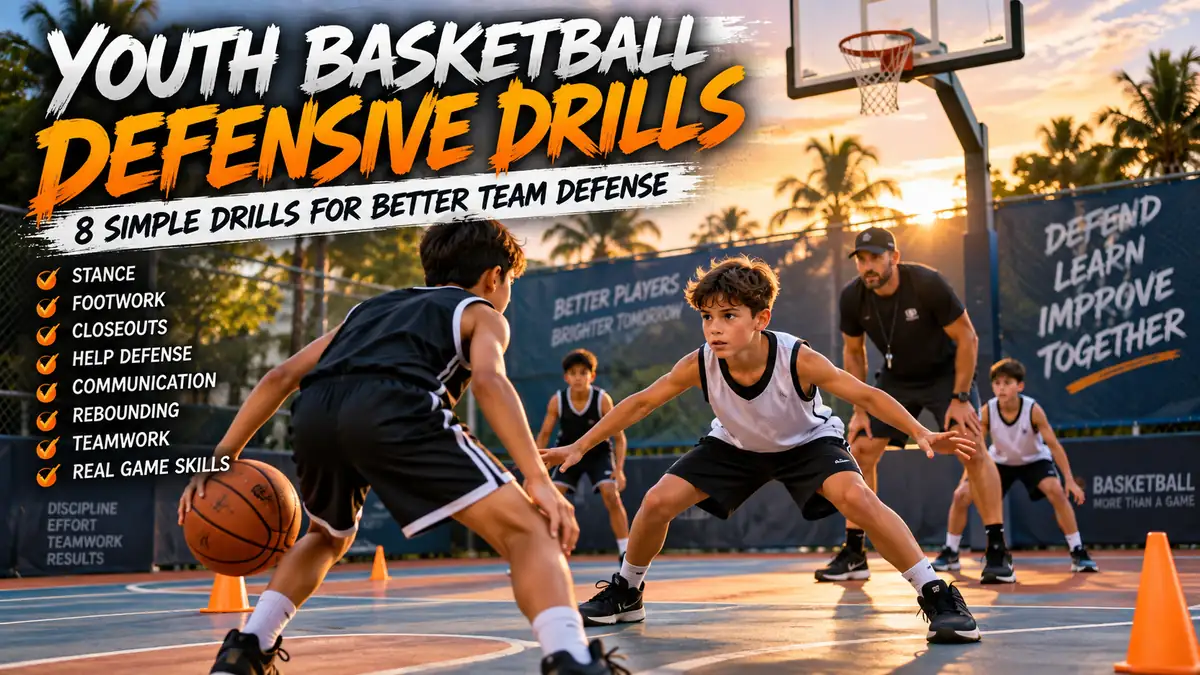
Defense is one of the most important skills young basketball players can learn.
A strong youth defense is not built by teaching complicated systems. It starts with simple habits: staying balanced, moving the feet, seeing both the ball and the player, communicating, and helping teammates when necessary.
That is why youth basketball defensive drills should focus on fundamentals before introducing advanced rotations or defensive schemes.
The eight drills below are designed to help young players improve defensive stance, footwork, closeouts, communication, help defense, rebounding, and decision-making.
Why Defense Matters in Youth Basketball
Young players often become excited about shooting and dribbling, while defense receives less attention.
However, good defensive habits can improve the entire team.
Defense teaches players how to:
- Stay balanced
- React instead of guessing
- Communicate with teammates
- Protect the basket
- Contest shots
- Recover after mistakes
- Finish possessions with rebounds
Strong defense also encourages players to understand spacing and movement from a different perspective.
Instead of asking, “Where should I go to score?” players begin asking, “Where is the offense trying to go?”
That awareness helps them become better overall basketball players.
Start With a Good Defensive Stance
Before beginning live drills, teach players how to stand correctly.
A basic defensive stance should be comfortable rather than exaggerated.
Players should:
- Keep the feet around shoulder-width apart
- Bend the knees slightly
- Keep the chest up
- Stay balanced on the feet
- Keep the hands active
- Avoid standing too upright
A useful coaching cue is:
“Low enough to move, tall enough to see.”
Players should feel ready to move left, right, forward, or backward.
If they are leaning too heavily in one direction, an offensive player can attack the opposite side.
Drill 1: Defensive Stance and Mirror Drill
This is a simple drill for teaching reaction and body control.
Setup
Place players in pairs.
One player is the leader and the other is the defender.
The leader moves laterally inside a small area.
The defender mirrors every movement.
No basketball is needed at first.
Coaching Points
The defender should:
- Stay balanced
- Keep the chest facing the leader
- Avoid crossing the feet
- Use short, controlled movements
- Keep the hands active
Run the drill for 15 to 20 seconds before switching roles.
This drill teaches players to react to movement instead of predicting where the opponent will go.
Once players improve, add a basketball to the offensive player.
The ball handler can dribble from side to side while the defender mirrors the movement.
Drill 2: Defensive Slide Between Cones
Defensive slides are one of the most basic movement skills in youth basketball.
Place two cones approximately eight to twelve feet apart.
Players begin at one cone in a defensive stance.
They slide toward the second cone, touch the line or cone area, and return.
The feet should stay apart.
Players should avoid bringing the feet together after every step.
A useful cue is:
“Push, slide, stay wide.”
Do not make this drill too long.
Short, high-quality repetitions are more valuable than forcing players to slide until they become tired and lose technique.
You can gradually turn the drill into a reaction activity by having the coach point left or right.
The player must immediately slide in that direction.
This connects naturally with the basketball footwork drills for youth players already practiced during skill-development sessions.
Drill 3: Closeout and Contain
A closeout happens when a defender moves toward an offensive player who has received the basketball.
It is an important skill because young defenders often make one of two mistakes.
They either approach too slowly and allow an open shot, or they sprint too aggressively and get beaten off the dribble.
Setup
Place an offensive player on the wing.
The defender begins several steps away.
The coach passes the ball to the offensive player.
As the pass travels, the defender closes out.
The offensive player then gets one or two dribbles.
Coaching Points
The defender should:
- Sprint during the first part of the closeout
- Shorten the final steps
- Stay balanced
- Raise a hand to contest
- Avoid jumping unnecessarily
- Prepare to move laterally
A simple cue is:
“Sprint, shorten, contain.”
Once the defender arrives under control, the goal is to prevent an easy drive.
Drill 4: 1-on-1 Channel Defense
This drill teaches players how to stay in front of the basketball.
Create a narrow channel using cones or court lines.
One offensive player begins with the basketball.
One defender guards them.
The offensive player tries to dribble through the channel.
The defender tries to stay between the ball handler and the basket.
Because the area is narrow, the defender can focus on positioning instead of guarding the entire court.
At first, limit the offensive player to three or four dribbles.
This prevents the drill from turning into a long one-on-one battle.
Teach defenders to move their feet before reaching with their hands.
A useful coaching phrase is:
“Chest first, hands second.”
Players should learn that staying in front of the opponent is more important than trying to steal every dribble.
Drill 5: Help and Recover
Individual defense is important, but basketball is a team game.
Players also need to understand when and how to help a teammate.
Setup
Use three offensive players around the perimeter and three defenders.
Begin with the ball on one side.
The offensive player drives toward the basket.
The nearest off-ball defender moves into a help position.
When the ball is passed back outside, the defender recovers to the original assignment.
Start at half speed.
The purpose is to teach positioning rather than winning the possession.
Coaching Points
Defenders should understand:
- Protect the basket first
- Help without completely losing the original player
- Recover quickly after the ball moves
- Communicate during the entire possession
Use simple language such as:
“See ball and player.”
and:
“Help, then recover.”
This drill prepares young players for more advanced team defense later.
Drill 6: Shell Defense for Beginners
Shell defense is one of the most useful team-defense drills, but it should be simplified for young players.
Start with four offensive players around the perimeter and four defenders.
The offense passes the ball around without dribbling.
Defenders adjust their positions every time the ball moves.
Basic Rules
When guarding the ball:
- Stay close enough to pressure
- Remain balanced
- Protect against the drive
When one pass away:
- Stay in a position to help and recover
When farther away:
- Move toward the middle enough to protect the basket
Do not overload young players with complicated terminology.
Instead, repeatedly ask:
“Where is the ball?”
“Where is your player?”
“Can you help?”
After players understand the movement, allow the offense to drive.
This creates realistic defensive decisions.
Drill 7: Closeout to Box Out
Defense does not end when the shot goes up.
A defensive possession is only complete when the team controls the rebound.
This drill connects perimeter defense with rebounding.
Setup
Place one offensive player on the wing and one defender near the lane.
The coach passes to the offense.
The defender closes out.
After one or two seconds, the offensive player takes a shot.
The defender must locate the player, make contact legally, box out, and pursue the rebound.
Coaching Points
Teach the sequence:
Close out — contest — find — box out — rebound.
Young players often watch the basketball after the shot.
This allows offensive players to run toward the rim uncontested.
Teach defenders to find the opponent first before chasing the ball.
This drill also prepares the team for future youth basketball rebounding drills.
Drill 8: 3-on-3 Defensive Stops
The final drill puts the skills into a live game.
Play half-court 3-on-3.
The defense earns one point for every successful stop.
A stop can be:
- A defensive rebound
- A forced turnover
- A shot-clock-style violation set by the coach
- An offensive possession with no clean shot
The offense earns a point for scoring.
After each possession, switch roles.
Add Defensive Bonus Points
You can also reward:
- Good communication
- A successful closeout
- Proper help defense
- A strong box out
- Forcing the offense away from the middle
This encourages players to value defensive actions that may not appear in a normal box score.
Because the team already uses 3-on-3 basketball drills for youth teams, this defensive version fits naturally into the existing practice structure.
Teach Players to Defend Without Reaching
One of the most common mistakes in youth defense is reaching for the basketball.
Players see the ball and immediately try to steal it.
That often causes them to lose balance.
Instead, teach players to move the feet first.
The goal should be to make the offensive player uncomfortable without giving away an easy driving lane.
A simple rule is:
“If your feet stop, your hands become dangerous.”
Players should use their hands actively, but they should not depend on reaching.
Teach Players to Protect the Middle
For many youth teams, a simple defensive principle is to avoid allowing easy drives directly toward the basket.
The defender should try to influence the ball handler toward less dangerous areas.
Do not introduce complicated defensive terminology too early.
Young players can begin with:
“Stay between your player and the basket.”
That one principle solves many positioning problems.
As players improve, coaches can introduce more detailed concepts such as forcing baseline or influencing the ball toward help.
Communication Should Be Part of Every Drill
Defensive communication should not be saved for games.
Players need to practice it.
During defensive drills, require simple calls such as:
“Ball!”
“Help!”
“Screen!”
“I’ve got help!”
“Shot!”
Young players may feel uncomfortable talking at first.
Make communication part of the scoring system.
For example, a defensive stop only counts if the team communicates during the possession.
Over time, talking becomes normal.
Keep Defensive Drills Competitive
Defense requires effort.
Competition can help young players stay engaged.
Try short challenges such as:
- First defender to earn three stops
- Team with the most stops in two minutes
- Three defensive rebounds in a row
- No-middle-drive challenge
- Closeout without allowing a drive
Keep competitions short.
Long defensive drills can lead to fatigue, poor technique, and frustration.
Avoid Punishment-Based Defense
Defense should not always be associated with running or punishment.
If players only hear about defense when they make mistakes, they may begin to view it negatively.
Instead, praise defensive habits.
Recognize players who:
- Talk early
- Help teammates
- Stay balanced
- Contest without fouling
- Box out consistently
- Recover after being beaten
Young athletes often repeat behaviors that coaches consistently notice.
Common Youth Basketball Defensive Mistakes
Standing Too Upright
Players become slower when they stand tall.
Remind them to bend the knees slightly and stay ready.
Crossing the Feet
Crossing the feet during lateral movement can make it difficult to change direction.
Use short slide drills to reinforce control.
Watching Only the Basketball
Off-ball defenders may lose track of their assigned player.
Teach them to see both the ball and the player whenever possible.
Reaching Too Much
Players should move the feet first.
Steals should come from good positioning rather than constant gambling.
Overhelping
Young players sometimes leave their assignment completely to help.
Teach them to help enough to protect the basket while still being able to recover.
Forgetting to Rebound
Defense is not finished after the shot.
Finish every defensive drill with a rebound whenever possible.
How Long Should Defensive Drills Last?
For many youth practices, 10 to 20 minutes of focused defense is enough.
You do not need to teach everything in one session.
One practice might focus on stance and slides.
Another can emphasize closeouts.
Later, introduce help defense and rebounding.
Short, consistent instruction usually produces better results than one long defensive session.
You can also include these drills inside a structured youth basketball practice plan so defense becomes part of the regular routine instead of an occasional topic.
How Coaches Can Measure Defensive Progress
Do not measure defense only by steals.
A player can gamble for steals and still be a poor defender.
Instead, watch for improvements such as:
- Fewer straight-line drives
- Better closeouts
- More communication
- Better help positioning
- Fewer unnecessary fouls
- More defensive rebounds
- Better recovery after mistakes
- Players staying engaged away from the ball
Those habits are stronger indicators of defensive development.
Frequently Asked Questions
What are the best youth basketball defensive drills?
Mirror drills, defensive slides, closeouts, one-on-one channel defense, help-and-recover drills, shell defense, box-out drills, and small-sided defensive games are excellent starting points.
How do you teach defense to beginners?
Start with stance, balance, and movement. Introduce one concept at a time before adding live offensive pressure.
Should youth players practice stealing the ball?
Players can learn proper hand activity, but staying balanced and protecting the basket should come first.
How do you teach help defense to kids?
Use simple positioning drills. Show players how to move toward the ball when a teammate is beaten and recover when the ball is passed.
How often should youth teams practice defense?
Defense can be included in every practice through short drills, competitive games, and small-sided play.
Should defenders always stay low?
Players should stay in an athletic position, but they should not become so low that movement feels uncomfortable or slow.
Final Thoughts
Effective youth basketball defensive drills do not need to be complicated.
Start with stance and movement.
Teach players how to close out under control.
Help them stay in front of the ball without reaching.
Introduce help defense, communication, and rebounding gradually.
Finally, give players opportunities to use those skills in live 1-on-1, 2-on-2, and 3-on-3 situations.
When defensive fundamentals become habits, the entire team improves.
Players communicate more, protect the basket better, rebound with greater purpose, and learn how to compete on every possession.
