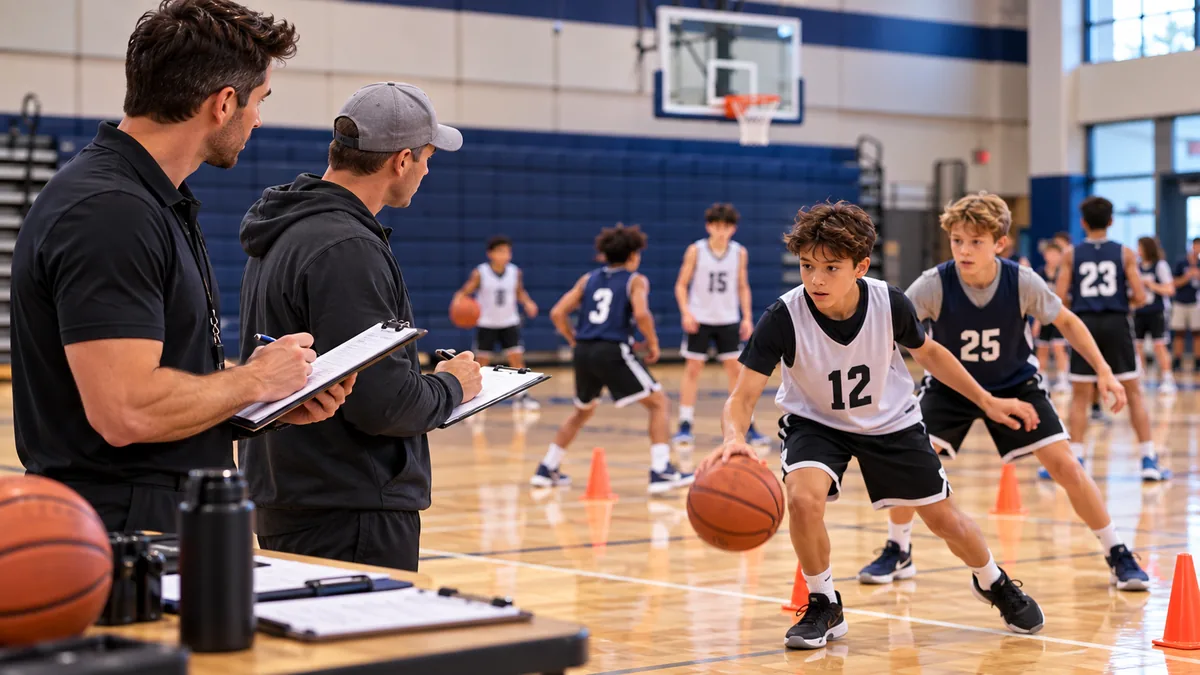
Youth basketball tryouts should do more than identify the five players who can score the most points.
A good tryout helps coaches understand how players move, handle the basketball, make decisions, compete, communicate, respond to coaching, and fit within a team environment.
That becomes especially important with young athletes.
One player may already have several years of organized basketball experience.
Another may be new to the sport but show excellent coordination, effort, awareness, and learning ability.
If the entire evaluation consists of layup lines and five-on-five scrimmages, coaches may miss important information about both players.
A better system combines fundamental skills with small-sided games, live decisions, and clear evaluation criteria.
The goal is not to create a perfect ranking.
The goal is to collect enough useful information to make fair, informed decisions.
Know What You Are Selecting For
Before players arrive, coaches should decide what the tryout is actually meant to accomplish.
Are you selecting a competitive travel team?
Creating balanced recreational teams?
Evaluating players before dividing them by skill level?
Identifying developmental groups?
Building one roster from a large number of athletes?
Those situations require different decisions.
For example, a developmental program may place more value on coachability, movement ability, and long-term potential.
A competitive team may require players who can already perform certain skills under pressure.
Neither approach is automatically better.
The important part is knowing the purpose before the evaluation begins.
Do not change the standard halfway through the session because one player makes several impressive shots.
Evaluate More Than Basketball Skill
Technical ability matters.
But youth coaches should evaluate several areas.
A useful framework is:
Skill
Can the player dribble, pass, finish, shoot, defend, and move with reasonable control?
Decision-Making
Does the player recognize open teammates, space, defensive pressure, and scoring opportunities?
Movement
Can the player stop, change direction, stay balanced, and coordinate basketball movements?
Competitive Habits
Does the player run back on defense, rebound, communicate, and continue working after mistakes?
Coachability
Can the player listen to an instruction and make an adjustment?
These areas create a more complete picture than scoring alone.
The Jr. NBA’s development philosophy similarly emphasizes fundamentals, teamwork, respect, sportsmanship, and the broader development of young players rather than treating basketball only as a scoring exercise. NBA.com: Jr. NBA
Do Not Begin With Five-on-Five
Five-on-five basketball is useful, but it should not be the first thing you evaluate.
There are ten players on the court.
Some athletes may barely touch the ball.
A strong player can dominate possession.
A quiet player may disappear even though they make good decisions.
The game can become difficult to evaluate.
Start with simpler situations first.
Individual activities show basic control.
Two-player activities reveal passing and movement.
One-on-one shows attacking and defensive ability.
Two-on-two and three-on-three reveal decisions.
Then five-on-five allows coaches to see how those abilities connect in a full game.
That progression provides much more information.
Start With a Consistent Evaluation Form
Do not rely entirely on memory.
After watching thirty players for ninety minutes, it becomes difficult to remember exactly who made which decisions.
Use a simple scorecard.
You might evaluate each player from 1 to 5 in:
| Area | What to Watch |
|---|---|
| Ball Control | Control with either hand, changes of direction, eyes up |
| Passing | Accuracy, timing, willingness to share the ball |
| Finishing | Balance, control, ability to finish near the basket |
| Shooting | Mechanics, balance, shot selection |
| Defense | Stance, positioning, effort, recovery |
| Decision-Making | Reads space and defenders, avoids forcing plays |
| Rebounding | Finds the ball, boxes out, competes |
| Communication | Talks, listens, helps teammates |
| Effort | Runs, competes, stays involved |
| Coachability | Listens and applies corrections |
You do not need to treat every category equally.
But using the same criteria for every athlete makes the process more consistent.
Avoid Evaluating Players by Body Size Alone
Young athletes develop physically at different rates.
The tallest player at age ten may not always be the tallest player later.
The smallest player may develop into an excellent guard.
Avoid designing the roster entirely around current height.
Size can be useful.
So can speed, coordination, awareness, touch, competitiveness, and decision-making.
Evaluate what a player can do now while also considering what they may be able to learn.
Phase 1: Movement and Ball Control
Begin with activities that allow every player to move.
Avoid long speeches.
Give each athlete as many repetitions as possible.
A simple ball-control section can include:
- Right-hand dribbling
- Left-hand dribbling
- Change of direction
- Controlled speed dribbling
- Stops and pivots
- Protecting the basketball
Do not judge only whether players lose the ball.
Watch how they respond.
Does the player immediately recover?
Do they become frustrated?
Do they adjust their speed?
Can they follow a new instruction?
Those details tell coaches a lot.
If players need further development after team selection, your existing guide to Basketball Ball Handling Drills for Beginners can become a useful internal resource.
Phase 2: Passing and Partner Decisions
Passing drills should not become target throwing contests.
Accuracy matters, but passing is also about recognizing another player.
Use moving partners.
Ask players to pass, relocate, receive, and continue.
Watch whether they:
Show a target.
Pass accurately.
Move after passing.
Communicate.
Lead a teammate into useful space.
Catch under control.
Then add light defensive pressure.
A player who makes simple, accurate passes repeatedly may help a team more than someone who attempts spectacular passes and turns the ball over.
Phase 3: Finishing Around the Basket
Layups provide useful information about coordination and body control.
Evaluate both sides if the age group is ready.
But do not eliminate a young player simply because they cannot yet finish equally well with both hands.
Watch the process.
Does the player understand the footwork?
Can they improve after one correction?
Can they finish while moving at game speed?
Can they protect the ball?
Can they adjust their angle?
For beginners, these developmental signals can be more important than the raw number of makes.
Phase 4: Shooting
A shooting station should provide enough repetitions to observe mechanics.
Do not turn the evaluation into a three-point contest.
Young players sometimes shoot from distances beyond their current strength, causing technique to break down.
Begin closer to the basket.
Watch:
Balance.
Foot positioning.
Ball control.
Release.
Follow-through.
Ability to repeat the motion.
Then gradually move farther away if appropriate.
Your existing article on teaching shooting form to young basketball players is useful for this stage because it focuses on balanced, repeatable mechanics rather than forcing identical shooting styles. How to Coach Youth Basketball
Phase 5: One-on-One
One-on-one reveals things that stationary drills cannot.
Offensively, watch whether the player can:
Create space.
Change speed.
Protect the ball.
Recognize a driving lane.
Stop under control.
Defensively, watch whether the player can:
Stay balanced.
Move their feet.
Protect the basket.
Recover after being beaten.
Compete without constantly reaching.
Keep the activity short.
For example, give the offensive player three dribbles or several seconds to create an advantage.
Then rotate quickly.
The goal is evaluation, not allowing two players to occupy the court for several minutes.
Phase 6: Two-on-Two
Two-on-two is one of the most useful parts of youth basketball tryouts.
Now players must interact with a teammate and two defenders.
They need to decide whether to:
Pass.
Drive.
Cut.
Create space.
Help defensively.
Switch responsibilities.
Rebound.
Move after the ball changes sides.
This is where basketball understanding begins to become visible.
One player may not look exceptional during isolated drills but suddenly becomes valuable when decisions are required.
Pay attention to those athletes.
Phase 7: Three-on-Three
Three-on-three adds more complexity while still giving every player frequent involvement.
The Jr. NBA curriculum has expanded its use of small-sided games and decision-making activities because fewer-player environments create repeated opportunities to read and react. NBA.com: Jr. NBA
During the tryout, watch:
Who creates useful spacing?
Who moves after passing?
Who helps defensively?
Who communicates?
Who recognizes an open teammate?
Who forces difficult plays?
Who remains involved without the ball?
Who reacts quickly after possession changes?
Three-on-three often reveals basketball awareness better than a line drill.
Your site’s existing 3-on-3 basketball drills for youth article also provides a natural internal link because it already focuses on spacing and decision-making. How to Coach Youth Basketball
Phase 8: Live Five-on-Five
Now move into normal basketball.
By this point, coaches already have information from individual skills and smaller games.
Five-on-five helps answer another question:
Can the player use those abilities inside a full team environment?
Do not judge only made baskets.
Look for habits.
Does the player sprint back on defense?
Do they communicate?
Do they move when they do not have the basketball?
Can they stay involved for several possessions without touching the ball?
Do they rebound?
Do they make the extra pass?
Do they recognize transition opportunities?
Do they understand spacing?
The player who helps the team function may not always be the player who scores the most.
Watch Players Without the Basketball
One of the biggest tryout mistakes is watching only the ball.
The player holding the basketball naturally attracts attention.
But coaches should deliberately watch other areas of the floor.
Observe a player for an entire possession.
What do they do after passing?
What happens when their teammate drives?
Do they help on defense?
Do they box out?
Do they communicate?
Do they stand still?
Some of the most useful evaluation information happens away from the basketball.
Coach One Small Detail During the Tryout
A tryout should not be completely silent.
Give players occasional coaching instructions.
For example:
“On defense, stay between your player and the basket.”
Then watch the next few possessions.
Who changes immediately?
Who understands after a second explanation?
Who continues doing the same thing?
This gives you information about coachability.
A player who is slightly less skilled today but learns quickly may have significant developmental potential.
Effort Should Mean More Than Running Fast
Coaches sometimes describe the fastest player as the hardest worker.
Effort appears in many forms.
A player demonstrates effort when they:
Sprint back after a turnover.
Fight for a rebound.
Move again after their first cut is not open.
Communicate on defense.
Retrieve a loose ball.
Stay engaged after missing a shot.
Listen while another group is receiving instructions.
Help organize teammates.
Watch for consistent habits rather than one dramatic hustle play.
Be Careful With Early Impressions
One player may make their first three shots.
Another may miss everything during the first station.
Do not decide the roster during the first fifteen minutes.
Players can be nervous.
Some take longer to become comfortable.
Others perform well in drills but struggle once defenders are added.
Collect information throughout the session.
Tryouts are more accurate when coaches allow their initial opinions to change.
Give Every Player Comparable Opportunities
If one group gets fifteen minutes of three-on-three and another gets five, the evaluation is less useful.
Try to keep stations, repetitions, and game opportunities reasonably consistent.
Avoid repeatedly placing your strongest player with the same teammates.
Mix groups.
Different combinations reveal different qualities.
You may discover that a quieter player becomes much more effective when paired with teammates who move the ball.
Use More Than One Evaluator When Possible
One coach cannot see everything.
If possible, use an assistant coach or another trusted evaluator.
Before the tryout, agree on the evaluation criteria.
Afterward, compare observations independently before discussing final selections.
This can reduce the influence of one person’s first impression.
It can also reveal things one coach missed while watching another part of the court.
Do Not Turn the Tryout Into Conditioning Testing
Conditioning matters in basketball.
But endless sprints provide limited information about whether a young player can play basketball.
If conditioning is important, observe it naturally through active drills and live play.
Watch whether players continue moving and making decisions when tired.
That gives you basketball-specific information rather than simply identifying who runs the fastest.
Do Not Overvalue Advanced Moves
A player may perform a complicated crossover or step-back shot.
That can look impressive.
Ask whether the move creates a useful advantage.
A simple player who consistently protects the basketball, passes to open teammates, defends, and makes good decisions may be more valuable than someone who performs advanced moves without control.
Youth evaluation should reward useful basketball.
Not just impressive-looking basketball.
Identify Roles Without Locking Players Into Positions
During tryouts, you may notice that some athletes handle the ball comfortably.
Others rebound well.
Some defend aggressively.
Some communicate.
Use those observations to understand potential roles.
But avoid permanently labeling young athletes.
Do not decide that a tall ten-year-old must always be a center.
Do not assume the smallest player must always be the point guard.
Young players need broad skill development.
Roles can help organize a team today without limiting what players may become tomorrow.
What About Players Who Are Very New?
A beginner can be difficult to evaluate against athletes with several years of experience.
Look for transferable qualities.
Can they move well?
Do they listen?
Do they compete?
Are they coordinated?
Do they understand simple instructions?
Do they show improvement within the session?
Do they remain engaged after mistakes?
If your program has space for development, these traits matter.
The Jr. NBA structures its instructional curriculum across several developmental levels, including Rookie and Starter programs, reflecting the idea that young athletes can enter the game at different stages of skill development. NBA.com: Jr. NBA
Create a Separate “Potential” Note
Your scorecard can include one field that is not numerical:
Development Potential
Write one short note.
Examples:
“Very raw, learns quickly.”
“Good coordination, needs ball-handling work.”
“Strong defender, hesitant offensively.”
“Excellent passer, limited shooting range.”
“Competitive and coachable.”
This note prevents the final decision from becoming purely mathematical.
Young athletes are developing.
A score represents what you observed that day.
It is not a permanent description of the player.
A Sample 75-Minute Tryout
A simple session could look like this:
| Time | Activity |
|---|---|
| 0–8 min | Dynamic movement and ball control |
| 8–18 min | Dribbling and change-of-direction |
| 18–28 min | Passing and partner movement |
| 28–38 min | Finishing and shooting |
| 38–48 min | 1-on-1 |
| 48–60 min | 2-on-2 and 3-on-3 |
| 60–73 min | 5-on-5 live play |
| 73–75 min | Final notes and player dismissal |
This is only a framework.
Adjust it for the number of players, available baskets, gym size, age, and total evaluation time.
The most important principle is that players spend most of the tryout actually playing rather than standing in lines.
What If You Have 30 or More Players?
Large tryouts require organization.
Create stations.
For example:
Station A: Ball handling
Station B: Passing
Station C: Finishing
Station D: Shooting
Station E: Small-sided play
Rotate groups every several minutes.
Assign an evaluator to specific stations when possible.
Use numbered pinnies or jerseys so coaches do not depend on remembering every name immediately.
After the station phase, divide players into balanced groups for live play.
Should You Publish Player Scores?
Usually, internal evaluation notes are more useful as coaching tools than public rankings.
A scorecard helps coaches make decisions.
It does not need to become a public comparison between children.
If a player or parent asks for feedback, offer useful developmental information.
For example:
“Your ball control was solid, and you competed well defensively. The next area to improve is making quicker passing decisions under pressure.”
That gives the player a direction.
A raw number usually does not.
Handling Roster Cuts
This can be the most difficult part of competitive tryouts.
Be respectful.
Communicate decisions clearly.
Avoid embarrassing public announcements when possible.
Do not tell a young athlete they are “not good enough.”
A roster decision is about the needs and limits of a specific team at a specific time.
When possible, provide another opportunity:
A developmental team.
Another local program.
A future evaluation.
Specific areas to practice.
Young players can change significantly over time.
Today’s roster should not become a permanent judgment about an athlete.
Do Not Select Only for Today’s Best Team
This depends on the level of competition, but youth coaches should think beyond the first game.
A roster with several players who can learn, communicate, and contribute in different ways may develop more effectively over the season than a group selected only because they scored the most during one tryout.
USA Basketball and the NBA’s youth guidelines explicitly emphasize age-appropriate development and caution against an excessive focus on early competitive success. USA Basketball
For youth programs, that perspective matters.
Selection should support the purpose of the program.
Review Notes Before Final Decisions
Do not finish the scrimmage and immediately announce the team.
Take time to review.
Compare:
Skill scores.
Decision-making.
Live-game observations.
Coachability.
Effort.
Potential.
Roster needs.
League constraints.
If another evaluator participated, compare notes.
Sometimes the player who seemed obvious during live play has important weaknesses visible elsewhere.
Sometimes a player you barely noticed has consistently strong ratings across every category.
The evaluation form exists to reveal those patterns.
Common Youth Basketball Tryout Mistakes
Selecting Players Only From Five-on-Five
Some players receive too little involvement to evaluate fairly.
Watching Only Scoring
Basketball includes far more than making shots.
Using Long Lines
Players receive fewer repetitions and coaches receive less information.
Deciding Too Early
First impressions can be misleading.
Ignoring Coachability
Youth players should be evaluated partly on their ability to learn.
Overvaluing Height
Physical development changes significantly during youth basketball.
Treating Every Mistake as a Negative
Trying an appropriate decision and failing can still show understanding.
Forgetting Off-Ball Play
Many useful team habits occur away from the basketball.
Frequently Asked Questions
How long should youth basketball tryouts last?
Around 60 to 90 minutes can work well for many groups, depending on age, roster size, gym availability, and whether multiple evaluation sessions are available.
What should coaches evaluate first?
Start with basic movement and ball control, then progressively add passing, finishing, defense, small-sided games, and full play.
Should shooting percentage decide who makes the team?
No. Shooting is one part of basketball. Decision-making, passing, defense, movement, effort, communication, and coachability should also be considered.
Is five-on-five necessary during a tryout?
It is useful because it shows how players function within a complete game, but it should not be the only evaluation method.
How do you evaluate beginners fairly?
Look beyond current skill. Observe movement, coordination, listening ability, competitiveness, learning speed, and improvement during the session.
Should coaches tell players exactly what they need to improve?
When possible, yes. Specific developmental feedback is more useful than simply telling an athlete they were not selected.
Final Thoughts
Good youth basketball tryouts are not designed to find the player with the fanciest move or the highest scoring total.
They are designed to help coaches understand players.
Evaluate skills.
Then create decisions.
Watch players with and without the basketball.
Give everyone comparable opportunities.
Notice effort and communication.
Test coachability.
Use live basketball.
Record what you see.
And remember that youth players are still developing.
A fair evaluation system will not make every roster decision easy.
But it will make those decisions more informed, more consistent, and more useful for building a team that can learn and improve together.
